One Cell, Every Job
Read the transcript of “One Cell, Every Job”
Film transcript: One Cell, Every Job
A Paramecium is one cell. You are made of about 30 trillion. You both do the same jobs, so why do you need so many cells? Both of you share one list of life jobs. You move, get food and exchange gases. You get rid of wastes and extra water. You respond to the world, and you reproduce. Watch one Paramecium do every job on that list.
Short, hair-like parts called cilia cover the whole cell. They beat together and push it through the water. It sweeps bacteria into a groove on one side. They end up in small sacs called food vacuoles, where the food is digested. Oxygen passes in across its outer membrane. Carbon dioxide passes out the same way. No lungs, no gills, just the surface of one cell. Pond water keeps moving into the cell. A sac called a contractile vacuole fills with the extra water and squeezes it out. Bits of food it cannot digest leave through a small opening. When it bumps into something, it backs up, turns, and swims off another way. That is a response. And it can divide.
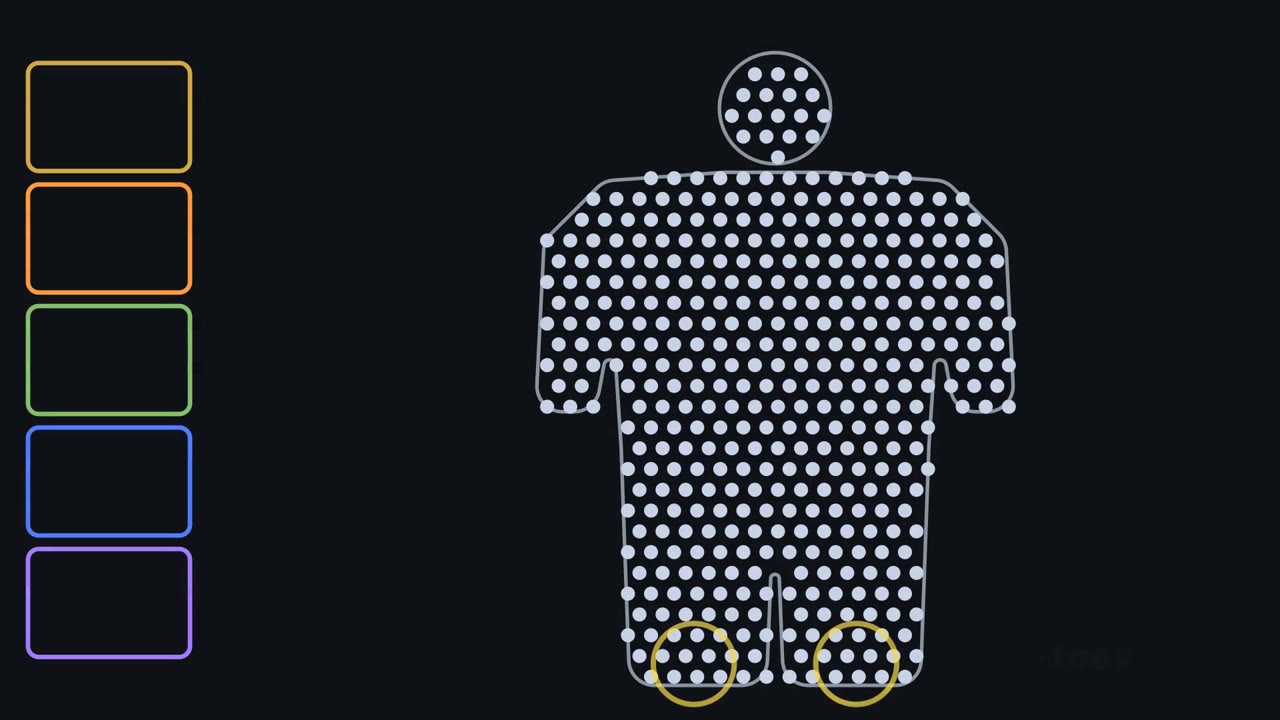
It pinches in the middle and becomes two cells. Every job is done inside one cell, with different parts helping. So why not keep one cell and make it bigger? Could one cell grow as big as you and still do every job? Pause and decide.
Not by just growing bigger in every direction. Food and oxygen must cross the cell’s surface, its outer membrane, to get in. Carbon dioxide and many wastes pass out across it. Now let the cell grow, but keep its shape. Its inside grows faster than its surface, and its middle gets farther away. Without special features, a big enough cell may not get food and oxygen to its middle fast enough. So your big body is not one giant cell. It is made of many small cells. Each one sits close to the watery fluid that brings it food and oxygen. Many cells bring a second gain. They can split up the job list. Different groups of cells can take on different jobs.
Sharing the work this way is called division of labor. A Paramecium does the whole list in one small cell. You do the same list with trillions of small cells that share it.
A Paramecium is one cell and does every job of life. Why does your body need trillions of cells to do the same jobs?
Continue in the lesson: From Cells to Organisms →
3:01 · Free, with captions and a transcript. The lesson has the full text, the questions and the sources.
More films from this lesson
How this film was made. Narration: written from this lesson's text and read by an AI narrator voice (Kokoro, af_heart). Animation: AI-generated in code (Manim) by Claude, a schematic with no drawn molecular structures. Captions come from the narration script. See something wrong? Report it.