Life Science · Skim version
Nitrogen for Life
Read the full lesson → Skim the whole course →
The guiding idea
If the air is mostly nitrogen, why does a cornfield need nitrogen added while the soybeans next door often do not?
Nitrogen is never used up, but the air's nitrogen gas is locked until bacteria, lightning or factories change it into usable nitrogen, so what a field can grow depends on its usable nitrogen, not on the air.
From the film: Nitrogen Everywhere, and Not a Bit to Use
- Living things need nitrogen to build proteins and DNA.
- The air holds a huge amount of nitrogen gas, but plants and animals cannot use it in that form.
- Bacteria, lightning and fertilizer factories change nitrogen gas into usable nitrogen.
- Bacteria in soybean root nodules change nitrogen gas for the plant, and the plant feeds them with food made from its sugar.
- Corn has no nodules, so it depends on usable nitrogen already in the soil.
From the film: Around the Loop, and Out of It
- Nitrogen moves from the air, into the soil, into plants and animals, and back again; this loop is the nitrogen cycle.
- Animals get nitrogen by eating plants or other animals.
- Decomposers break down dead things and wastes and return usable nitrogen to the soil.
- Other soil bacteria change some usable nitrogen back into nitrogen gas in the air, especially in soggy soil with little oxygen.
- Usable nitrogen the plants do not take up can wash into streams and the Chesapeake Bay.
-
Explore: grow a soybean field and a cornfield
-
Explain: what the lock is
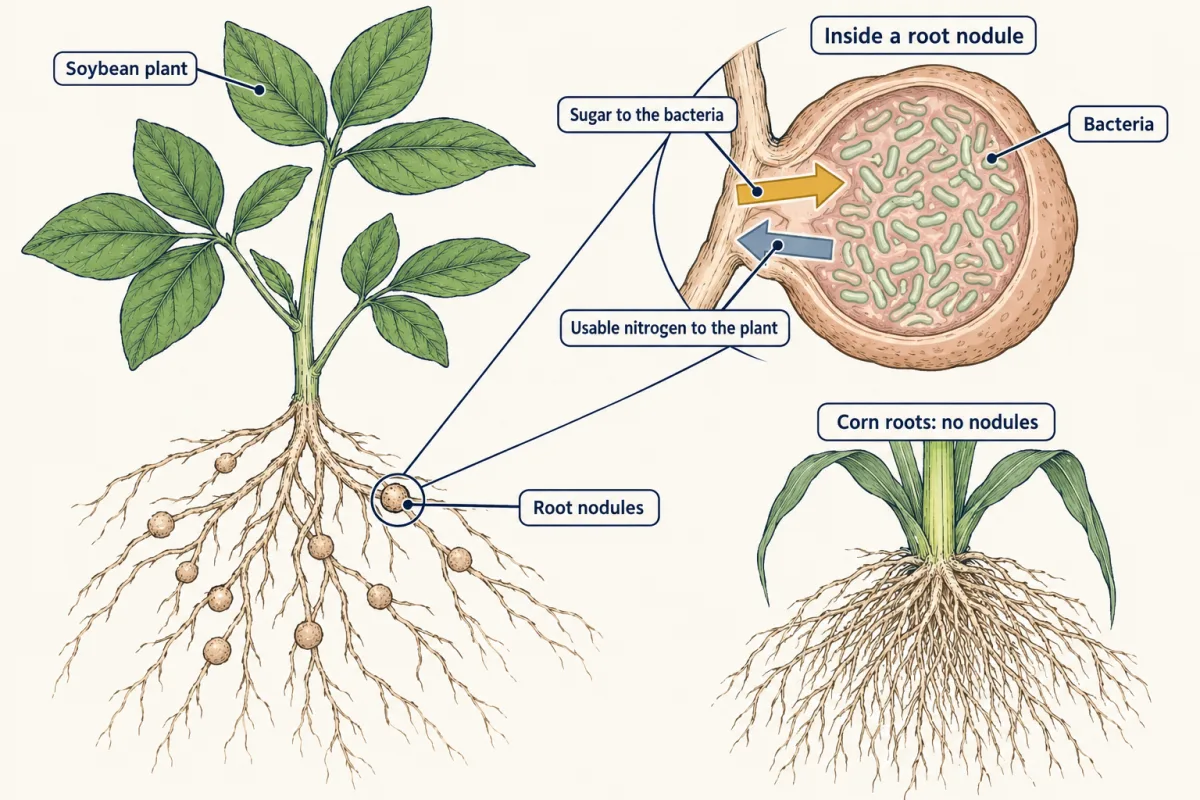
Bacteria in soybean root nodules trade usable nitrogen for food made from the plant's sugar; corn has no nodules, so it depends on usable nitrogen already in the soil. AI-generated illustration -
Evidence: do the bumps open the gate?
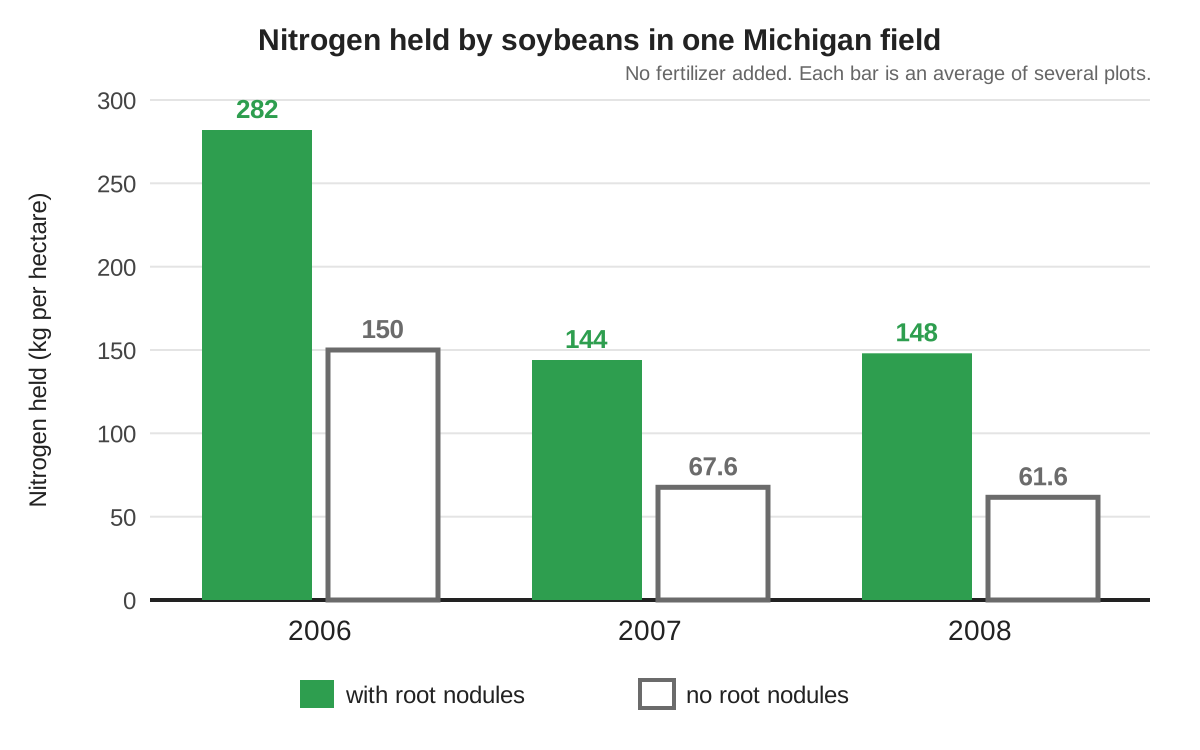
In the same field and the same air, with no fertilizer added, soybeans with root nodules held about twice as much nitrogen as soybeans without nodules (1.9 to 2.4 times), every year from 2006 to 2008. AI-generated illustration -
Explain: never used up, but it can leave
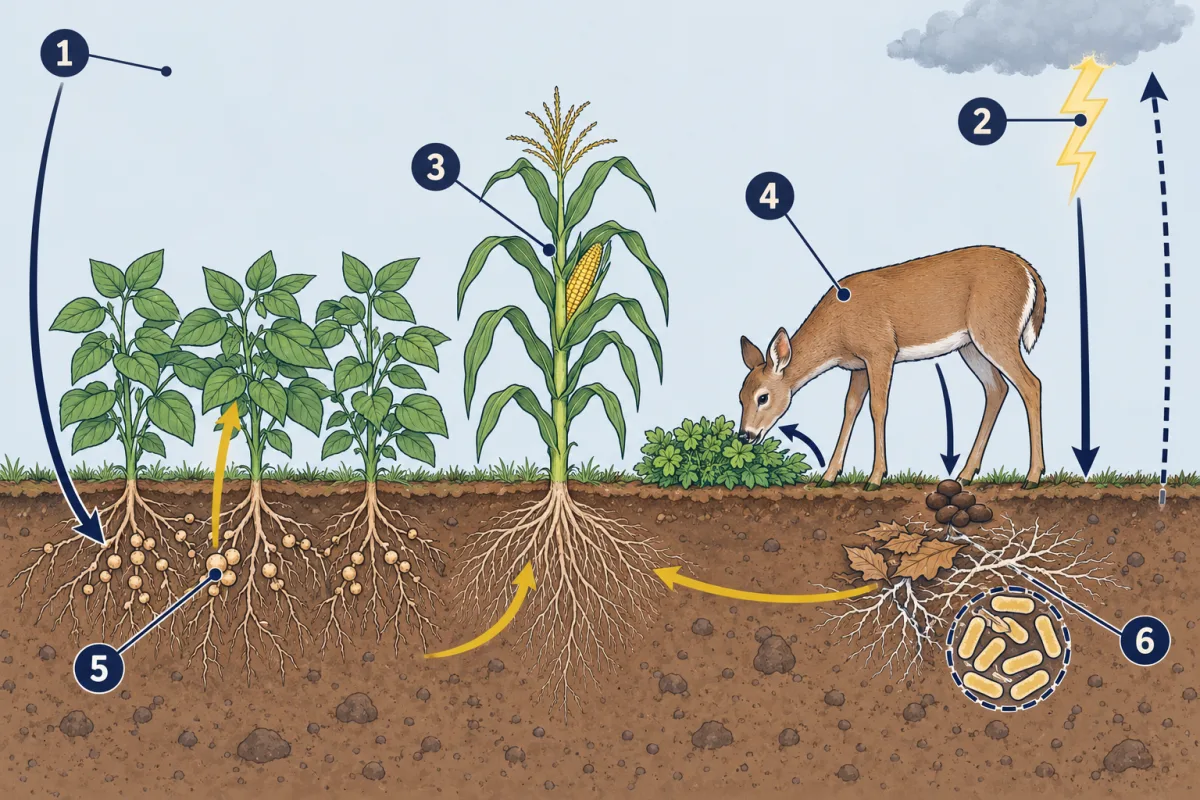
- nitrogen gas
- lightning
- corn
- deer
- root nodule
- decomposer
-
Explain: too little or too much nitrogen
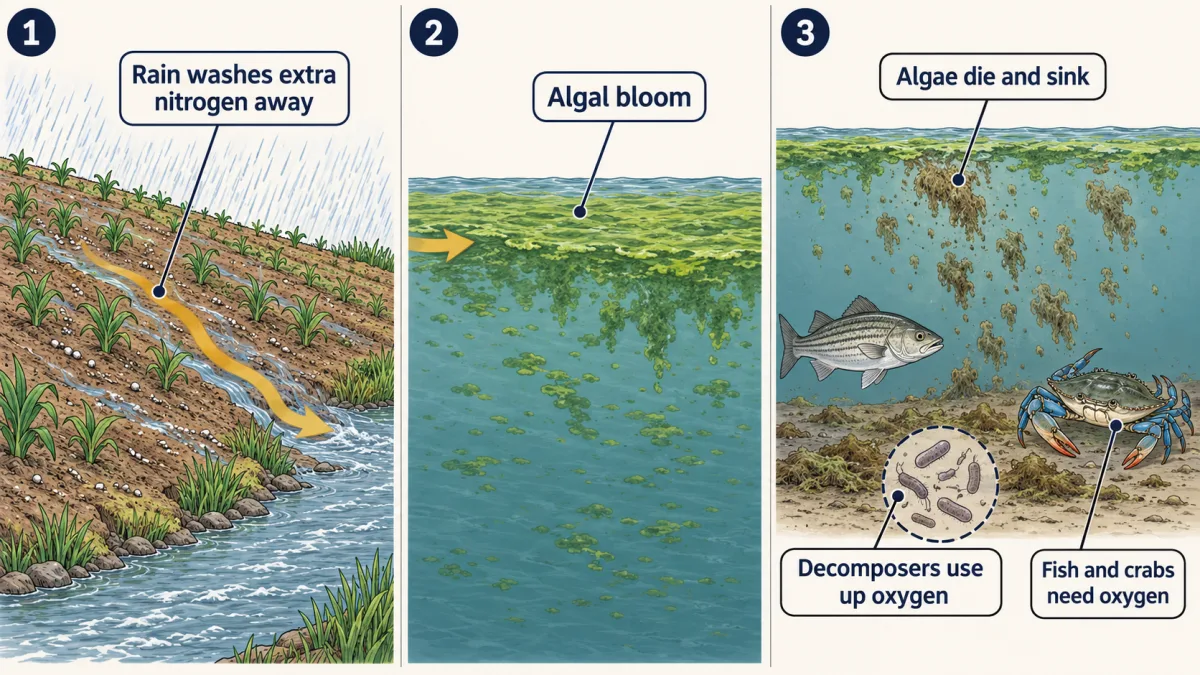
Too much nitrogen: rain carries it to the Bay, it feeds an algal bloom, and decomposers breaking down the dead algae use up oxygen that fish and crabs need. AI-generated illustration -
Evaluate: check your thinking
-
Going deeper
Where this lesson fits
Before thisReview first
- Photosynthesis Feeds the WorldThis course · Lesson 9
Plants use sugar from photosynthesis to build proteins and to feed nodule bacteria, so you need that idea here.
- The Carbon and Water CyclesThis course · Lesson 14
This lesson ties the nitrogen loop to the carbon and water cycles, which that lesson explains first.
- Producers, Consumers and DecomposersThis course · Lesson 13
Decomposers return usable nitrogen to the soil, and animals get nitrogen by eating, as taught there.
After thisStudy next
- Big Changes: Dead Zones, Storms and ClimateThis course · Lesson 24
Extra nitrogen washing into the Bay feeds algae blooms that leave deep water without oxygen.
- DNA: The Code of LifeThis course · Lesson 27
The nitrogen in DNA is one reason living things need it, and that lesson takes DNA further.
- Matter CyclesOne level up · Biology
This lesson takes the nitrogen cycle further, following atoms through living and nonliving parts of ecosystems.
Elsewhere on the siteFilms, simulations and method films in other courses
- Set Up: Soil ShakeFilm · Biology Together
Soil is where usable nitrogen is held, and this film shows what soil is made of.
- Set Up: Rot DetectivesFilm · Biology Together
It shows decomposers breaking down dead things, the step that returns usable nitrogen to the soil.
Suggested by an AI model from the lessons themselves, then checked. How we use AI