Neuroscience · Skim version
Memory Systems
Read the full lesson → Skim the whole course →
The guiding idea
H.M. got better at mirror drawing over three days and did not remember ever having done it. What kind of memory improved?
Memory systems are told apart by crossed failures, and a crossing shows that the damaged tissue is needed for a task, not that the memory is stored there.
From the film: Two Ways of Remembering
- H.M. improved at mirror drawing over three days without remembering the task, so memory can show in performance without being recalled.
- Memory you can bring to mind and state is declarative, memory expressed in performance is nondeclarative, and working memory holds a few items for seconds.
- Memory systems are told apart by crossed failures, a double dissociation, which shows a structure is needed for its task, not that the memory is stored there.
From the film: Lines That Cross
- In the weather prediction study, amnesic patients learned the classification but remembered the training poorly, while Parkinson's patients showed the reverse.
- These are group averages, so the crossing argues against the simplest difficulty account rather than ruling out every single-capacity one.
- Scores are measured above the chance baseline; the correction changes how big a loss looks, not which group is higher.
- In the conditioning studies, memory that could be reported and memory shown in performance depended on different structures.
From the film: Needed Is Not Stored
- In rabbit eyeblink conditioning, removing the lateral cerebellum abolished the learned response while the reflex blink survived, so the cerebellum is needed for it.
- A lost response cannot tell a lost store from a cut output route; silencing the output route during training still left the rabbits having learned.
- H.M.'s amnesia followed a medial temporal lesion on both sides, and his case alone cannot assign it to one structure.
-
One patient, two ways of remembering
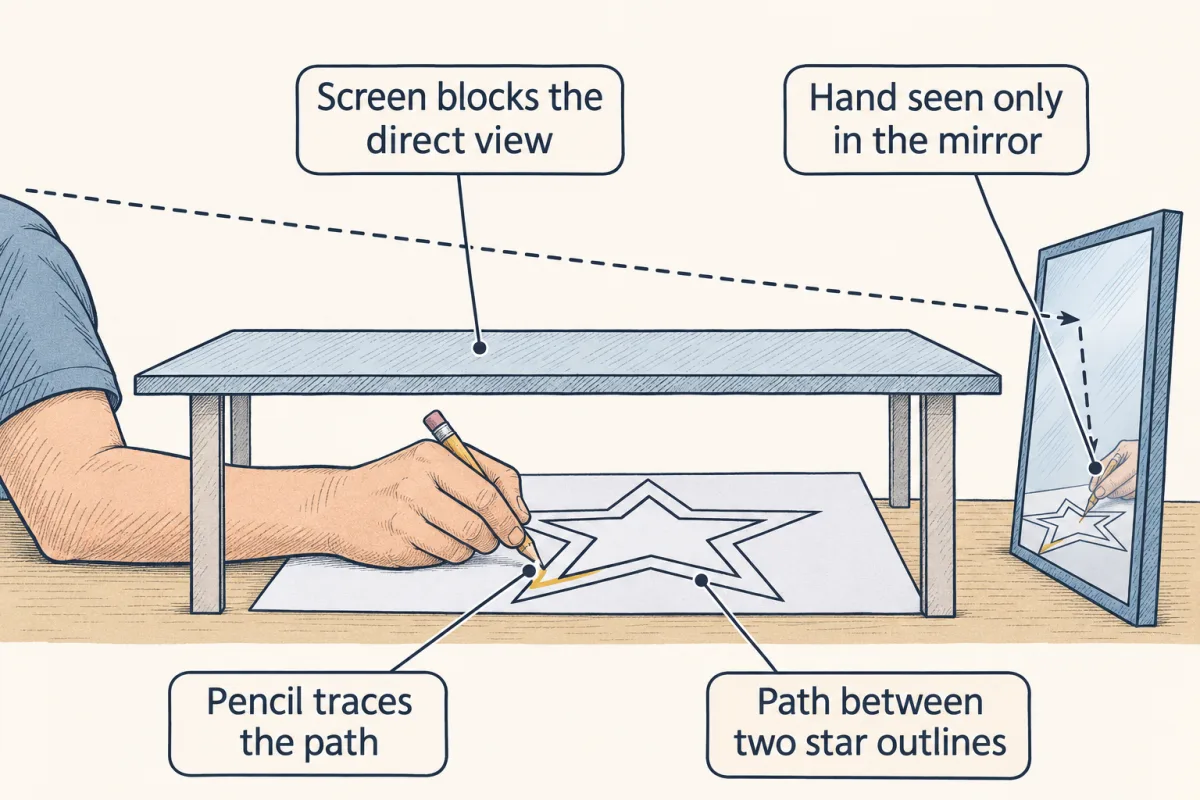
In mirror drawing the hand and the star are seen only reversed, so tracing the path is a motor skill learned by practice, one H.M. improved at over three days without remembering having done it. AI-generated illustration -
Why one patient is not enough
-
The key experiment: lines that cross
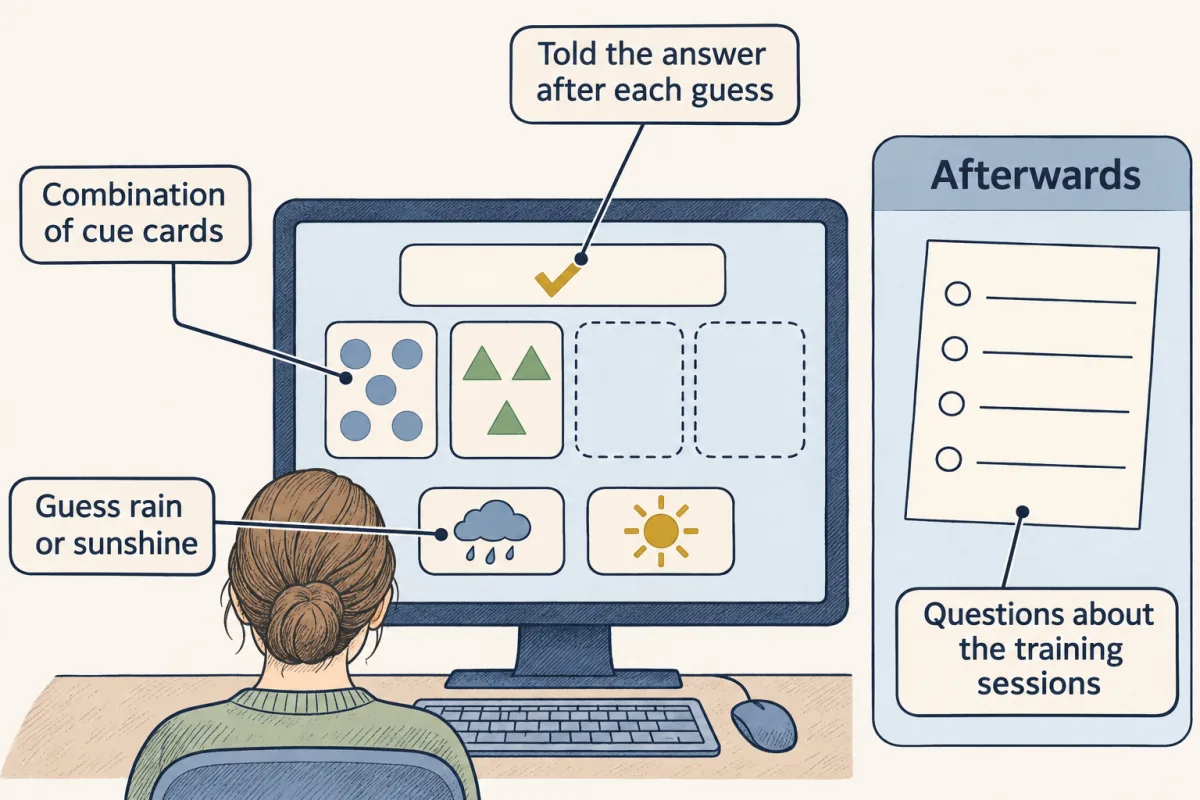
The task gives two separate measures: learning from feedback to guess rain or sunshine from cue cards, and a later questionnaire about the training sessions, the two whose results crossed between patient groups. AI-generated illustration -
Needed is not stored
-
Systems that interact
-
Going deeper
Where this lesson fits
Before thisReview first
- Descending Control and the Basal GangliaThis course · Lesson 16
The striatum and its dopamine input matter here, because Parkinson's patients fail the weather-prediction task.
- The CerebellumThis course · Lesson 17
You need the cerebellum's circuit from there to follow the eyeblink conditioning evidence.
- The Map: How the Nervous System Is OrganizedThis course · Lesson 1
It places the medial temporal lobe, hippocampus and striatum that the lesion evidence refers to.
After thisStudy next
- Plasticity, Networks and ConsolidationThis course · Lesson 23
It takes up how memory's dependence on the hippocampus changes over time, which this lesson only mentions.
- Attention, Executive Control and DecisionsThis course · Lesson 25
It covers the prefrontal side of working memory, which this lesson only defines.
- Designing a Causal Circuit ExperimentThis course · Lesson 28
It extends the needed-versus-stored limit into designing experiments that show what a circuit does.
Elsewhere on the siteFilms, simulations and method films in other courses
- Extracellular single-unit and nerve recordingMethod film
The cerebellum eyeblink section asks whether a store or only an output route was lost, which recording from single cells can test.
Suggested by an AI model from the lessons themselves, then checked. How we use AI