Neuroscience · Skim version
Plasticity, Networks and Consolidation
Read the full lesson → Skim the whole course →
The guiding idea
Shine light on cells tagged during learning in a mouse's hippocampus and it freezes as if afraid. Has anyone found where the memory is stored?
Learning strengthens links among cells active together, so in a suitable recurrent circuit a partial cue can reactivate the stored pattern, and consolidation stabilizes and reorganizes the circuits that support the memory.
From the film: A Part Recalls the Whole
- In the guiding model, learning strengthens the links among cells active together, so a fragment close enough to the stored pattern can pull the rest back on.
- In the four-unit model, each unit takes votes from its partners, and the state rolls downhill to the stored pattern.
- Mice lacking NMDA receptors only in CA3 pyramidal cells searched poorly with few cues, a deficit the model predicts, though completion was inferred from behaviour.
From the film: Replay and Ripples: Correlation to Perturbation
- Pairs of hippocampal cells that co-fired in a task co-fired more in the sleep after it, in three rats; that is a correlation, not a test of memory.
- Much replay rides on sharp-wave ripples, and cutting ripples short in sleep after training impaired rats the next day while delayed stimulation did not.
- Ripple-linked activity aids memory in the tasks tested, but cutting ripples removes ripple-linked activity in general, not one route.
From the film: Enough Does Not Prove Needed
- Light on cells tagged during fear learning made mice freeze in a different box, so those cells are enough to drive the fear in this preparation.
- Showing necessity needs the reverse test: silencing the tagged cells during natural recall.
- Enough does not prove needed; in mouse fear memory over days to weeks, the group spans regions, so for each claim ask which control it needs.
-
Three puzzles and a ladder of evidence
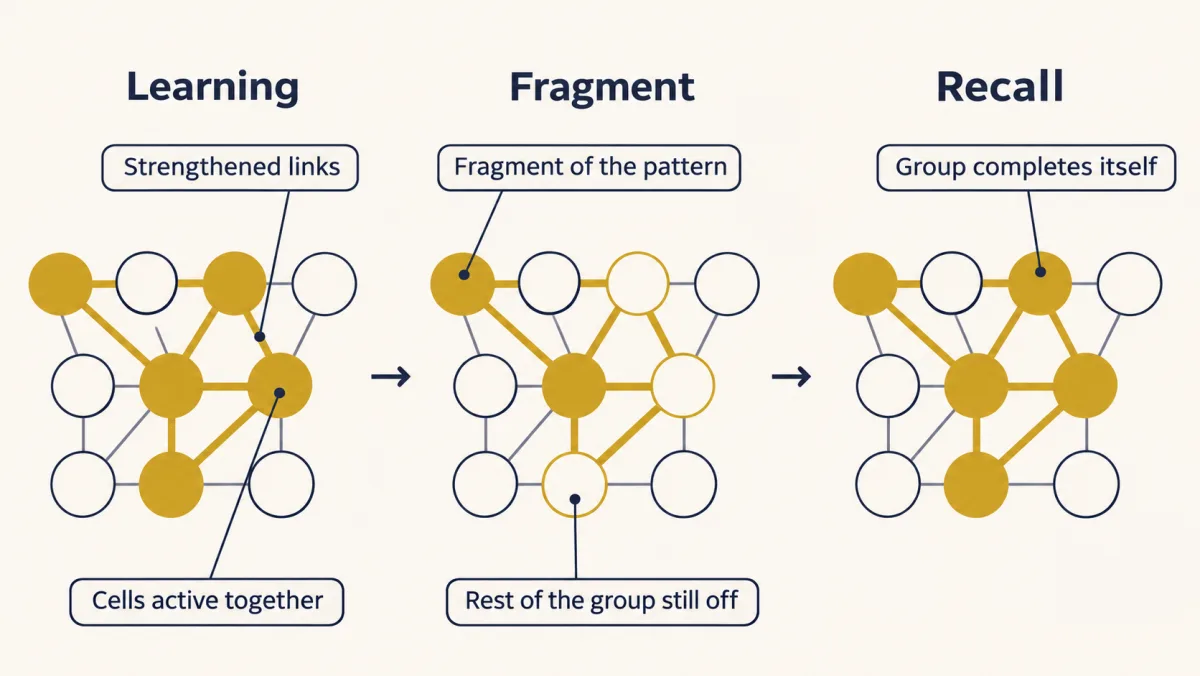
In the lesson's guiding model, learning strengthens the links among cells active together, so later a fragment of the pattern can switch the whole group back on. AI-generated illustration -
Place and grid cells: candidate members of a group
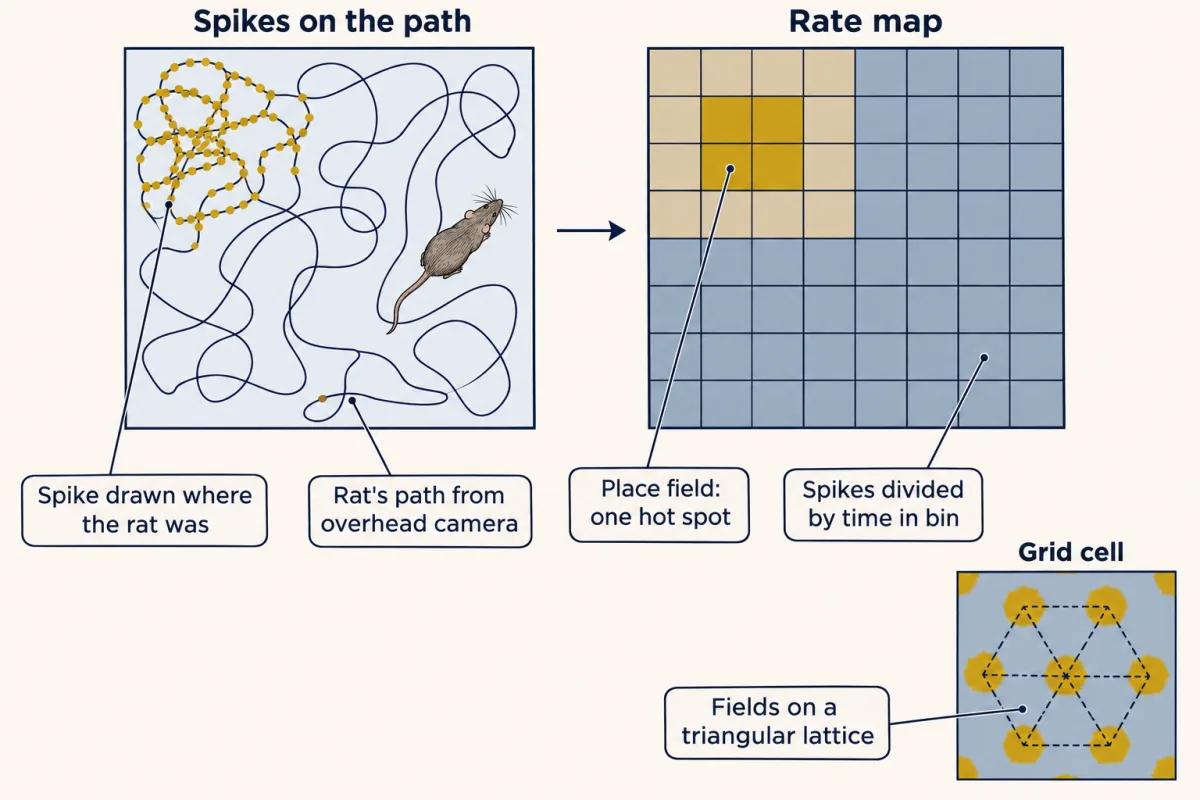
Dividing each bin's spikes by the time the rat spent there turns the raw path record into a rate map, where a place cell shows one hot spot and a grid cell many fields on a triangular lattice. AI-generated illustration -
Wiring the pattern and completing it
-
Making a memory last: replay and ripples, from correlation to perturbation
-
Engrams: enough does not prove needed
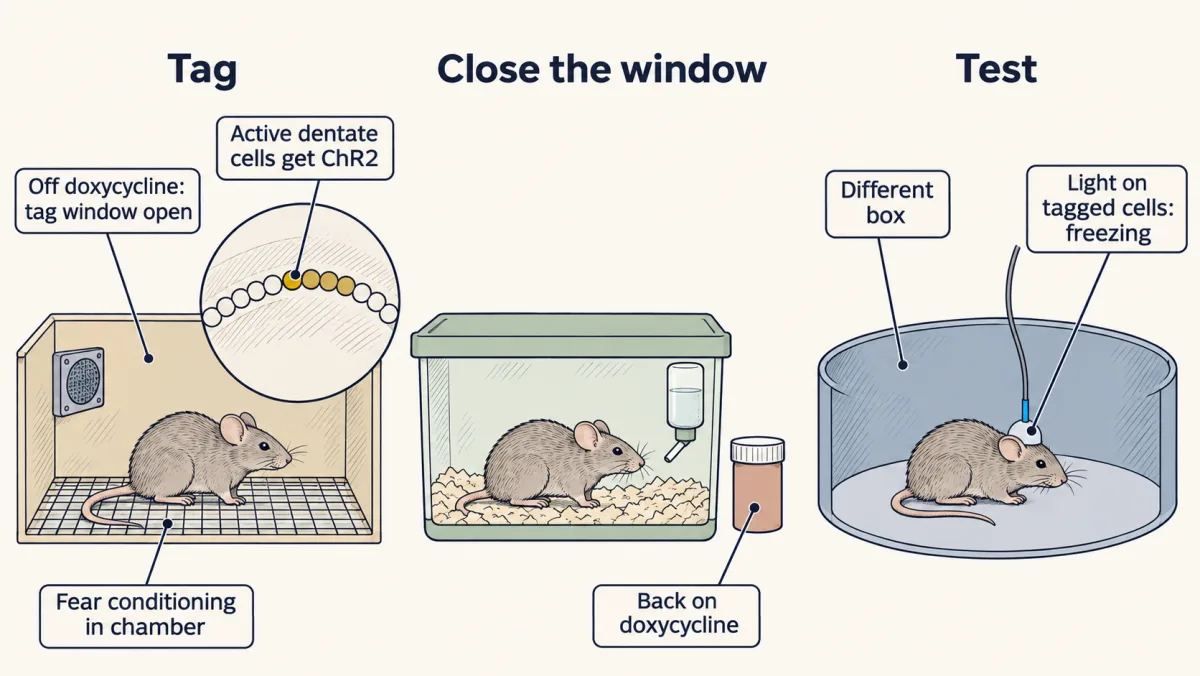
Liu and colleagues tagged dentate cells active during fear learning, closed the tagging window with doxycycline, and later made the mouse freeze in a different box by shining light on the tagged cells: a test of sufficiency, not necessity. AI-generated illustration -
Going deeper
Where this lesson fits
Before thisReview first
- Synaptic PlasticityThis course · Lesson 8
You need LTP and strengthening of co-active synapses from there, since consolidation here stabilizes those strengthened links.
- Memory SystemsThis course · Lesson 22
The standard model of systems consolidation is read against patients with hippocampal damage described there.
- Integration, Inhibition and NeuromodulationThis course · Lesson 7
Inhibition shaping activity and competition in the network builds on the integration ideas taught there.
After thisStudy next
- Attention, Executive Control and DecisionsThis course · Lesson 25
It continues the cognition unit, with neurons whose activity is read against behaviour and tested by causal manipulation.
- Recording Many Neurons: Imaging, Arrays and AtlasesThis course · Lesson 27
It shows how ensembles like place-cell groups and engram candidates are recorded across many neurons and regions.
- Designing a Causal Circuit ExperimentThis course · Lesson 28
It takes the sufficiency-versus-necessity logic of engram experiments further, with the controls light-based circuit tests need.
Suggested by an AI model from the lessons themselves, then checked. How we use AI