Biology Together · Unit 3: What plants need and how they work
Leaf Detectives
Rewritten on : new text and film. Your notes and highlights stay, but the text around them may have moved.
How can you tell an oak from a maple without a label? A pile of fallen leaves and a few yes-or-no questions can do it.
Three real-life stories behind this activity, about 2 minutes aloud, or read them below.
The film, 3 minutes, and the safety notes, for the grown-up to look at before the activity.
The hands-on part, done with a child: about 30 minutes.
Pause when the reading reaches a film, and offer to play it. Saved on this device.
Watch the film now, or keep listening
That is the end of the reading
This idea at other levels
An activity for ages 5 to 10 about classification. Next, for an older child: Sorting Living Things (grade 7).
See every levelHide the levels
Classifying living things (taxonomy)
Scientists sort living things into nested groups, from three domains down to species, by shared traits and how they are related.
Taught at four levels: ages 5 to 10, grade 7, high school and a first college course.
College, a first course · the level you chose
Ether-linked isoprenoid lipids back the rRNA split; many-gene trees nest eukaryotes near Asgard archaea.
Organismal Biology · about 21 min · film 3:18 · 3 practice questions
Ages 5 to 10 · the level you chose
Leaf Detectives · this lesson
Sort fallen leaves one feature at a time, then build a yes-or-no key.
Biology Together · about 30 min · film 3:08 · Virginia 1.4 c, 4.3 d, K.9 b
Play the ladder · 7 films, about 24 min, from grade 7 to a first college course. Each film waits for you to press play.
Next door to classification
- Dichotomous keysA key puts the sorting into use: two-choice questions about visible traits lead you to a name.Nearest lesson: Sorting Living Things (grade 7)
- Scientific names (binomial nomenclature)Each species ends up with a two-part name that scientists in every country use the same way.Nearest lesson: Sorting Living Things (grade 7)
Short versions inside this lesson
The grade 7 version · about 1 minute to read
In grade 7 Life Science, children use dichotomous keys on all kinds of living things, including Virginia plants and animals. They learn the scientists' system of eight groups, from the largest, domain, down to species, and that each species has a two-part scientific name. A tulip poplar is called Liriodendron tulipifera everywhere in the world, whatever people call it locally.
The plainest version · about 1 minute to read
Every kind of tree has its own kind of leaf. Some leaves are smooth on the edge, and some have little teeth. Some have pointy parts like fingers. A pine tree has thin leaves called needles. Colour is not a good clue, because a leaf can be green in summer and red or yellow in fall. Shape and edges stay the same through the seasons, so we use those.
Find an idea: every idea, searchable
Which lessons teach an idea, and the notes on each level, were written by AI models from the lessons and checked by a second model. A person has not yet read every one. How we use AI
About this activity what is in it
Builds on:Plant Parts We Eat (read)Why these?
Rewritten on : new text and film. Notes and highlights stay, but the text around them may have moved.
Before you start
- Hands-on time
- About 30 minutes
- Where
- Indoors or outdoors
- Ages
- 5 to 10, with an easier and a harder version below
- Grown-up
- Stay with your child outdoors, within sight and close by near roads and water. Check each leaf before it goes in the bag, and handle any glass magnifying glass or spiny leaves.
What you need
- A bag or basket for collecting
- 8 to 12 fallen leaves from different trees, or printed photos of leaves if you can't get outside
- A bundle of pine needles, if pines grow nearby (optional)
- Crayons with the paper peeled off, and thin paper for rubbings
- Two hoops or loops of string to make sorting circles
- A magnifying glass (optional)
- A tree field guide or a plant-identification app (optional)
- Paper and a pencil, or the printed observation sheet below
Virginia science standards SOL 1.4 cSOL 4.3 dSOL K.9 b
In this activity. You and your child collect fallen leaves, sort them one feature at a time, and make crayon rubbings.
The film
 ▶ Watch Leaf Detectives: Parent Guide · 3:08
Read the transcript of “Leaf Detectives: Parent Guide”
Film transcript: Leaf Detectives: Parent Guide
Which leaf clues would you trust in summer and fall? In thirty minutes, you can help your child sort fallen leaves and test which clues hold up. Your child practices looking closely and sorting by one rule at a time. They also practice asking a question and checking it. Instead of memorizing tree names, they discover which leaf clues stay steady all year. Grab a bag or basket, two hoops or string loops, thin paper, and a peeled crayon. Take a ten to fifteen minute walk to collect eight to twelve different fallen leaves. Printed leaf photos work if you stay indoors. Stay with your child outdoors and keep them in sight. Keep them within arm’s reach near roads, parking lots, and water.
Collect only fallen leaves where permitted. Leave unfamiliar leaves and leaves with three leaflets on the ground. Even dead or fallen poison ivy can cause a rash. Never taste any plant part or mushroom. Wash hands after collecting. Keep crayon pieces and small finds away from children under four. Spread out the leaves you checked. Look at their edges, veins, and tips. Keep spiny leaves for the adult to handle. Let your child sort the leaves into two piles. Then ask, "What was your rule?" Write down their words. Next, sort by one feature at a time using the two hoops. Try one leaf together first: needle or flat, smooth edge or toothed, lobes or no lobes. Before each round, ask, "Which hoop do you think will hold more?"
A bright red leaf makes color tempting as a sorting rule. Imagine using that same rule again in summer. Would leaves from the same tree land in the same pile? A red maple leaf can be green in summer. In fall, it can be red, orange, or yellow. Ask your child, "What color was this leaf back in July?" If you can find two differently colored leaves from the same tree, compare their shapes and edges. Slide a leaf under thin paper with the veins facing up. Rub with the side of a peeled crayon. The veins and edges show up. For older children, try a yes-or-no key together. Ask whether the leaf is a needle. If it is, the example key leads to pine. A key only covers the leaves you built it for.
Help your child write questions for your own set. Give someone a leaf from that set and ask them to try the key. Rewrite any question that trips them up. Your child practices choosing clues that stay steady.
Before you start
- Hands-on time
- About 30 minutes
- Where
- Indoors or outdoors
- Ages
- 5 to 10, with an easier and a harder version below
- Grown-up
- Stay with your child outdoors, within sight and close by near roads and water. Check each leaf before it goes in the bag, and handle any glass magnifying glass or spiny leaves.
What you need
- A bag or basket for collecting
- 8 to 12 fallen leaves from different trees, or printed photos of leaves if you can't get outside
- A bundle of pine needles, if pines grow nearby (optional)
- Crayons with the paper peeled off, and thin paper for rubbings
- Two hoops or loops of string to make sorting circles
- A magnifying glass (optional)
- A tree field guide or a plant-identification app (optional)
- Paper and a pencil, or the printed observation sheet below
Virginia science standards SOL 1.4 cSOL 4.3 dSOL K.9 b
The big idea
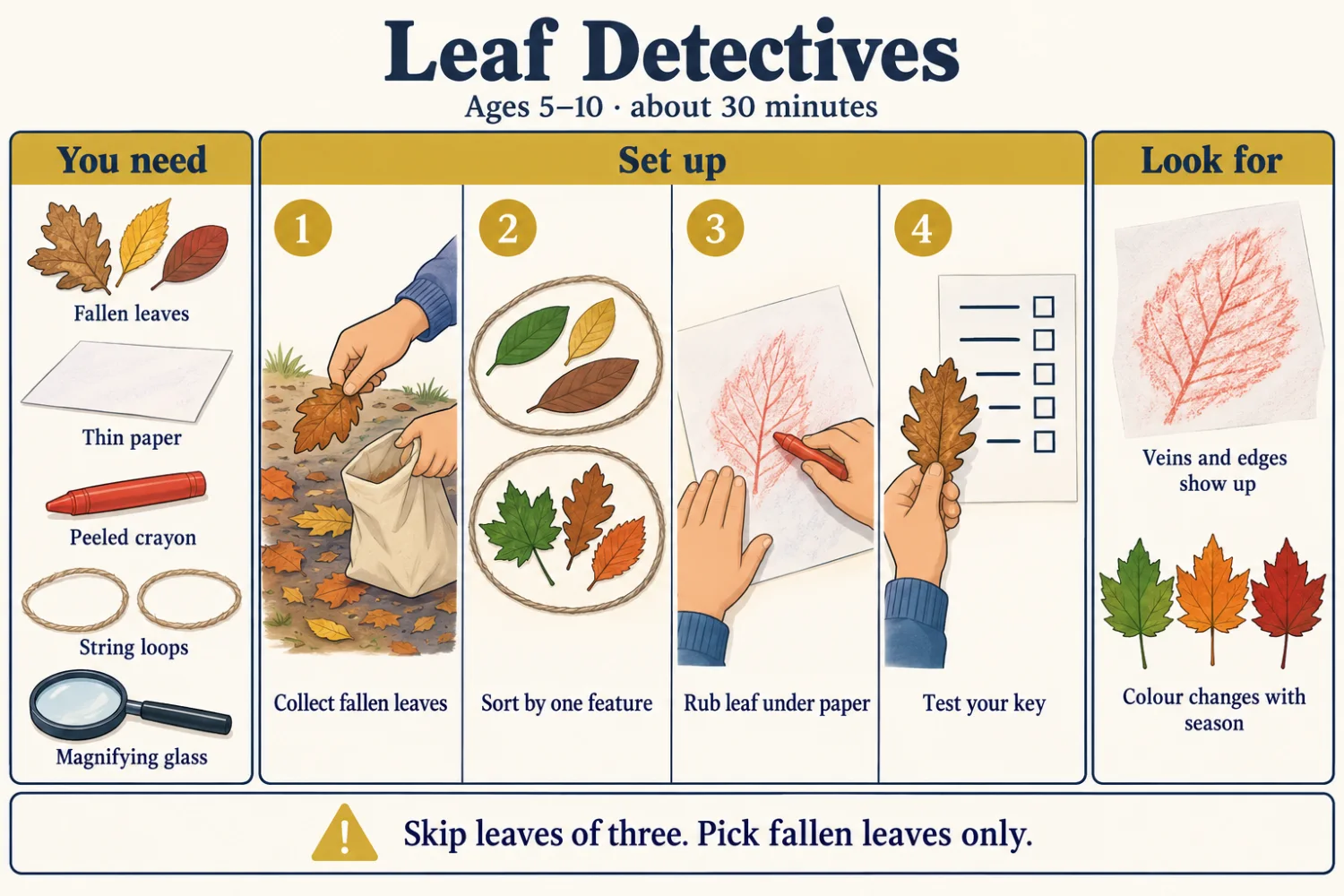
Hand a child a pile of leaves and they start sorting: big ones, red ones, pointy ones. In 30 minutes, your child practises looking closely, sorting by one rule at a time, and checking which clues stay steady from summer to fall. Older children turn those clues into a working yes-or-no key.
Say it together “A leaf’s shape and edge give us clues about its tree. Colour changes with the seasons. Let’s look closely and sort by one clue at a time.”
Leaves differ in shape and in their edges, which can be smooth, toothed or prickly. Some have lobes, parts that stick out like fingers. Some are one piece, and some are made of many small leaflets on one stalk. Colour is a poor clue, because the same leaf can be green in summer and red or yellow in fall. A dichotomous key is a list of yes-or-no questions that splits a group in two until only one kind of leaf is left.
What to do
- Collect. On a 10 to 15-minute walk, pick up 8 to 12 different fallen leaves, checking each together first. Choose whole, fairly flat leaves, plus a bundle of pine needles if found. With a class, give each group of four a bag and ask for at least six kinds.
- Look closely. Spread the leaves out. Ask, “Is this edge smooth, toothed or prickly? What do you notice on the back?” Look at the veins, stalk and tip. Let your child feel the edge of a leaf you have checked for spines. Use a magnifier if you have one, away from direct sun. The adult handles any glass magnifier and any spiny leaves.
- First sort. Lay out the two hoops or string loops. Say, “Split these into two piles any way you like.” Then ask, “What was your rule?” Write it down in their words.
- One feature at a time. Sort one feature per round: needle or flat; smooth edge or toothed; lobes or no lobes; one piece or many leaflets. Try one leaf together first: “Lobes like fingers, or no lobes? Which hoop?” Before sorting the rest, predict, then check: “Which hoop do you think will hold more? Let’s test it.”
- Test colour (predict, then check). Hold up a bright fall leaf and ask, “What colour was this leaf in July? Would colour give the same answer all year?” Find two leaves from the same tree in different colours if you can. A red maple leaf can be green, red, orange or yellow depending on the date.
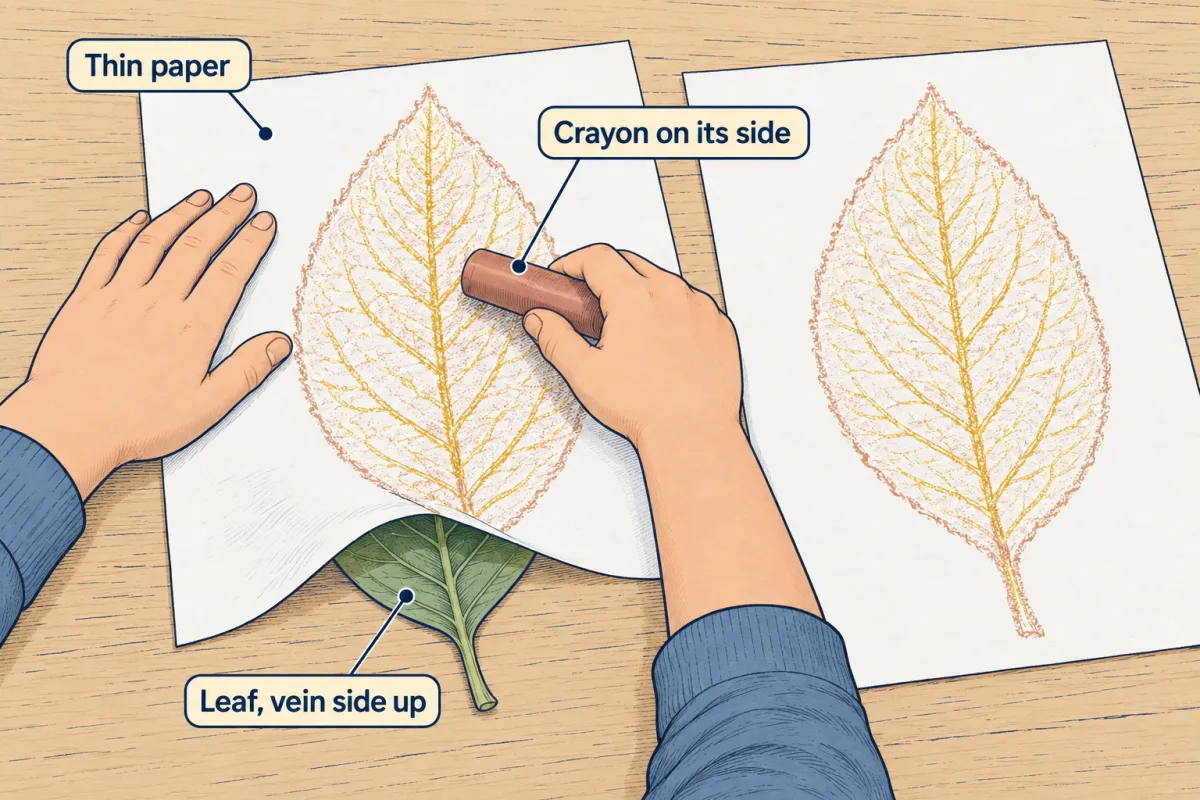
- Rubbings. Put a leaf vein side up under thin paper and rub the side of a peeled crayon over it. Ask, “What do you think will show up first?” Your child sees the veins and edges pop out. Make rubbings of three very different leaves.
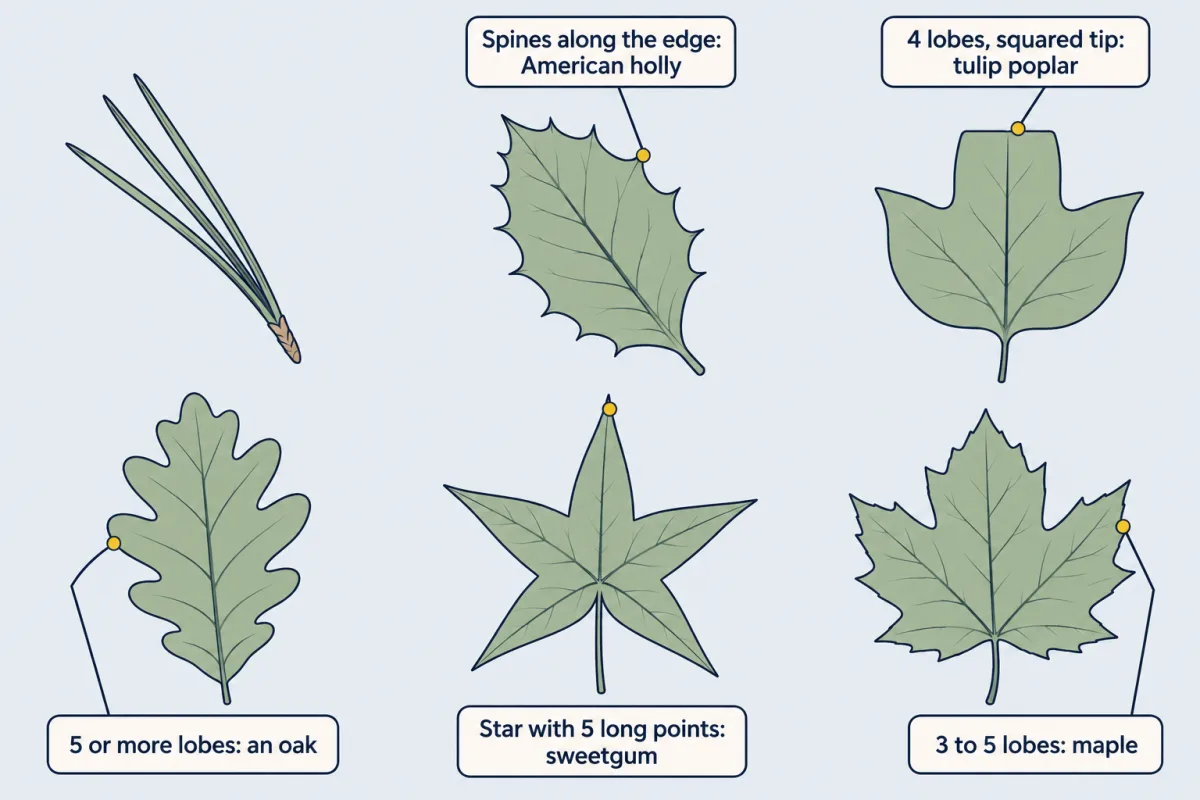
- Build a key. Try one leaf together with the example below. It has six outcomes: pine, American holly, tulip poplar, a lobed oak such as white or red oak, sweetgum, and red maple. Other leaves may go to the wrong answer, such as the smooth, unlobed leaf of a willow oak. If your child is ready to make a key, write a set of yes-or-no questions together that leads to each of the leaves you collected.
- Is it a needle? Yes: pine (2, 3 or 5 needles per bundle point to different pines). No: next question.
- Is it a stiff, shiny leaf with no lobes and sharp spines along the edge? Yes: American holly. No: next question.
- Does it have 4 lobes (sometimes 6) and a flat or notched tip? Yes: tulip poplar. No: next question.
- Does it have 5 or more lobes spaced along both sides of a long middle vein, like a feather? Yes: an oak with many lobes, such as white oak or red oak. No: next question.
- Is it a star with 5 (sometimes 7) long, even points? Yes: sweetgum. No: maple, with 3 to 5 lobes and often pale underneath.
- Test the key. Give a friend or family member one leaf and the key. Does it lead them to the right name?
- Wrap up together. Ask these two questions:
- “Which clue told two leaves apart best today—shape, edge or colour?”
- “If we visited the same tree in July, would that clue still work?”
Questions to ask while you do it
Ask your child to guess first, then check.
- “I wonder if all the leaves from one tree look exactly alike. How could we check?”
- “Which feature do you think will split our pile closest to half and half?”
- “Is a pine needle a leaf? What does a leaf do?”
- “What do you think this leaf looked like in summer?”
- “If we found a new leaf, what question would you ask first?”
- “What do you think will show up in the rubbing?”
What children often think
-
A child might say “All the leaves on one tree are the same.”
You could try Collect five leaves from under one tree and line them up by size. They differ in size and sometimes in shape. A sassafras tree grows three shapes on one tree: oval, mitten-shaped and three-lobed. Each kind of tree still has its own range of features.
-
A child might say “Pine needles aren’t leaves.”
You could try Ask what leaves do for a tree. Needles are green, grow on the twigs, and make food from light just as flat leaves do. They are narrow leaves. Pines keep most of their needles through the winter.
-
A child might say “You sort leaves by colour.”
You could try Ask what colour this leaf was in July. The same leaf changes through the year, so colour is a weak clue. Shape, edges and lobes stay the same as the seasons change, which makes them better clues.
-
A child might say “This one with lots of little leaves is lots of leaves.”
You could try If you can, look at a twig on the tree. A bud sits where a whole leaf joins the twig, not at each leaflet. Leaflets that share one stalk make one compound leaf, like a black walnut leaf.
Why it works
To name a living thing, scientists use features that stay steady from one plant to the next and through the year. For leaves, these include needle or flat, simple (one piece) or compound (made of leaflets), lobed or not, edge type, vein pattern, and whether leaves sit in pairs or one at a time along a twig. Size varies, so it helps only a little.
Colour changes with the seasons. In fall, a tree stops making chlorophyll, the green colouring, and the green fades. Yellows and oranges that were there all along show, and some trees make new reds. A key built on colour would give a different answer in July and in October.
A dichotomous key only chooses among the kinds it was built for. Field guides, such as the Virginia Department of Forestry’s guide to native trees, use longer keys of the same type; that guide covers about 80 native trees. A key is a tool for naming, while scientists group living things into families by how they are related—so two trees with look-alike leaves, such as sweetgum and maple, can belong to different families.
For teachers: Virginia standards
Virginia’s grade 1 standard (1.4 c) asks children to sort plants by their features, grade 4 (4.3 d) asks them to use a simple key, and kindergarten (K.9 b) connects leaves to the change of seasons.
Easier and harder
Ages 5 to 7
Use six very different leaves. Sort one feature at a time in two hoops on the floor: “pointy edges” and “smooth edges”, then “fingers” and “no fingers”. Skip the written key. Make rubbings and let your child match each rubbing to its leaf. Ask them to find two leaves that are alike in one way and different in another.
For older children (8 to 10)
Let your child write a yes-or-no key from scratch for their own leaves. Test it on someone else and fix any question that confused them. Add tree names from a field guide or app. Measure each leaf’s length in centimetres and check whether size is a steady feature for one kind of tree.
If it doesn’t go as planned
If you only find leaves from one or two kinds of tree, use printed photos or visit a park with labelled trees. Crumbly leaves tear during rubbings; pick fresher fallen leaves that still bend, and press curled ones flat inside a heavy book for a day first. If a key leads to a wrong answer, find the question that failed and rewrite it. Fixing a key is what scientists do too.
Observation sheet
Worked example. American holly — flat, spiny edge, no lobes.
Observation sheet
Leaf detectives
NameDate
Look at each leaf. Circle or write what you see.
| Leaf | Needle or flat? | Edge: smooth, toothed or spiny? | Lobes: yes or no? |
|---|---|---|---|
My first sorting rule was:
The best question in my key is:
stemhop.com · Biology Together
The three stories, told aloud Side Hops: three stories that go with this lesson Side Hops
Three easy ways to talk about leaves with your child
1:49 · Narration: an AI narrator voice (Kokoro, af_heart).
Read the transcript
Hi there! Heading out to be leaf detectives? Here are three easy ways to help the big idea click while you and your child look at dry fallen leaves you've checked and picked up from a lawn or path.
First, if your child wants to sort by colour, try a little closet trick back home. Zip a green jacket over a yellow shirt and ask what is hiding underneath. A leaf does something a lot like that. Green chlorophyll covers yellow and orange colours that were sitting inside the leaf all summer long. When fall days get shorter, the green breaks down and fades, and the hidden colours peek through. You can still recognise the leaf by its shape. That makes shape a good clue.
Second, when you make crayon rubbings, watch your child's face as the bumpy lines appear, and say, "Whoa, you just found the leaf's drinking straws!" Those raised veins really do carry water and nutrients through the leaf. Their pattern, together with shape and edges, can help you tell one tree from another. And keep any little broken crayon bits away from children under four, since they are a choking risk.
Finally, on any walk, with you close by, look up at the twigs together, no pulling on branches needed. Maple leaves and twigs grow straight across from each other in pairs, like a pair of outstretched arms. On white oaks and most other trees, leaves join the twig one at a time, at different spots along it. In winter, look along the sides of the twig, where the buds follow the same pattern as the leaves, so it is a clue you can spot all winter long.
Have fun out there, detectives!
The idea underneath them. You and your child collect fallen leaves, sort them one feature at a time, and make crayon rubbings.
Your notes
Select any text in the lesson to highlight it or add a note to it. Your highlights and notes are saved in this browser and collected in your notebook.
This browser is not letting the site save anything (a private window or strict privacy settings), so highlights and notes will be lost when you leave the page.
Where this lesson fits
Before thisReview first
- Plant Parts We EatThis course · Lesson 8
Your child has already looked closely at plant parts, so they know a leaf is one part of a plant.
After thisStudy next
- Hidden Leaf ColorsThis course · Lesson 27
It uses the idea that leaf colour changes with the season to show where fall colours come from.
- Adopt a TreeThis course · Lesson 25
Your child can use leaf features to name a tree, then watch that tree through the year.
Suggested by an AI model from the lessons themselves, then checked. How we use AI
Those are the stories. The idea under them is the one the lesson builds.
That is the film. The rest of the activity is the fun part.
The rest of the activity is here when you want it.
Finish line
Test yourself
4 questions
Questions to talk over together.
Next · Lesson 11
Take a Flower Apart
What is a flower for? Taking one apart, piece by piece, shows a child where seeds begin.
Continue →Rewritten on : new text and film. Notes and highlights stay, but the text around them may have moved.