Climbing the Evidence Ladder
Read the transcript of “Climbing the Evidence Ladder”
Film transcript: Climbing the Evidence Ladder
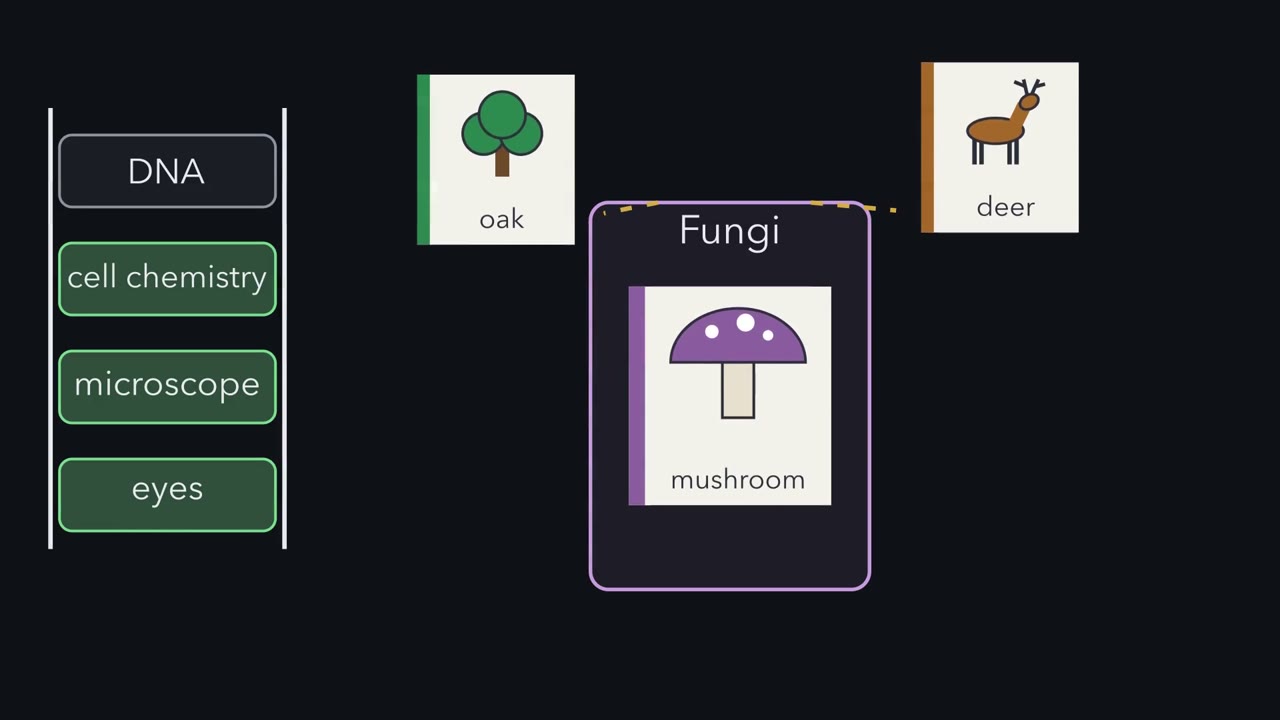
A mushroom stays in one place, like a plant. So why don't scientists call it a plant? The answer depends on your tools. Here are six living things: a mushroom, an oak, a deer, a paramecium, a bacterium and an archaeon. Scientists sort living things with several kinds of evidence. This ladder orders them; it is not a timeline. The bottom rung is your eyes. The mushroom stays put, like the oak, so it sits with the plants. The deer has an animal's body and walks away, so it goes with the animals. The three tiny ones are too small to make out. For a long time, many scientists grouped mushrooms with plants. Next rung, the light microscope. It answers three questions.
Does each cell have a nucleus, the part that holds its DNA? Which cell parts does it have? Does it have one cell or many? A fourth question needs other tests. Does it make its own food, or take food in? The first question splits the cards. Four of them have cells with a nucleus. The bacterium and the archaeon have no nucleus, and under the microscope they look alike. Now zoom in on the mushroom. Its cells have a nucleus and a cell wall, like a plant's. But they have no chloroplasts, the green parts where a cell makes sugar using light. So a mushroom cannot make its own food. It releases digesting substances into the log. They break the wood into tiny dissolved pieces, and the mushroom takes them in.
Most plants make their own food instead. So the mushroom slides out of the plant group. Later, fungi got a kingdom of their own. Third rung, cell chemistry. The bacterium and the archaeon look the same under a microscope. Are they the same kind of living thing?
No. The chemicals that build their cell walls and membranes are different. Their genes, compared on the top rung, differ too. So scientists split them into two domains, Bacteria and Archaea. Every living thing whose cells have a nucleus goes in a third domain, Eukarya. So life has three domains.
Kingdoms sit inside them. Fungi, plants and animals are kingdoms inside Eukarya. The paramecium waits. You will place it yourself. Look back. The living things never changed. The evidence did, and new evidence could move a card to a new group. One rung is left, DNA.
Scientists compare the same gene in different living things. Will the mushroom's gene match the oak's or the deer's more closely?
A mushroom stays in one place like a plant, so why do scientists say fungi are closer relatives of animals?
Continue in the lesson: Domains, Kingdoms and DNA →
3:20 · Free, with captions and a transcript. The lesson has the full text, the questions and the sources.
More films from this lesson
How this film was made. Narration: written from this lesson's text and read by an AI narrator voice (Kokoro, af_heart). Animation: AI-generated in code (Manim) by Claude, a schematic with no drawn molecular structures. Captions come from the narration script. See something wrong? Report it.