Organismal Biology · Skim version
The Kidney
Read the full lesson → Skim the whole course →
The guiding idea
Your kidneys filter about 180 litres of plasma a day. Why filter so much only to take almost all of it back?
What leaves in urine is what the kidney filtered, minus what its tubules took back, plus what they added; an adult human filters about 180 litres of plasma a day and takes back about 99% of the water, so the take-back largely sets how much water leaves.
From the film: Filter Far More, Take Most Back
- What leaves in urine is what the kidney filtered, minus what its tubules took back, plus what they added.
- An adult human filters about 180 litres of plasma a day and passes one or two litres of urine, so about 99% of the filtered water comes back.
- The filtrate carries water and small solutes such as salt, glucose and urea, but no blood cells and very little protein.
- Because so much is filtered, a small change in take-back makes a large change in urine; in a healthy kidney hormones make the fine adjustments in the last stretches of the tube, mainly the collecting duct.
From the film: Making Urine More Concentrated Than Blood
- No pump in the kidney moves water: it moves solute, mostly salt, and water follows by osmosis.
- In the outer medulla, the thick ascending limb moves salt out but holds its water, so the tissue there becomes saltier than blood.
- Because fluid flows down one limb and up the other, a modest difference at each level adds up along the loop; rat kidney slices show osmolality rising from cortex to papilla, and how the inner medulla keeps rising is still debated.
- With ADH, the collecting duct inserts water channels and water leaves into the concentrated medulla, so urine becomes concentrated; without ADH, dilute urine flows out.
-
Where each term happens
-
Micropuncture: is the first step really a filter?
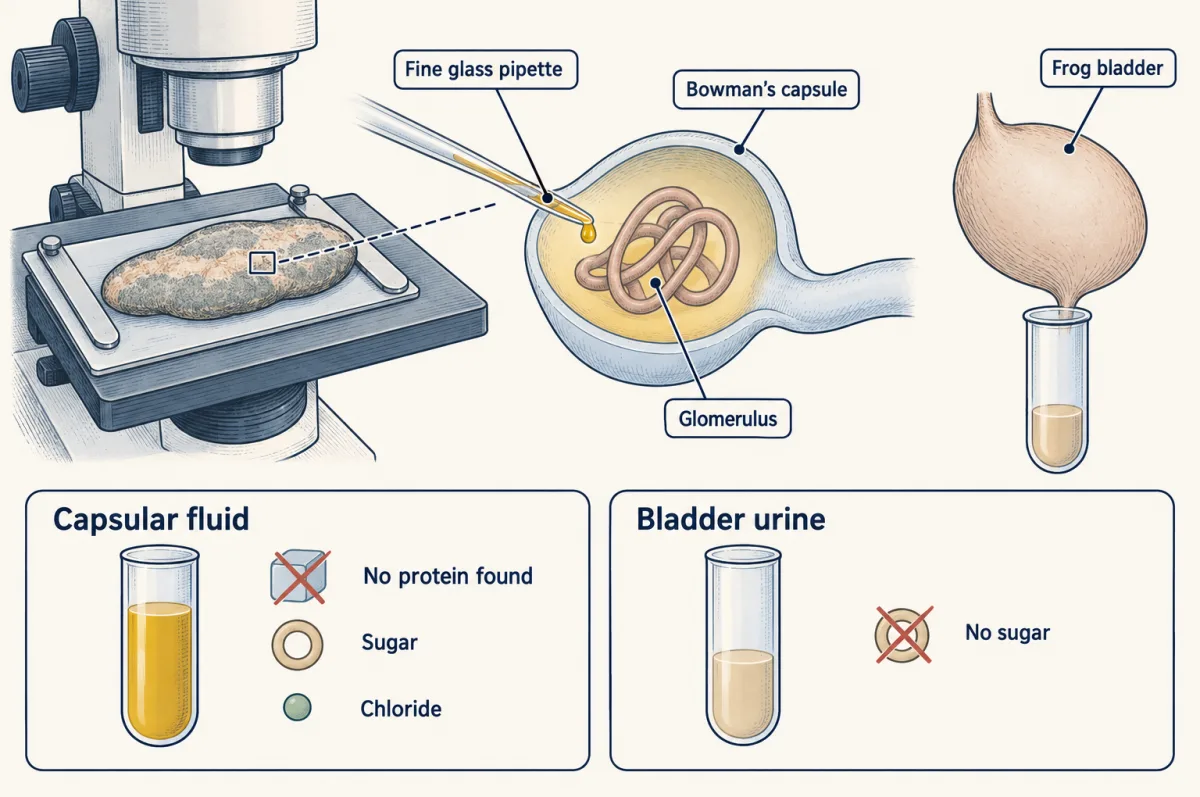
Wearn and Richards (1924) guided a fine pipette into Bowman's capsule of a frog kidney. The fluid held no protein their tests could find but did contain sugar and chloride, while the frog's bladder urine held no sugar: a protein-free filtrate, then reabsorption of glucose. AI-generated illustration -
Clearance: reading the ledger from outside
-
Making urine more concentrated than blood
-
Hormones tune the reabsorbed term
-
Kidneys compared: the ledger in other animals
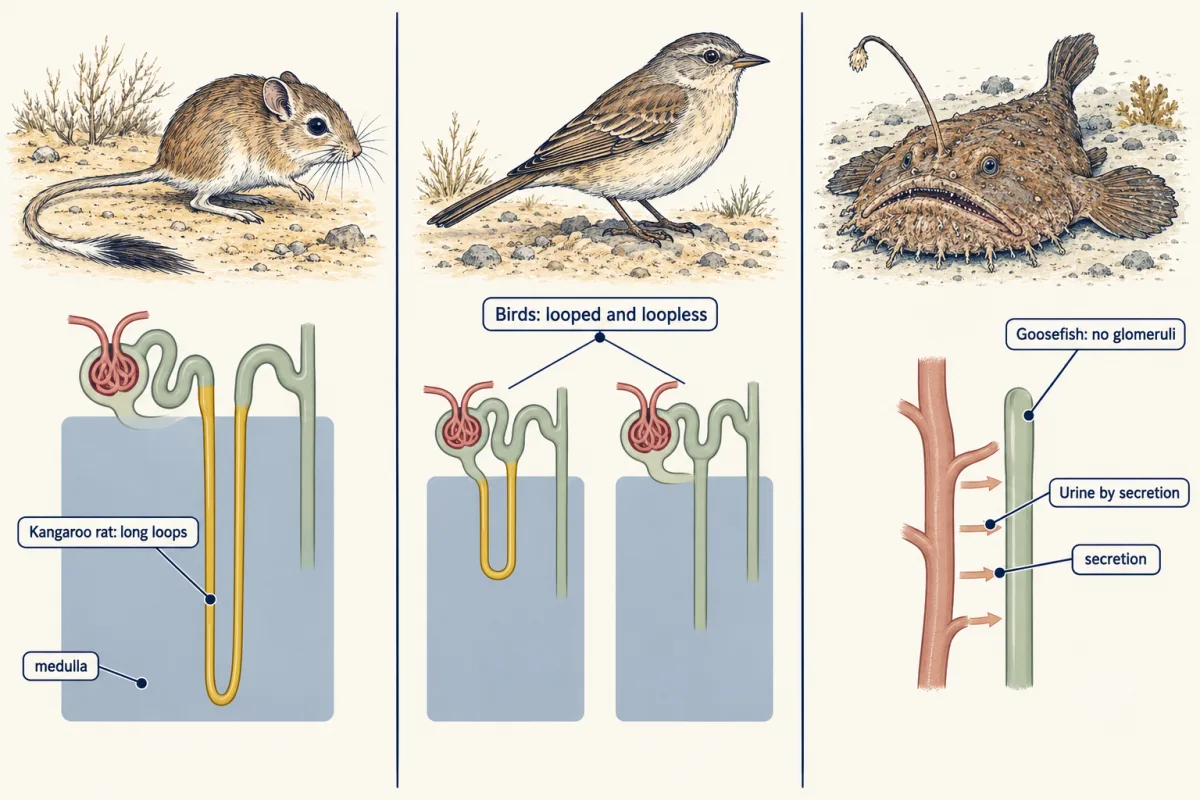
Loops of Henle occur only in mammals and birds, and a thicker medulla goes with more concentrated urine: the kangaroo rat has long loops, birds a mix of looped and loopless nephrons. Some marine teleosts such as the goosefish have no glomeruli and form urine by secretion, with water following. AI-generated illustration -
Going deeper
Where this lesson fits
Before thisReview first
- Osmoregulation and Nitrogenous WasteThis course · Lesson 15
It explains how water and salt balance is kept, which this lesson takes as its starting point.
- Blood Vessels, Blood and LymphThis course · Lesson 11
You need Starling forces and capillary flow from there to see how the glomerulus filters in bulk.
- Tissues, Organs and HomeostasisThis course · Lesson 6
You need negative feedback control from there to follow how hormones tune the kidney's take-back.
After thisStudy next
- Moving Water and Sugar in PlantsThis course · Lesson 23
It moves water by water potential with no filter, which this lesson sets against the kidney.
Elsewhere on the siteFilms, simulations and method films in other courses
- Random Moves, One-Way DriftFilm · Life Science
It shows water moving toward the side with more particles, which drives water leaving the limbs.
- Downhill for FreeFilm · Biology
It shows net water movement by osmosis across a membrane, as in the collecting duct.
Suggested by an AI model from the lessons themselves, then checked. How we use AI