Cell Signaling · Skim version
Cytokine Receptors and JAK–STAT
Read the full lesson → Skim the whole course →
The guiding idea
How does a signal reach a gene when the only relay between the receptor and the DNA is one kind of protein?
How does a cytokine such as interferon or erythropoietin switch on genes within minutes when its receptor has no enzyme at all?
-
The idea: a receptor with no enzyme borrows one
-
The interferon puzzle: activating a factor without making more of it?
-
The mechanism: one phosphate, and an SH2 domain used twice
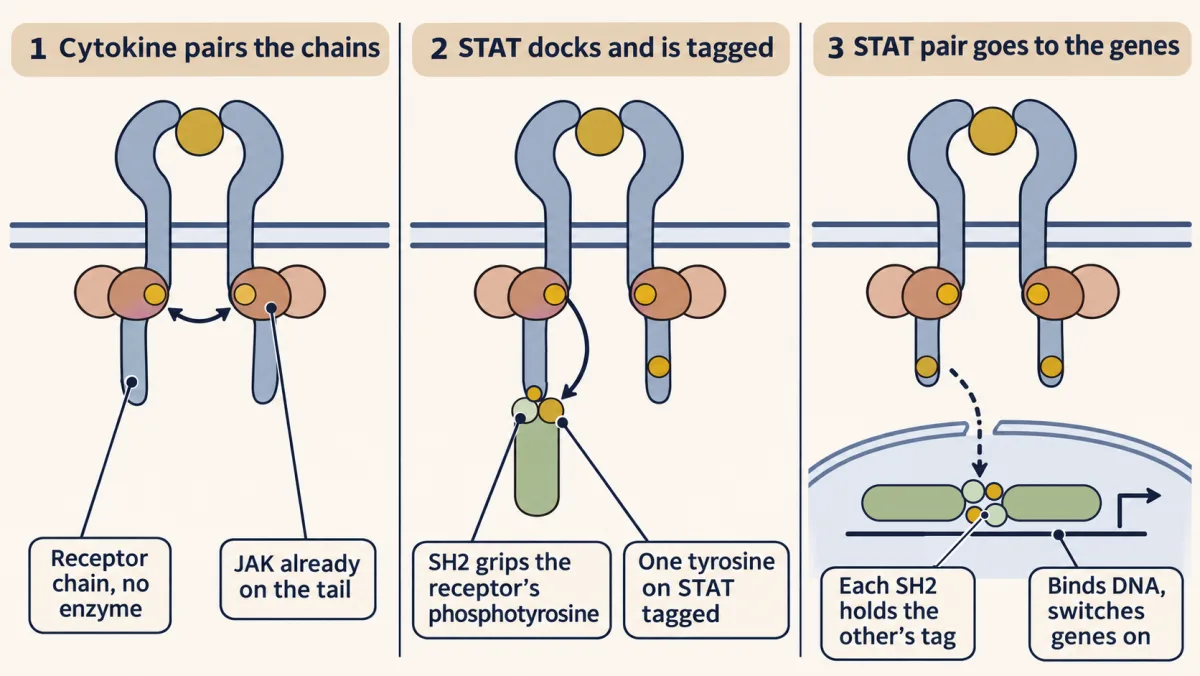
A cytokine receptor has no enzyme of its own; it borrows a JAK. Once the cytokine sets two chains in place, the JAKs activate each other and tag the receptor tails; a STAT docks by its SH2 domain and is tagged on one tyrosine beside it; then two tagged STATs hold each other, each SH2 gripping the partner's phosphotyrosine, and the pair builds up in the nucleus and switches genes on. AI-generated illustration -
One family, many jobs: four JAKs, seven STATs
-
Switching it off, and what happens when a JAK is stuck on
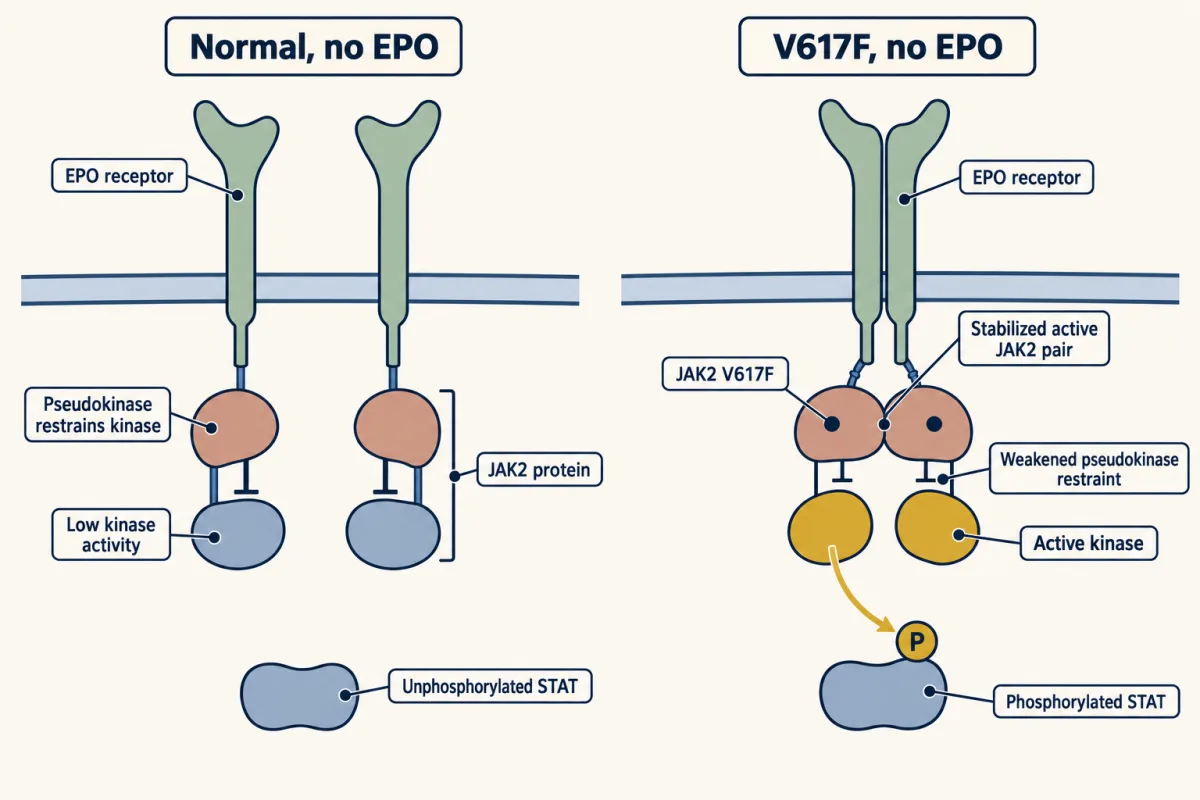
Normally the pseudokinase domain restrains the working kinase, and JAK2 waits for EPO. With valine 617 changed to phenylalanine, that restraint is weakened and JAK2 signals with little or no EPO present. AI-generated illustration
Where this lesson fits
Before thisReview first
- Phosphorylation: Kinases and PhosphatasesThis course · Lesson 6
JAK activation-loop trans-phosphorylation and phosphatase removal of phosphates rely on the kinase and phosphatase switch described there.
- Protein Modules: SH2, SH3, PTB, PDZ and PHThis course · Lesson 9
STAT docking on the receptor and STAT pairing both use the SH2 domain reading a phosphotyrosine, as taught there.
- A Field Guide to ReceptorsThis course · Lesson 4
The lesson sets enzyme-less cytokine receptors against receptors that carry their own kinase, a split drawn in that field guide.
After thisStudy next
- The Shape of a Signal: Size, Duration, Frequency and PlaceThis course · Lesson 35
It asks how a cell reads signal duration and size, which STAT signaling and its SOCS feedback illustrate.
- Oncogenes: When the Switch SticksThis course · Lesson 41
Stuck-on JAK2 V617F in polycythaemia vera is an oncogene-style gain-of-function switch taken further there.
- Drugs Against a PartThis course · Lesson 42
It takes up how kinase inhibitors for the ATP pocket achieve selectivity, as with JAK inhibitors and TYK2.
Elsewhere on the siteFilms, simulations and method films in other courses
- RNAi and antisense knockdownMethod film
Knocking down one JAK or STAT with siRNA is a way to test what each part does.
Suggested by an AI model from the lessons themselves, then checked. How we use AI