Organismal Biology · Skim version
Innate Immunity: Recognize and Respond
Read the full lesson → Skim the whole course →
The guiding idea
A cut lets in 100 bacteria that double every 20 minutes, and new antibodies take days. What does your body have to do in the first few hours to stay ahead?
In the first hours of an infection, innate defense is a race against doubling: if defenses remove a fraction k of the bacteria each doubling time, the count changes by 2 × (1 − k) per doubling, so once removal starts they must remove more than half every doubling time; starting early keeps the pile smaller.
From the film: Winning the First Hours
- In the first hours of an infection, defenses race bacteria that can double every 20 minutes or so, long before new antibodies can be made.
- If defenses remove a fraction k of the bacteria each doubling time, the count changes by 2 × (1 − k) per doubling, so it shrinks only when more than half are removed. This is an illustrative model, not a measured wound.
- Start early: each hour of delay lets bacteria that double every 20 minutes grow eightfold before killing begins, leaving a bigger pile to bring down, which is why innate receptors are ready before infection.
- In this model of a bacterial wound, the defenses the film follows do three jobs: barriers lower the number that get in, ready-made receptors start the response at once, and inflammation brings neutrophils and then monocytes that remove more per doubling.
From the film: Cells or Serum?
- Metchnikoff watched mobile cells in transparent water fleas engulf swallowed yeast spores: the outcome tracked the flea's fate, as fleas whose cells destroyed the spores lived and those where spores grew into budding yeast died.
- That showed eating cells, phagocytes, are an active defense; it did not show that they work alone.
- Bordet found that immune serum's killing needs two parts: a heat-stable one raised by immunization, antibody, and a heat-sensitive one present in all fresh serum, complement.
- Cells and serum proteins are one system: complement coats microbes so phagocytes eat them faster, which raises the fraction removed per doubling.
-
Near the threshold
-
Fewer get in: barriers
-
Starting the clock: sensing and inflammation
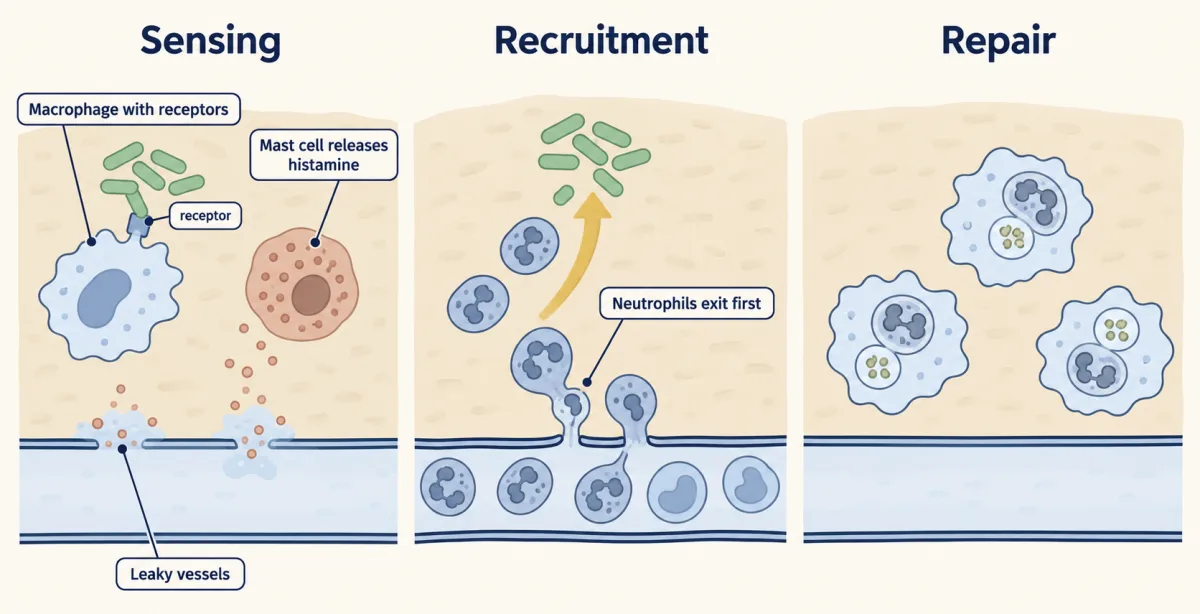
Inflammation turns sensing into more removal: resident cells sense microbes, vessels turn leaky and sticky, neutrophils and then monocytes leave the blood, and macrophages clear up as the tissue rebuilds. AI-generated illustration -
Eating the invader: phagocytes
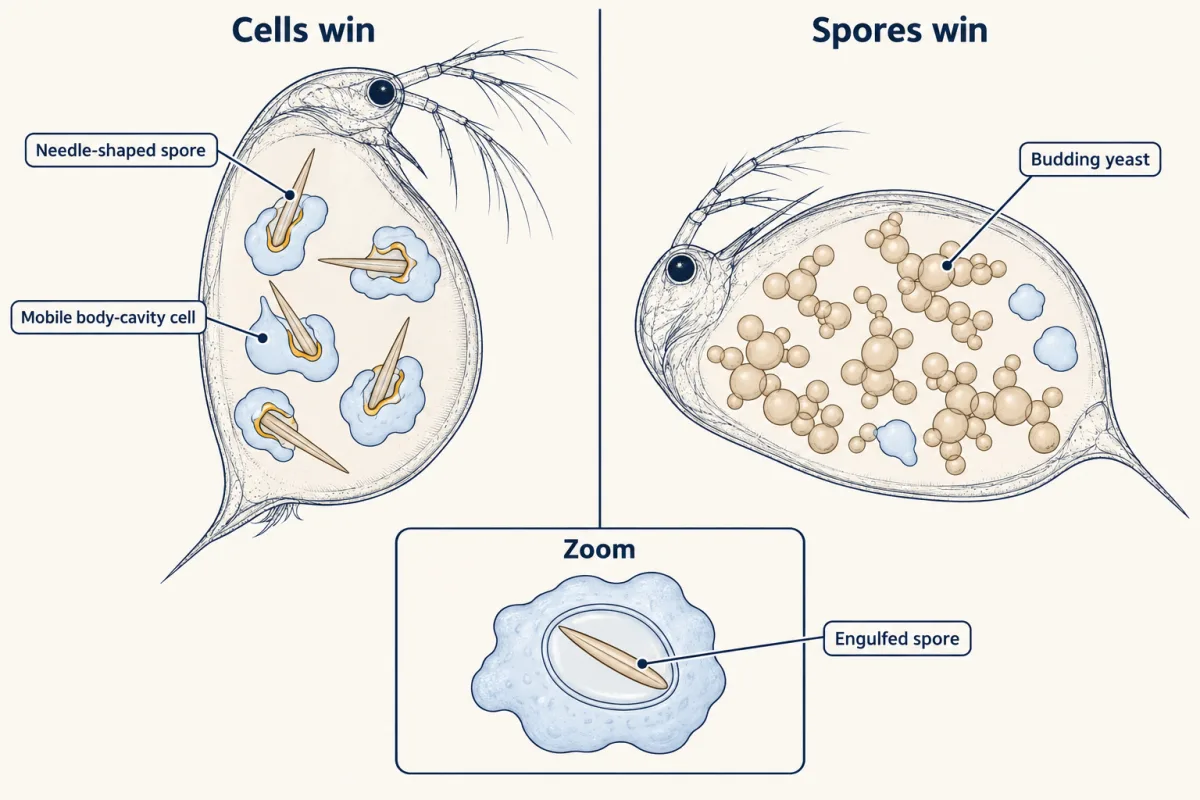
Watching a transparent animal shows which cells act and when; only removing those cells could show that the animal needs them. AI-generated illustration -
Complement: mark, alarm, puncture
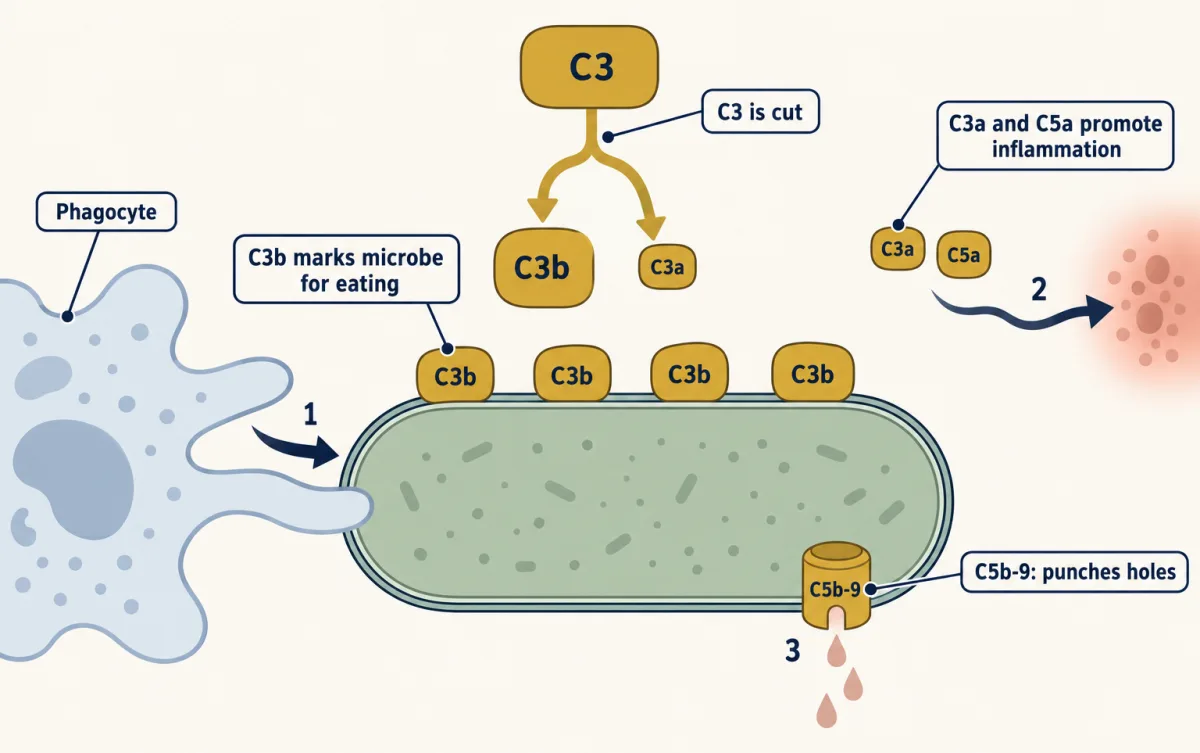
Once C3 is cut, the large piece C3b binds the microbe and marks it for eating; the small pieces C3a and C5a drift off as alarms; and later proteins build C5b-9, which can punch holes in some microbes. AI-generated illustration -
Viruses: interferons and natural killer cells
-
Three organisms, one problem: fly, plant, mouse
-
What innate immunity lacks, and how it can change
-
Going deeper
Where this lesson fits
Before thisReview first
- Germs, Vaccines and AntibioticsBiology · High school
It introduces how germs spread and how the body's defenses and antibiotics fight them, which this lesson's race with bacteria assumes.
- How Microbes MultiplyBiology · High school
You need bacterial doubling from there to see why the count grows by 2 each doubling time.
- Tissues, Organs and HomeostasisThis course · Lesson 6
It introduces feedback and tissue organization, which the inflammation response here builds on.
After thisStudy next
- Adaptive ImmunityThis course · Lesson 18
It takes up the antibodies and T cells that arrive days later, once the innate race has bought time.
- Cell Death and ClearanceOne level up · Cell Biology
It shows how dying cells are cleared, a job complement and phagocytes share with those met here.
Suggested by an AI model from the lessons themselves, then checked. How we use AI