Biology · Skim version
How Microbes Multiply
Read the full lesson → Skim the whole course →
The guiding idea
One bacterium can become millions of cells in an afternoon, yet a virus never divides at all. How, then, can a cold sore heal and come back in about the same spot?
A bacterium copies itself; a virus is copied by a host cell, which builds new viruses right away in the lytic cycle, or in the lysogenic cycle copies only the viral DNA each time it divides.
From the film: Copy Yourself, or Be Copied
- Most bacteria reproduce by binary fission: a cell copies its DNA, grows and splits into two.
- Each doubling multiplies the count by 2: at the best-case pace, 21 doublings turn one cell into about two million, a calculated number.
- In a closed flask, food runs low and wastes build up, so growth levels off.
- A virus cannot split, grow or make anything on its own; a host cell builds every new virus.
From the film: Built Now, or Carried Along
- Cells broken open early in an infection hold viral parts but no whole viruses: viruses are built from parts, not divided.
- In the lytic cycle the host builds new phages right away, then bursts and dies.
- In the lysogenic cycle of phage lambda, the viral DNA joins the host chromosome as a prophage and is copied each time the host divides; no new phages are built.
- Something such as damage to the cell's DNA can switch a prophage into the lytic cycle; only then are new phages built.
-
Explore: grow a population and follow a virus
-
Explain: how bacteria make more bacteria
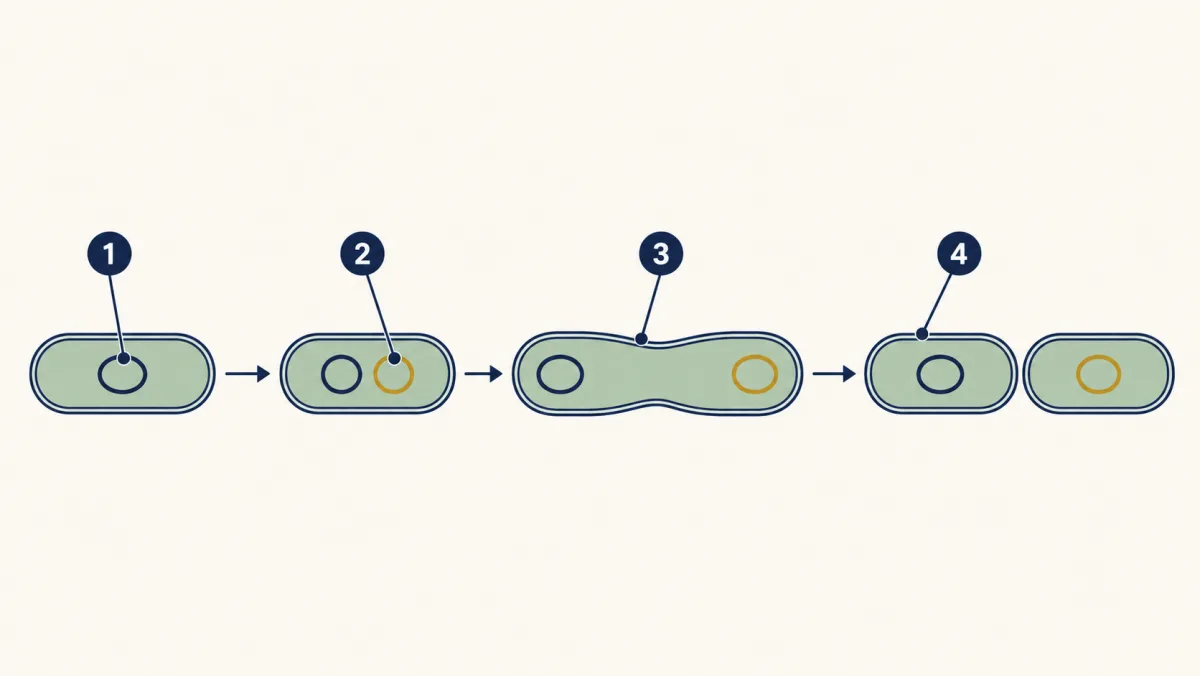
- chromosome
- copy of the chromosome
- grows longer
- daughter cells
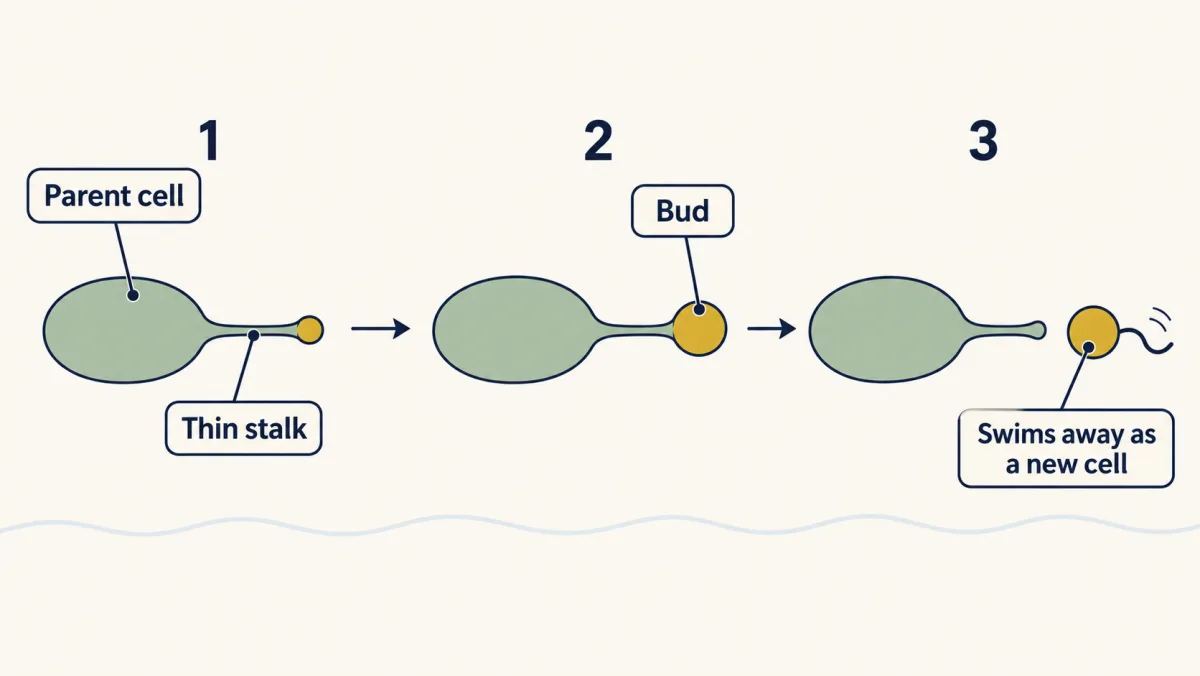
Budding in the ocean bacterium Hyphomonas neptunium: a bud forms at the tip of a thin stalk, then breaks off and swims away as a new cell. AI-generated illustration 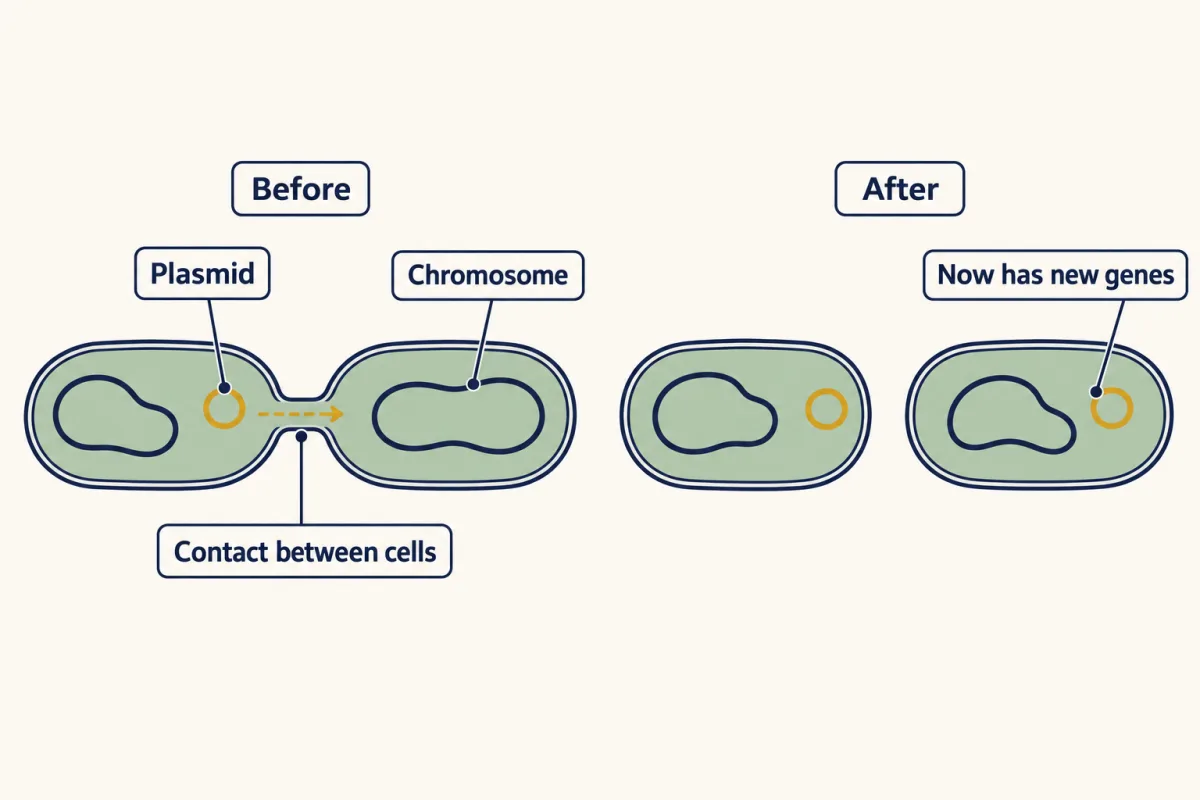
In conjugation, one bacterium passes DNA, often a plasmid, to another through contact. No new cell is made: there are still two cells, but one has new genes. AI-generated illustration -
Explain: doubling, and why it stops
-
Elaborate: a real growth curve
-
Explain: how viruses make more viruses
-
Evaluate: check your thinking
-
Going deeper
Where this lesson fits
Before thisReview first
- Living or Not? Viruses and BacteriaThis course · Lesson 12
It explains why a virus needs a host cell, which this lesson builds on when viruses are copied by hosts.
- The Cell Cycle and MitosisThis course · Lesson 10
Binary fission is compared with mitosis, so you need to know how a eukaryotic cell copies and divides.
After thisStudy next
- Populations and Carrying CapacityThis course · Lesson 29
It takes the idea that growth levels off when food runs low and shows what limits real populations.
- Germs, Vaccines and AntibioticsThis course · Lesson 15
It uses fast bacterial doubling to explain how infections spread and how resistance can arise.
- Engineering GenesThis course · Lesson 22
It uses bacteria multiplying and plasmids passing between cells to make human insulin.
Elsewhere on the siteFilms, simulations and method films in other courses
- Bacterial and phage geneticsMethod film
This shows how conjugation and phage transfer of DNA are used to map genes in bacteria.
Suggested by an AI model from the lessons themselves, then checked. How we use AI