Physiology · Skim version
Gut Motility, Secretion and Gut Hormones
Read the full lesson → Skim the whole course →
The guiding idea
A glass of water is usually half gone from your stomach in about 10 minutes. A rich, high-calorie drink may take about 2 hours to be half gone. What holds the rich drink back?
The gut wall keeps its own time with pacemaker cells, runs its own reflexes with a nervous system of its own, and makes a fluid about a million times more acidic than the parietal cell's cytosol.
-
The wall, from the lumen outward
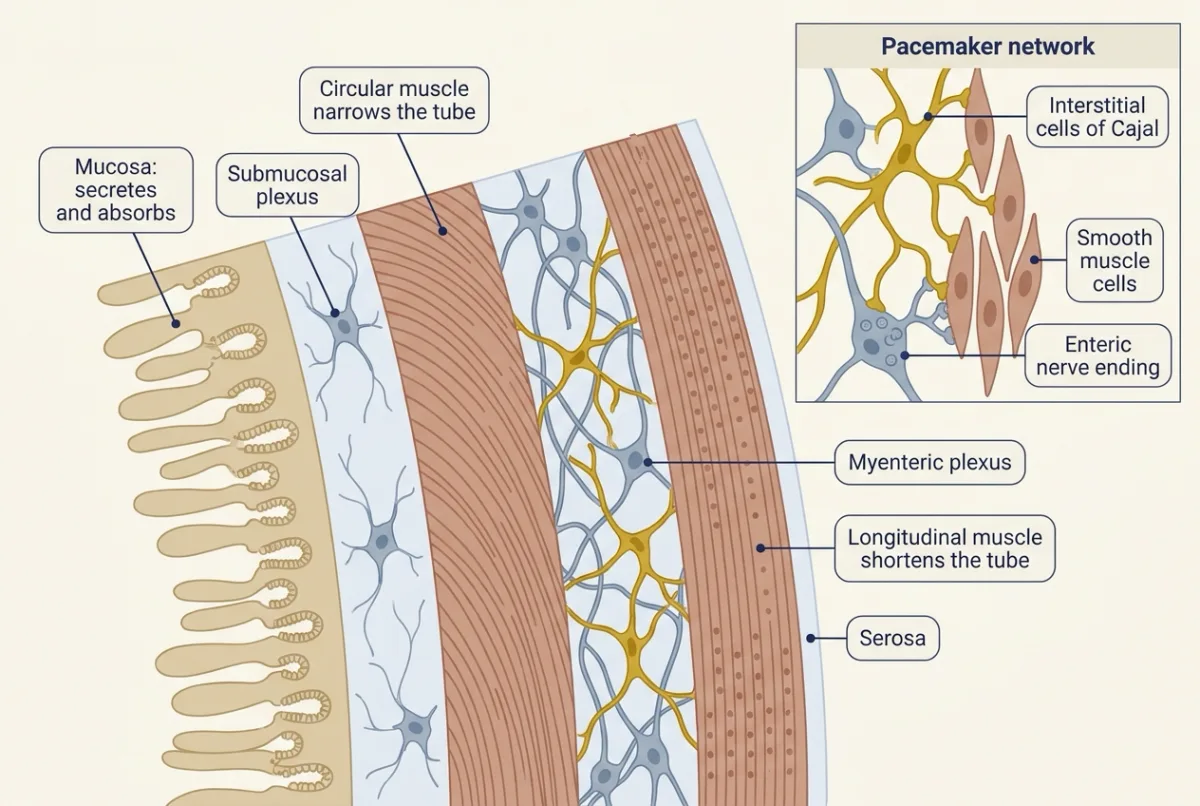
The gut wall carries its own machinery: two meshes of neurons, one under the lining and one between the muscle layers, and a network of interstitial cells of Cajal beside the muscle that keeps the beat. AI-generated illustration -
The clock: Cajal’s cells keep the beat; nerves decide how hard
-
The gut wall has its own nervous system
-
Mouth to stomach: wet, swallow, store, grind, meter
-
Acid from a pump, protection from a gel
-
Switching acid on and off
-
The duodenum answers back
-
Going deeper
Where this lesson fits
Before thisReview first
- Digestive Systems and NutritionOrganismal Biology · Starting college
It gives the first look at the gut and the first hormone table, which this lesson fills in with cells and numbers.
- Transport Across MembranesCell Biology · College: the core
You need pumps, electroneutral exchange and ion gradients from there to follow the parietal cell's proton pump.
- Signal-Transduction Pathways: How Cells Compute With Molecular SwitchesBiochemistry · College: going further
Gq and Gs receptors, Ca2+ and cAMP from there explain how acetylcholine, gastrin and histamine switch on the pump.
After thisStudy next
- Absorption, the Liver and Enterohepatic CirculationThis course · Lesson 24
It follows the chyme and the secretin and CCK signals into bile, pancreatic juice and absorption.
Elsewhere on the siteFilms, simulations and method films in other courses
- Three digestion lanesSimulation · Biochemistry
Its digestion lanes follow the same meal through secretions and enzymes as it leaves the stomach.
- The master switch of digestionFilm · Biochemistry
It shows the hormone switch that controls digestion, which is the gut-hormone control used here.
Suggested by an AI model from the lessons themselves, then checked. How we use AI