Developmental Neuroscience · Skim version
Pioneers, Guideposts and the Logic of Guidance Cues
Read the full lesson → Skim the whole course →
The guiding idea
Kill a guidepost cell on a grasshopper embryo's leg, and the first axons to grow past it lose their way.
A growth cone reads only what is within its reach, so a long route is built as a chain of legs, each ending at a choice point.
From the film: A Route in Legs
- A growth cone reads only what is within its reach.
- So a long route is usually built as a chain of legs.
- Each leg ends at a choice point, where the growth cone reads something new or reads the same thing differently.
From the film: Kill a Guidepost
- Removing a guidepost cell can make pioneer axons lose their normal route at that turn.
- A choice point is a place where the growth cone picks its next path.
- A guidepost is one important cue among several, since some legs are read from boundaries in the tissue.
From the film: Followers, Glue and the Reader
- Growth cones can choose particular bundles of axons to follow, as the labeled pathway hypothesis proposes.
- In the fly, the amount of adhesion between axons matters, and Beat works at least partly against it.
- A cue is a message, and the growth cone's receptors and internal state decide what it means.
-
What a growth cone can read
-
Why a route needs legs
-
Kill a guidepost
-
Followers read the pioneers
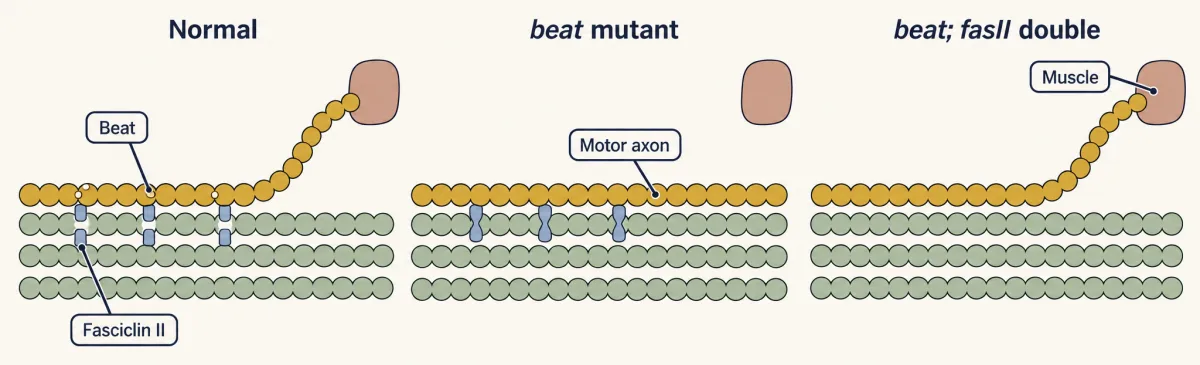
In Drosophila, motor axons normally leave their nerve at choice points, whereas beat mutants can bypass their muscle targets. Reducing Fasciclin II suppresses this defect; the right panel shows an example of restored exit, not a claim of complete rescue. This supports a role for Beat in overcoming axon–axon adhesion. Beat is present on motor axons and also helps them recognize the pathway cue Sidestep. AI-generated illustration -
Choice points in vertebrates
-
Same cue, different meaning
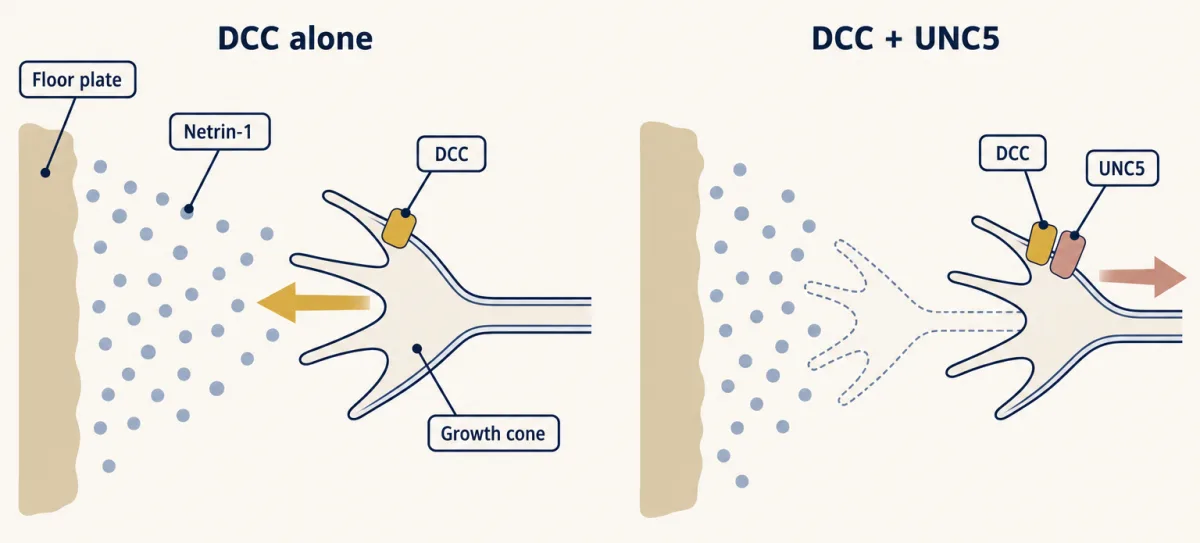
A simplified comparison of responses to netrin-1: DCC can mediate attraction, while DCC together with UNC5 can mediate repulsion. Receptor complement helps determine the response, but internal signaling state and the surrounding substrate can also change its sign. This schematic does not specify the tissue source or range of netrin action in vivo. AI-generated illustration -
Going deeper
Where this lesson fits
Before thisReview first
- The Growth Cone: The Tip That Steers the AxonThis course · Lesson 3
You need the growth cone's actin, filopodia and adhesion grip from there to follow how it reads cues and turns.
- Seeing Neurons: Golgi, Cajal and the Neuron DoctrineThis course · Lesson 2
You need the picture of the neuron and its axon from there to follow how single axons are traced and labeled.
After thisStudy next
- Netrin and DCC: One Cue, Two AnswersThis course · Lesson 23
It takes the idea that one cue can attract or repel and shows how DCC and UNC5 decide it.
- Crossing the Midline Once: Slit, Robo and CommThis course · Lesson 24
The midline is the intermediate target described here, and Slit and Robo mark the choice point after crossing.
- Semaphorins and RepulsionThis course · Lesson 25
It takes the long-range repulsion class of cues and shows how it sorts axons at a choice point.
Suggested by an AI model from the lessons themselves, then checked. How we use AI