Life Science · Skim version
Food Webs and Energy
Read the full lesson → Skim the whole course →
The guiding idea
If ospreys eat menhaden and menhaden eat plankton, how much of the sun’s energy ever reaches an osprey?
At each feeding step, less energy is available to the next level.
From the film: Follow the Energy Arrows
- Food-web arrows point from food to eater, the direction energy moves.
- A consumer's order depends on the path: an osprey can be second-order or third-order.
- Producers bring energy into the living web, and decomposers receive dead matter from every level.
- At each feeding step, less energy is available to the next level.
From the film: Test the Pyramid with Real Data
- Every step passes on less energy, but how much less varies.
- At Silver Springs the three steps passed on different percentages; one-tenth is a rough classroom rule.
- Energy not passed on leaves as heat or goes to decomposers, a side branch fed by every level.
- An energy pyramid measures energy flow, not a count of animals.
-
Explore: build an energy pyramid
-
Explain: living and nonliving parts of an ecosystem
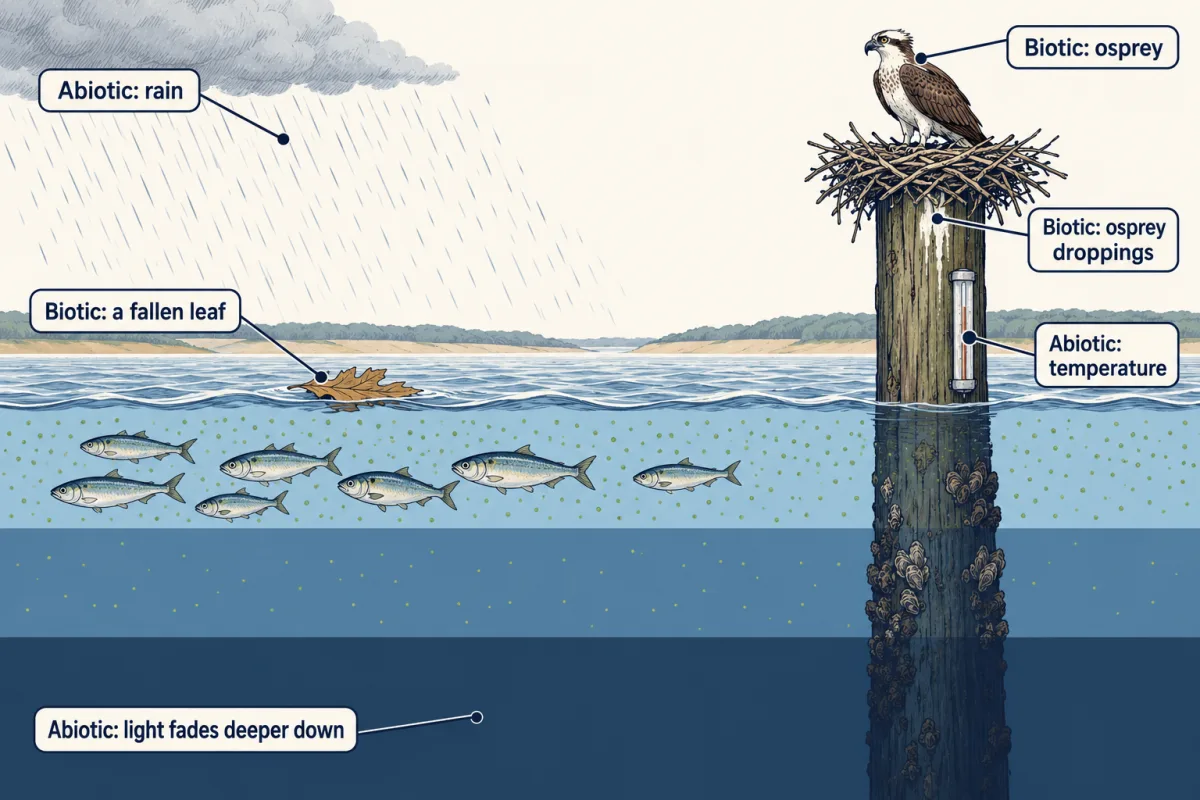
Living and once-living things are biotic factors; rain, temperature, and light are abiotic factors that shape where organisms can live. AI-generated illustration -
Explain: food chains and food webs
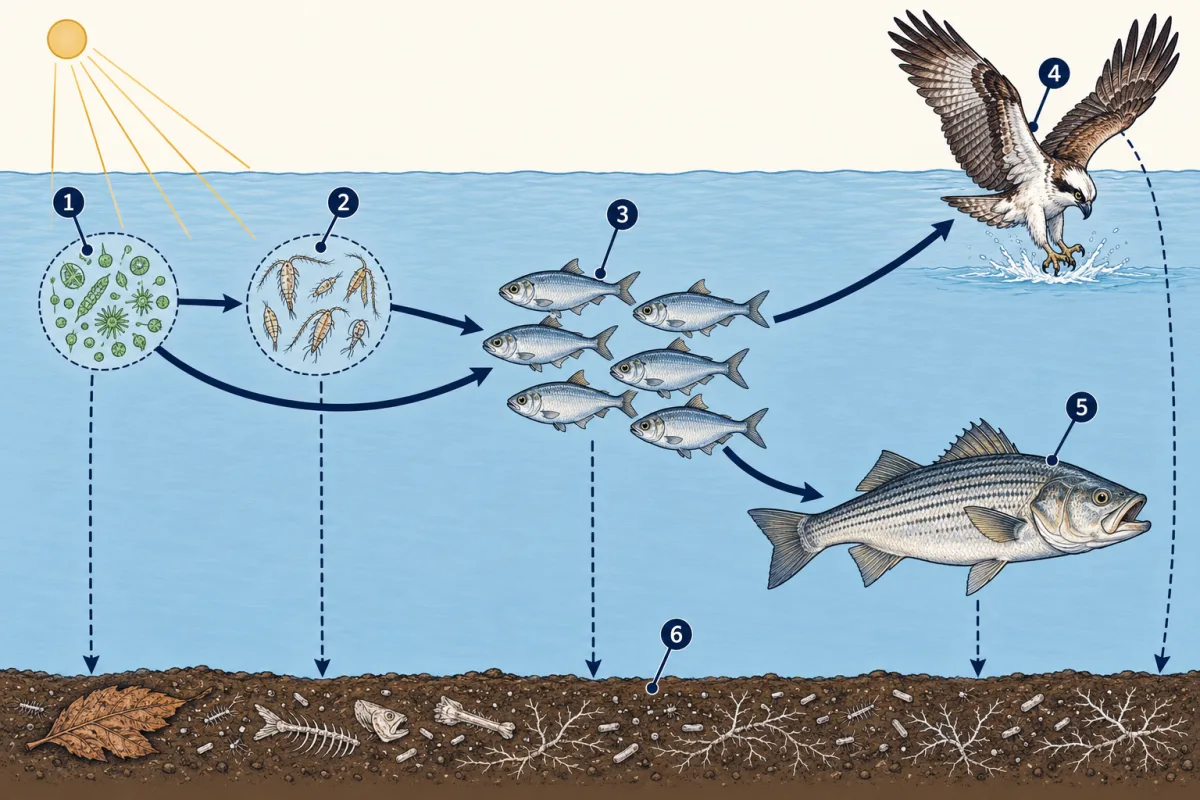
- phytoplankton
- zooplankton
- menhaden
- osprey
- larger fish
- decomposers
-
Explain: why each level has less energy
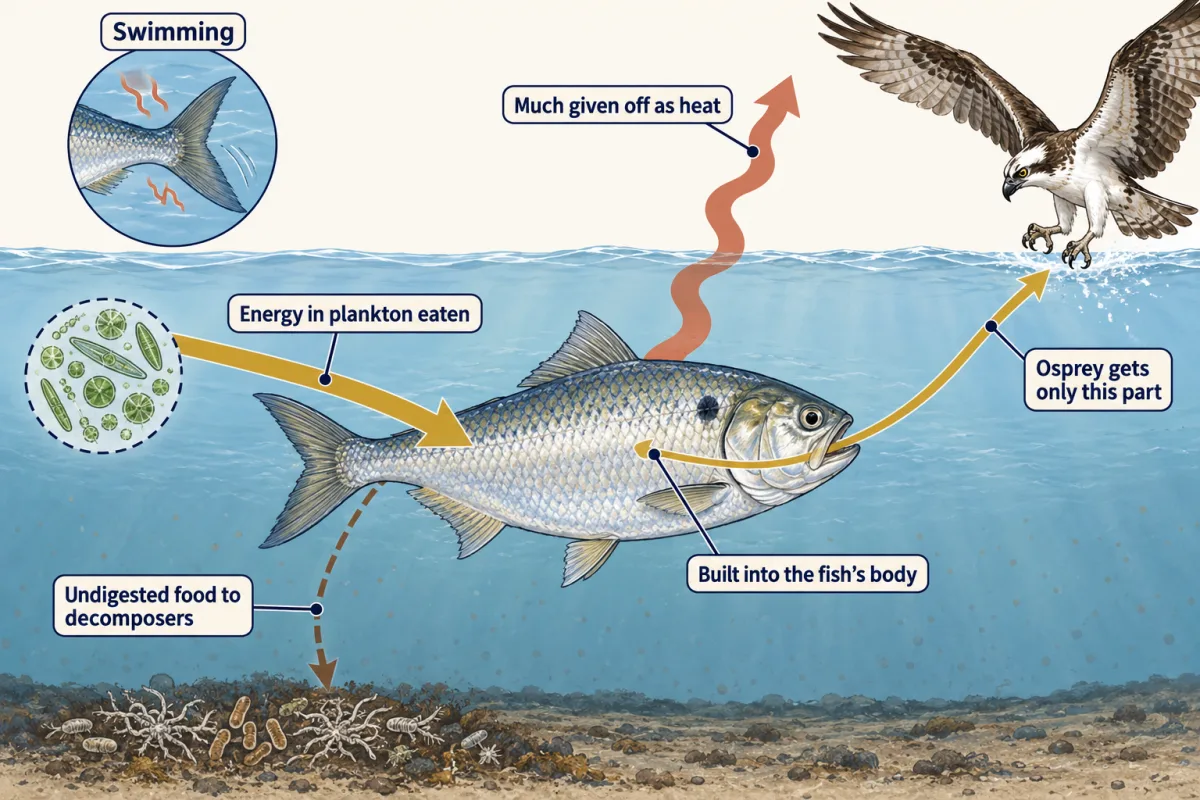
Most energy a menhaden takes in does not become new menhaden. Only energy stored in its body can continue to an osprey; the rest leaves as heat or goes to decomposers. AI-generated illustration -
Elaborate: real energy numbers from a Florida spring
-
Evaluate: check your thinking
Where this lesson fits
Before thisReview first
- Photosynthesis Feeds the WorldThis course · Lesson 9
You need to know how producers capture sunlight energy and store it in food before following it up the chain.
- Releasing Energy from FoodThis course · Lesson 10
Respiration is where much of each level's energy is given off as heat, which this lesson counts.
- Who Eats Whom?Biology Together · Ages 5–10, with a grown-up
You should already know how a food chain or web shows who eats whom, with arrows from food to eater.
After thisStudy next
- Producers, Consumers and DecomposersThis course · Lesson 13
It takes the decomposer branch of the web further, showing how dead matter and wastes return nutrients for reuse.
- The Carbon and Water CyclesThis course · Lesson 14
It shows matter being reused while energy flows one way and leaves as heat.
- Populations Rise and FallThis course · Lesson 23
It uses limited food energy to explain why populations of top animals stay smaller and change over time.
Suggested by an AI model from the lessons themselves, then checked. How we use AI