Cell Signaling · Skim version
Finding a Signal: NGF, EGF and the Bioassay
Read the full lesson → Skim the whole course →
The guiding idea
A mouse tumor that never touched a chick embryo's nerves made its ganglia swell. What was it releasing, and why do neurons depend on a signal from their targets?
Sympathetic neurons depend on a signal from the tissue they connect to, and that signal was found by following a mouse tumor that made chick nerves grow without touching them.
-
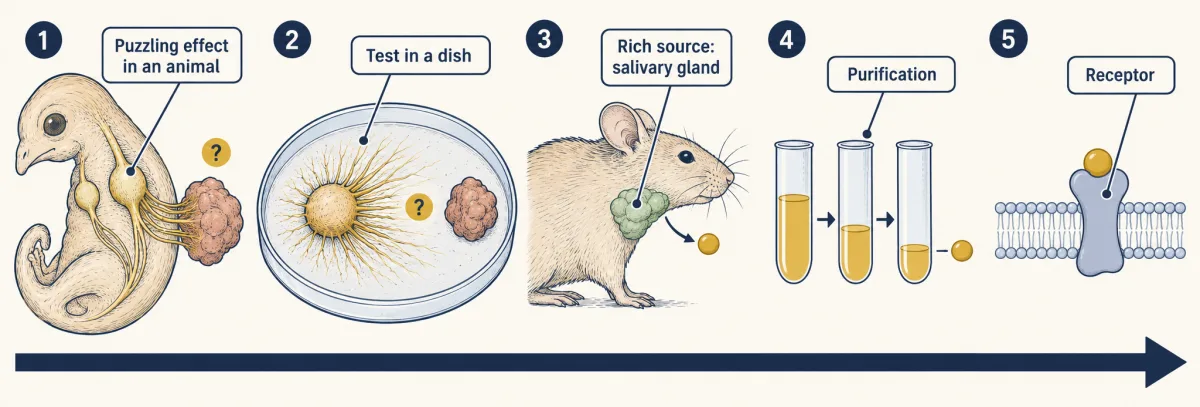
The classic route illustrated by NGF: an effect in a chick embryo, a ganglion bioassay, a rich source in mouse salivary gland, purification, and last the receptor. EGF did not follow every step shown. AI-generated illustration -
A tumor that reaches nerves without touching them
-
Turning a halo into a number
-
A control that became the source
-
Take the factor away
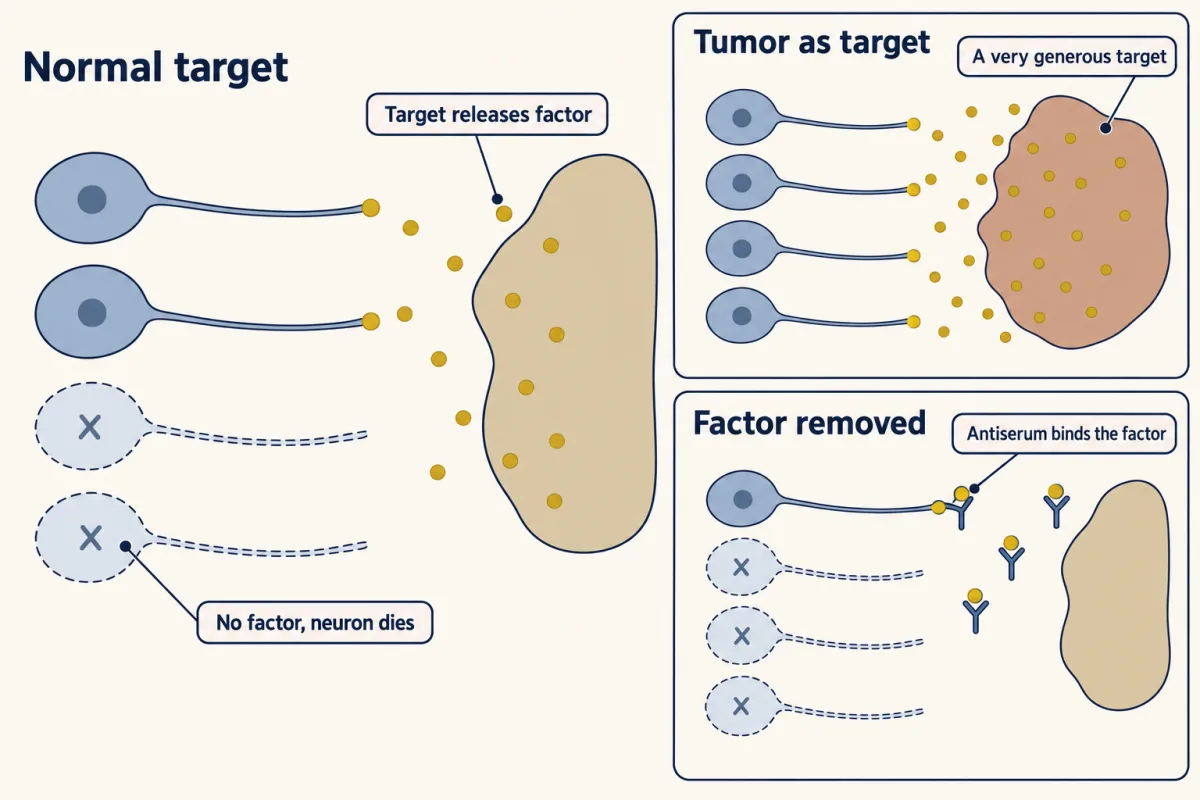
Targets help decide how many sympathetic neurons survive, like musical chairs. Tumor-derived activity swelled chick ganglia; anti-NGF antiserum destroyed most sympathetic ganglia in newborn animals. Neuron numbers and survival fractions here are schematic, and swelling alone does not show how many neurons were rescued. AI-generated illustration -
Two factors in one extract
-
The receptor is an enzyme
-
Back to the opening question
-
Going deeper
Where this lesson fits
Before thisReview first
- Signals and How Far They TravelThis course · Lesson 1
It introduces the idea of a signal acting at a distance, which this lesson's tumor experiment and factor hunt build on.
After thisStudy next
- Receptor Tyrosine KinasesThis course · Lesson 18
It answers how a single-pass receptor like EGFR switches on its kinase, the question this lesson ends with.
- Long-Distance Signaling in NeuronsThis course · Lesson 37
It follows how a survival signal taken up at the axon tip reaches the cell body, which this lesson leaves open.
- Binding: Affinity, Occupancy and Dose–ResponseThis course · Lesson 3
It takes the receptor question further, measuring how a factor binds and how response scales with dose.
Elsewhere on the siteFilms, simulations and method films in other courses
- Gel electrophoresis, SDS-PAGE and western blotMethod film
Detecting phosphotyrosine in the EGF receptor depends on detecting a phosphorylated form of a protein with antibodies.
- Too Small, or Lost?Film · Developmental Neuroscience
It shows the target-derived NGF idea tested in newborn mice.
Suggested by an AI model from the lessons themselves, then checked. How we use AI