Biochemistry · Skim version
Fatty Acid Synthesis: Building the Chain Two Carbons at a Time
Read the full lesson → Skim the whole course →
The guiding idea
Cytoplasm, ACP, NADPH: three choices that keep building fat from colliding with burning it.
Fatty acid synthesis turns a fed cell's spare acetyl CoA into long-chain fat, and it is deliberately not beta-oxidation run backward.
From the film
- ACC spends one ATP to make each malonyl CoA extender.
- The added carboxyl group leaves as carbon dioxide and helps drive condensation.
- Each CRDR turn adds two carbons and uses two NADPH.
- In the simplest case, seven turns build palmitate from a two-carbon primer.
-
Why it is not beta-oxidation in reverse
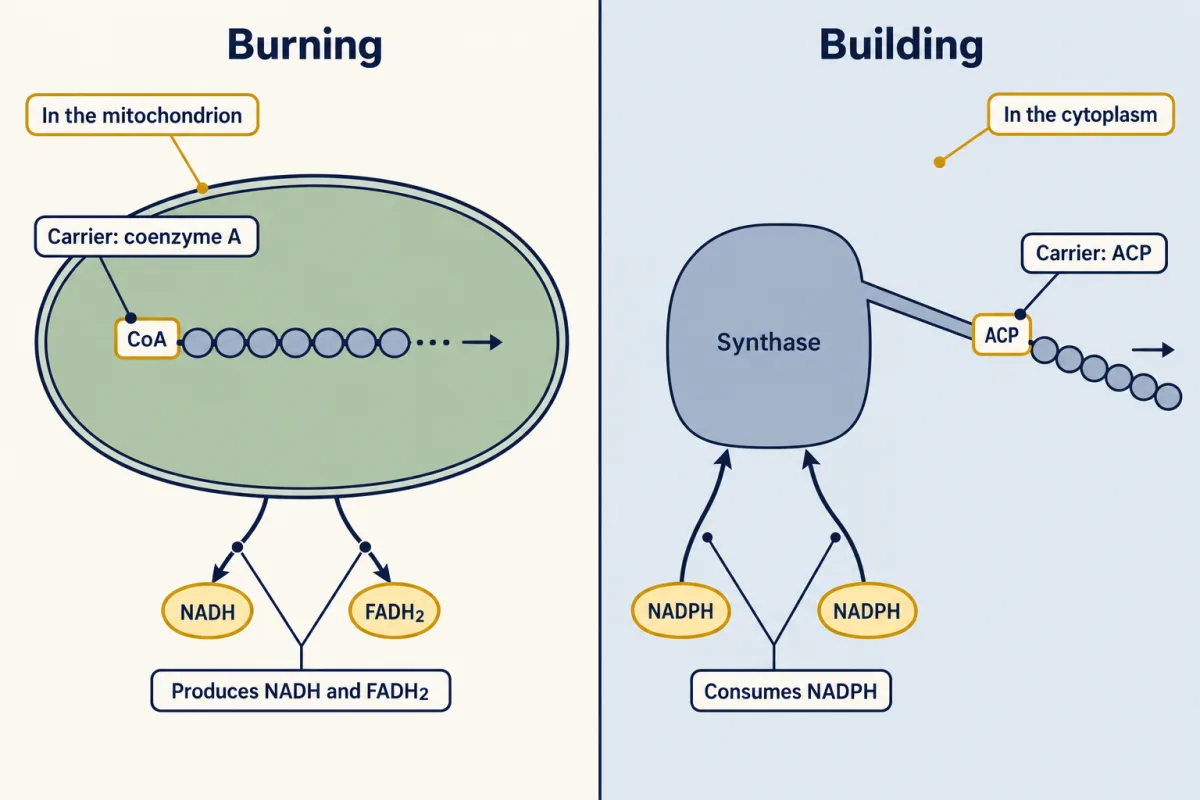
Synthesis is not beta-oxidation run backward. Burning happens in the mitochondrion with coenzyme A as carrier and makes NADH and FADH2; building happens in the cytoplasm with ACP as carrier and consumes NADPH. AI-generated illustration -
Stage 1: Transport. Citrate carries the acetyl group out
-
Stage 2: Activation. The committed step
-
Stage 3: Elongation, one turn at a time
-
Paying the bill: NADPH and delivery
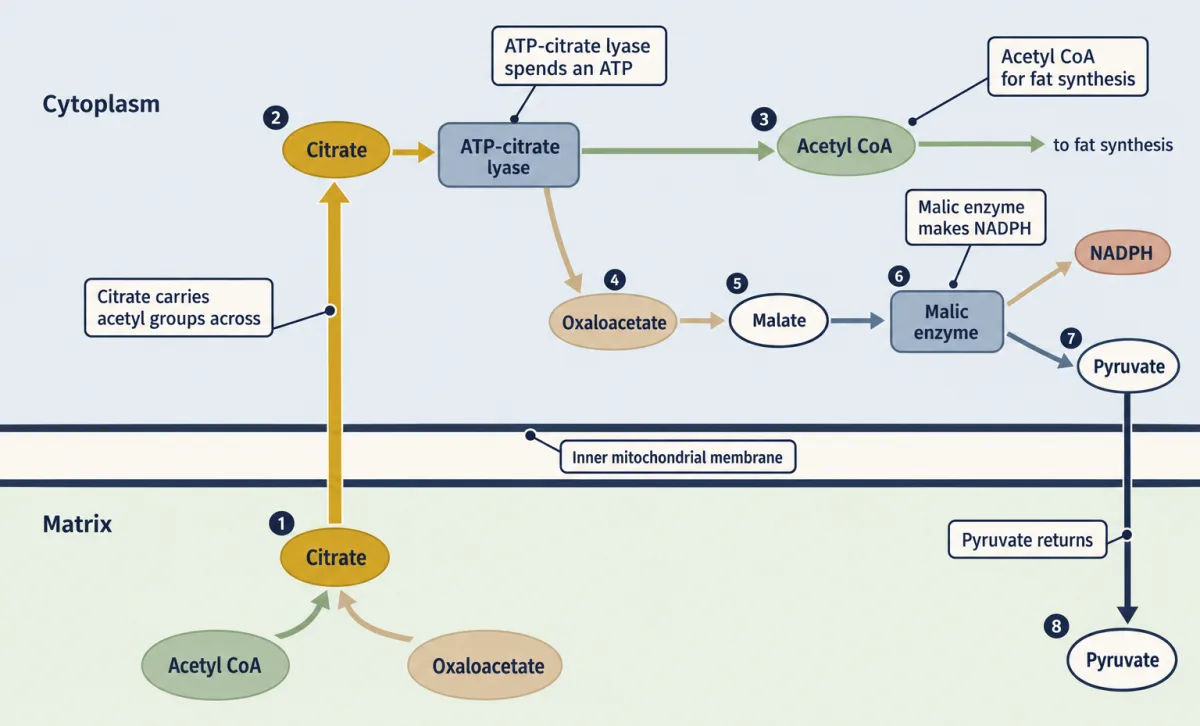
Citrate carries acetyl groups across the membrane; ATP-citrate lyase releases acetyl CoA in the cytoplasm, and the leftover oxaloacetate is reduced to malate, which malic enzyme decarboxylates to pyruvate, making NADPH on the way. Up to eight of the fourteen NADPH per palmitate can come from this shuttle. AI-generated illustration -
Regulation: malonyl CoA’s second job
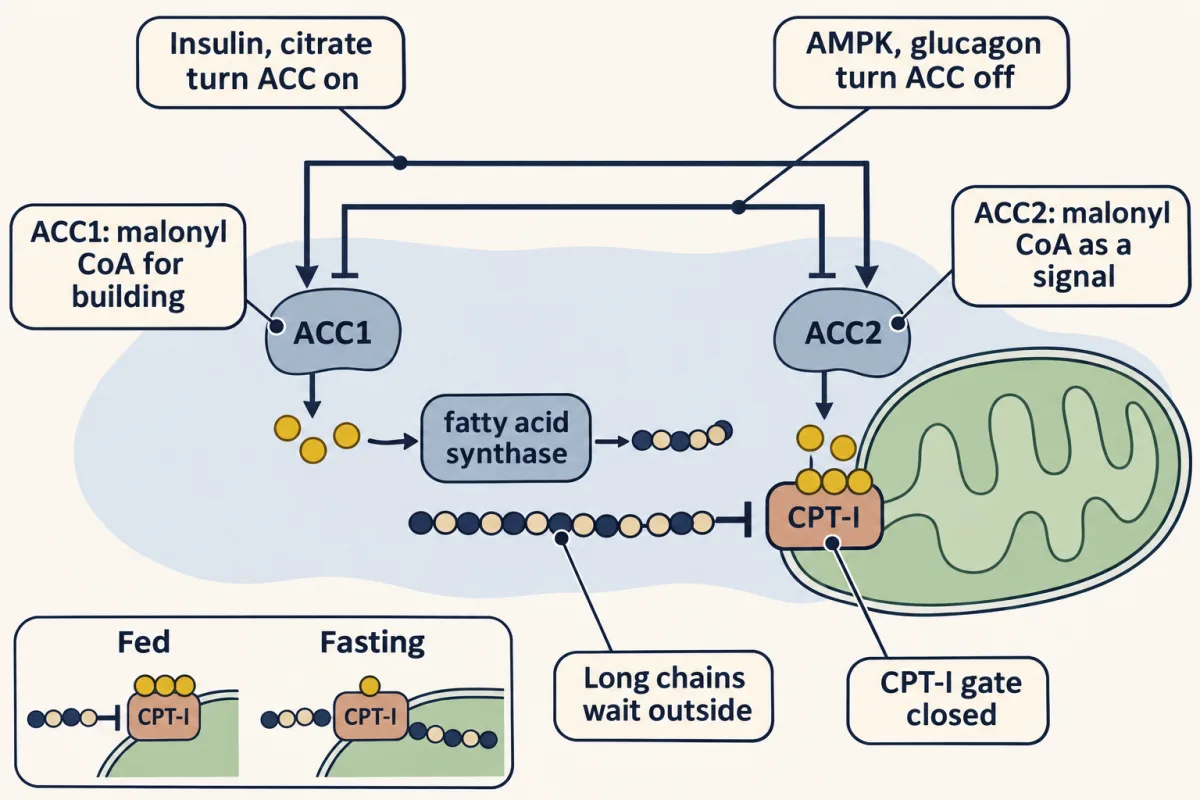
Malonyl CoA has two jobs. ACC1's malonyl CoA mostly feeds fatty acid synthase as a building block; much of the malonyl CoA that closes CPT-I is made by ACC2 on the mitochondrion, so a cell that is building fat tends not to burn it. AI-generated illustration -
After palmitate
-
Going deeper
Where this lesson fits
Before thisReview first
- Fatty Acid Degradation: The β-Oxidation SpiralThis course · Lesson 25
You need beta-oxidation from there to see why synthesis is a separate pathway, not its reverse.
- The Citric Acid Cycle: Harvesting ElectronsThis course · Lesson 19
Citrate made in the cycle is the form that carries acetyl groups out to the cytoplasm here.
- The Pentose Phosphate Pathway: NADPH and Five-Carbon SugarsThis course · Lesson 24
This pathway supplies part of the 14 NADPH that each palmitate needs.
After thisStudy next
- Integration of Metabolism: How the Body Switches FuelsThis course · Lesson 30
The malonyl CoA see-saw between building and burning fat is part of how fed and fasting states switch.
Suggested by an AI model from the lessons themselves, then checked. How we use AI