Biology · Skim version
Enzymes at Work
Read the full lesson → Skim the whole course →
The guiding idea
Why does fresh pineapple keep gelatin from setting, while canned pineapple lets it set?
An enzyme's rate depends on how many of its active sites are working and the speed of each site, and heat, pH and substrate each turn one dial or both.
From the film: Count the Working Sites
- An enzyme is a catalyst: it speeds up a reaction and comes out unchanged, ready to work again.
- The substrate fits into the enzyme's active site, a pocket whose shape and charges match it.
- An enzyme lowers the activation energy, the hill a reaction must get over; it does not add energy.
- Rate = working active sites × speed of each site: how many sites still fit the substrate, times the product each makes per second.
From the film: Why Heat Gives a Peak
- Fresh pineapple contains bromelain, protein-cutting enzymes that cut gelatin's chains so they cannot link into a net.
- Warming makes each working active site faster, up to a point.
- Too much heat can denature an enzyme: it unfolds, its active site stops fitting, and that site stops working.
- In this model, the rate peaks at the optimum, where faster sites are offset by lost working sites.
- Canning heat denatures most of the bromelain, so canned pineapple lets gelatin set; heat damage is often permanent.
-
Explain: what the first film left out
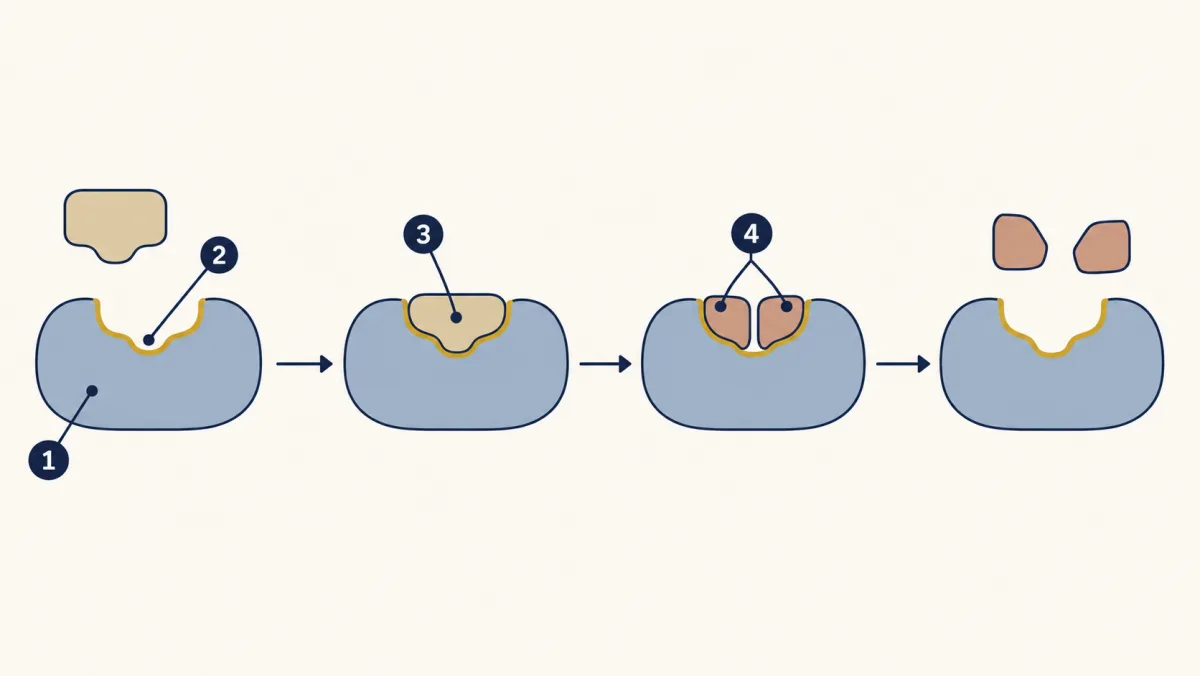
- enzyme
- active site
- substrate
- products
-
Explore: speed up and slow down an enzyme
-
Explain: the wrong pH, and what an optimum means
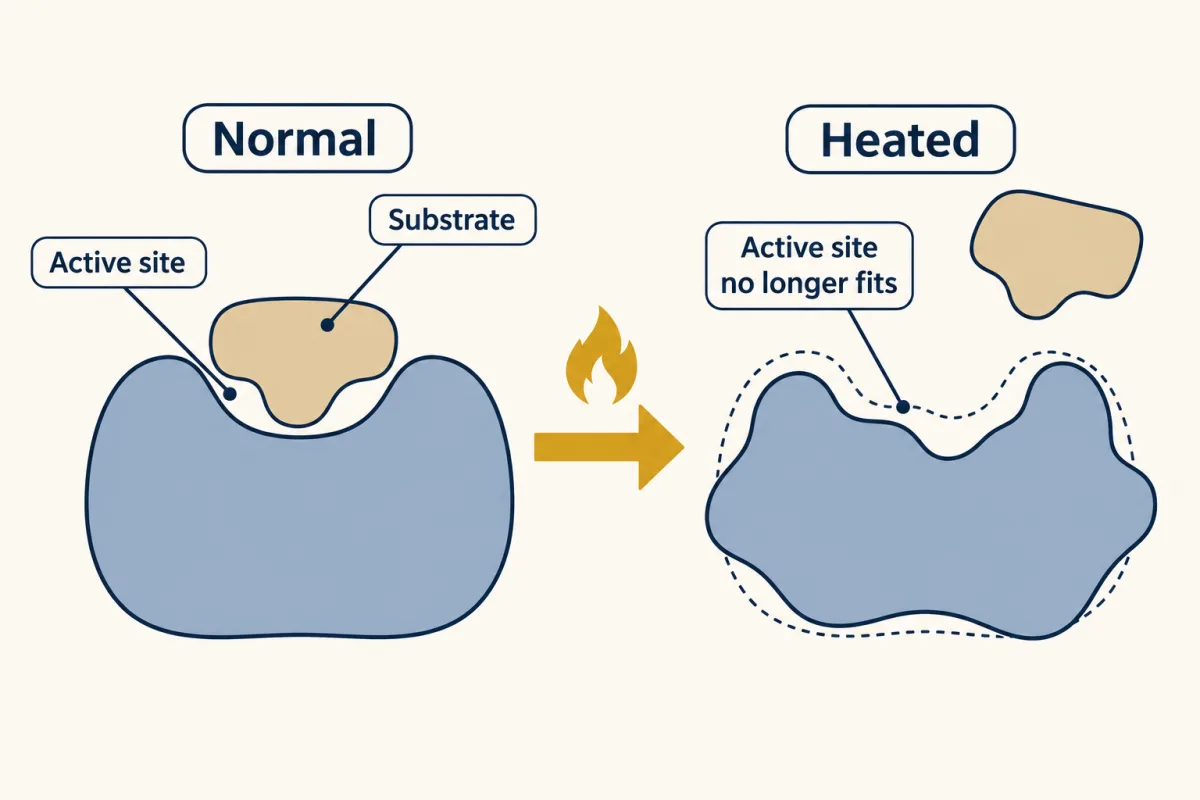
Heat does not kill an enzyme. It unfolds it, so the pocket no longer fits the substrate, and the damage is often permanent. AI-generated illustration -
Explain: more substrate, until the sites are full
-
Elaborate: an enzyme tested at five temperatures
-
Evaluate: check your thinking
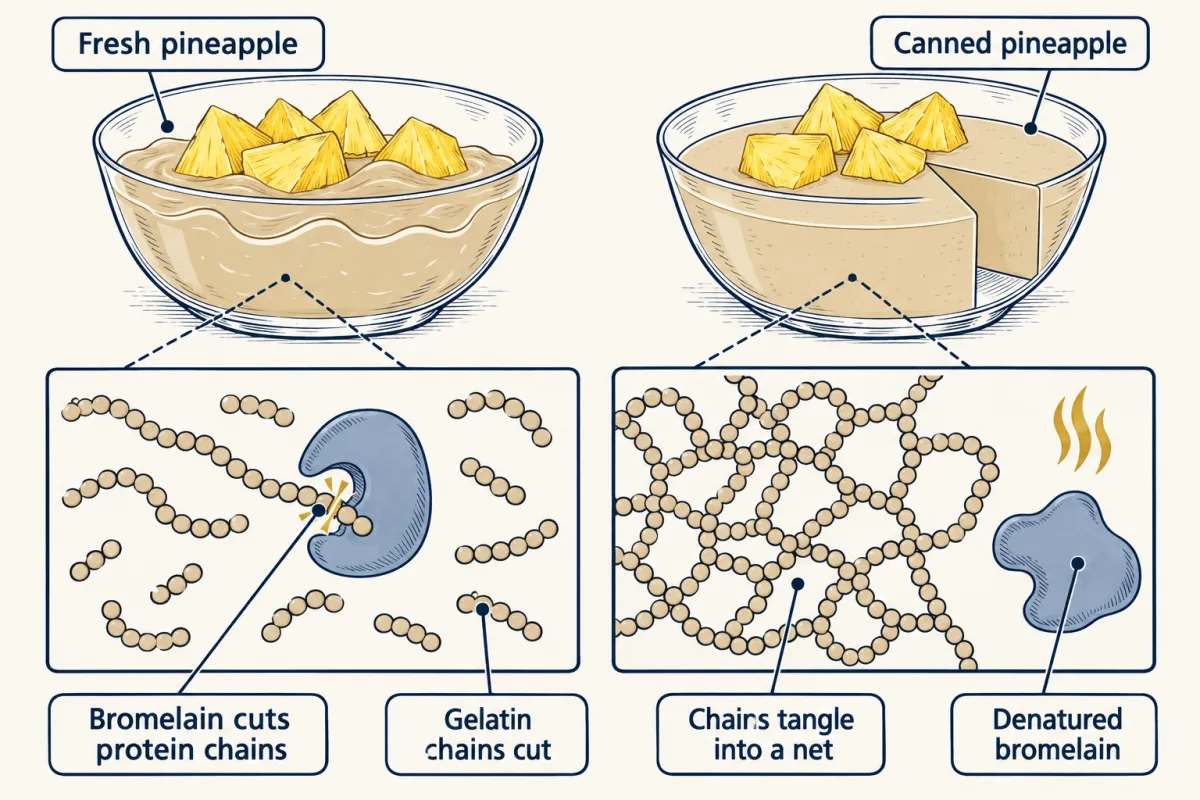
Bromelain in fresh pineapple cuts gelatin's protein chains, so they cannot link up into a net. Canning heats the fruit and denatures bromelain, so the gelatin sets. AI-generated illustration -
Going deeper
Where this lesson fits
Before thisReview first
- What Am I Made Of?This course · Lesson 2
You need to know enzymes are proteins folded from amino acids, so heat and pH can change their shape.
After thisStudy next
- Respiration and ATPThis course · Lesson 5
Respiration is a chain of enzyme-catalysed steps, so rate, temperature and working sites apply directly.
- Homeostasis in ActionThis course · Lesson 9
Keeping body temperature and pH steady matters because enzymes stop working well when either drifts too far.
- From DNA to ProteinThis course · Lesson 18
This lesson shows how one changed amino acid can alter a protein's shape and stop it working.
Elsewhere on the siteFilms, simulations and method films in other courses
- Spectrophotometry and enzyme kineticsMethod film
Measuring how fast product forms is how enzyme rates are read from data like the temperature set here.
Suggested by an AI model from the lessons themselves, then checked. How we use AI