Cell Biology · Skim version
Endocytosis, Recycling and Degradation
Read the full lesson → Skim the whole course →
The guiding idea
Why can a patient's cells grip cholesterol-carrying LDL normally and still leave most of it on the surface?
How does a cell take in a particle it needs, keep the receptor that caught it, and destroy the particle?
From the film: A Loop and a One-Way Trip
- For the LDL receptor, the receptor runs a loop and its LDL makes a one-way trip to the lysosome.
- Adaptors hold the receptor tails and the membrane; clathrin builds the cage, and dynamin cuts the neck.
- In the mildly acid early endosome, LDL lets go of its receptor, and their paths split.
- Empty receptors return to the surface in tubules; the LDL goes on to a lysosome to be broken down.
- Follow one batch of LDL receptors round the loop: losing binding or entry stops its later handling, but a release defect only reduces return.
From the film: The Receptor That Does Not Come Back
- Some receptors, such as many activated growth-factor receptors, are meant to be destroyed, not reused.
- A ubiquitin tag marks such a receptor, and ESCRT complexes at the endosome recognize the tag.
- ESCRT sorts tagged receptors into vesicles that bud into the endosome's lumen, making a multivesicular body.
- When it fuses with a lysosome, the inner vesicles are digested, receptors and all.
- In the cultured human cells tested, PCSK9 sends the LDL receptor to the lysosome instead of back to the surface.
-
The record: binding, then uptake, read in order
-
Entry: adaptors choose, clathrin cages, dynamin cuts
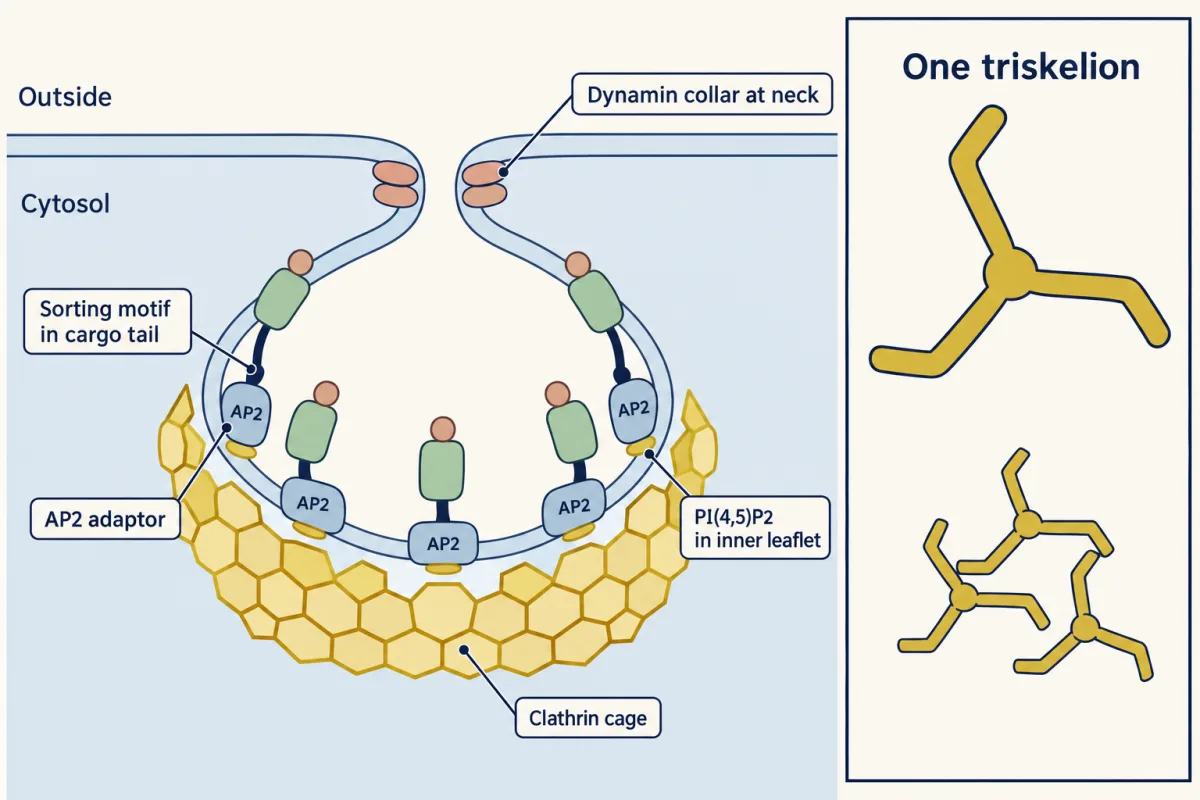
Clathrin builds the cage, but adaptors do the binding: AP2 reaches the membrane lipid PI(4,5)P2 and cargo tails, and the cage is made of three-legged triskelia. Dynamin gathers at the narrow neck. AI-generated illustration -
The fork: acid parts receptor from cargo
-
Return: the loop closes, or runs down
-
When the receptor itself is the cargo
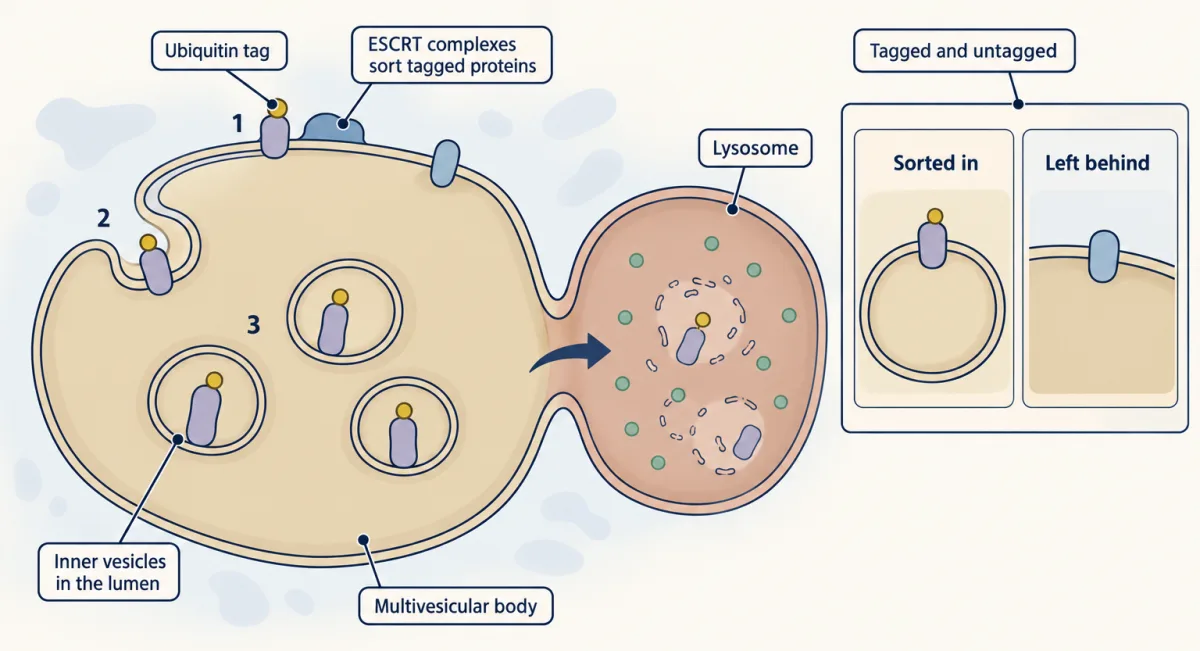
In a multivesicular body, ESCRT complexes sort ubiquitin-tagged proteins into vesicles that bud into the lumen. When the body fuses with a lysosome, those inner vesicles are digested. AI-generated illustration -
Other doors into a cell
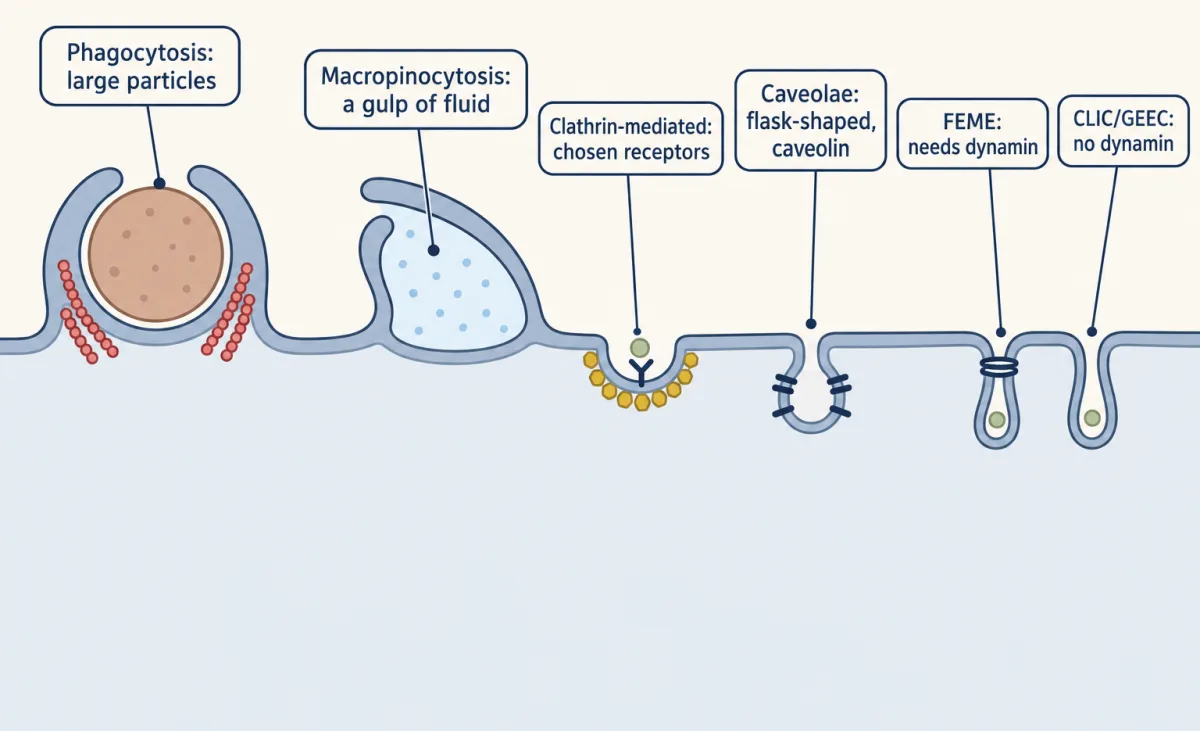
Cells have several doors, and each has its own machinery. Clathrin-independent does not mean caveolar: FEME and CLIC/GEEC are separate routes. AI-generated illustration -
Going deeper
Where this lesson fits
Before thisReview first
- Vesicle Budding, Targeting and FusionThis course · Lesson 11
This lesson reuses coated vesicle budding, Rab identity and fusion with endosomes without re-teaching them.
- Organelles as Distinct EnvironmentsThis course · Lesson 6
You need proton pumps setting endosome and lysosome pH to see why acid makes LDL let go of its receptor.
- Protein Sorting into CompartmentsThis course · Lesson 7
Short tail motifs read by adaptors, like the NPXY motif here, build on how signals sort proteins.
After thisStudy next
- Cell Identity, Cell State and DiseaseThis course · Lesson 25
Classifying a receptor defect at binding, entry or return carries over to reading how cell state and mutations produce disease.
Elsewhere on the siteFilms, simulations and method films in other courses
- Shape is destinyFilm · Biochemistry
It covers cholesterol as a membrane lipid, the cargo LDL delivers to cells.
- The cholesterol gaugeFilm · Biochemistry
It shows how LDL import and cholesterol synthesis together control a liver cell's cholesterol supply.
Suggested by an AI model from the lessons themselves, then checked. How we use AI