Ecology and Evolution · Skim version
Integrative Evidence Workshop
Read the full lesson → Skim the whole course →
The guiding idea
Twenty negative PCR wells from one pond. Is the newt gone?
A run of negative eDNA tests never proves a species is absent: each independent negative water sample multiplies the occupied sites still hidden among the negatives by the chance an occupied site is missed, and wells from one sample cannot push that sample's detection above the chance the water holds DNA.
From the film: What a Negative Is Worth
- A negative eDNA result does not show that a species is absent: DNA can be missed in the water, in the extraction or in the qPCR well.
- Together, the three steps set q, the chance that one water sample detects an occupied pond: its water must hold DNA, and at least one extraction must capture it and have a well amplify it.
- Each independent negative sample multiplies the occupied sites still hidden among the negatives by that miss chance, while the empty sites stay put, so the probability of occupancy falls with every new sample but, as long as a sample can sometimes detect and sometimes miss, never reaches zero.
- That probability is the hidden occupied sites divided by all the sites that tested negative, so it also depends on how likely occupancy was before sampling (the prior).
- The count assumes no false positives and a site that stays occupied or empty for the whole survey.
From the film: Wells Share One Scoop
- Wells and extractions from one water sample all test that sample's water: they are second chances at the lab steps, not new tries at the scoop, so they cannot detect DNA the sample does not contain.
- However many wells you add, one sample's chance of detecting an occupied pond cannot exceed θ (theta), the chance the water holds DNA.
- In this example, adding wells to two samples (two extractions each) leaves an all-negative pond above the 5% line; a third independent water sample brings it below.
- Counting wells as if they were separate field samples is pseudoreplication: it makes a pond look emptier than the evidence shows.
-
What eDNA detects and what it misses
-
Detection probability and an all-negative site
-
Sampling design: field replicates versus PCR replicates
-
What a positive can and cannot mean
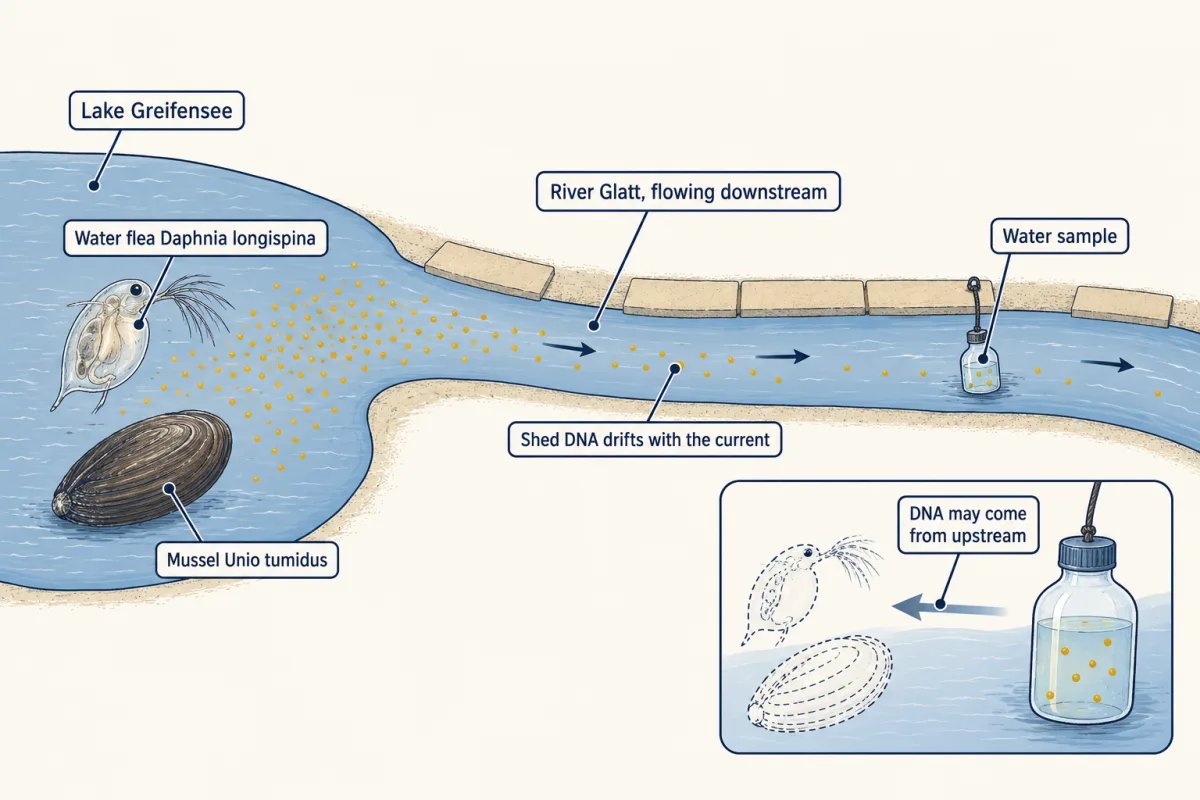
In the river Glatt below Lake Greifensee, Deiner and Altermatt detected DNA of lake-dwelling animals in the river, so in flowing water a sample can carry DNA from upstream. A positive tells you about the water, not only about the spot where the bottle was filled. AI-generated illustration -
Reproducible analysis and the decision
-
Whose data? CARE and FAIR
-
Going deeper
Where this lesson fits
Before thisReview first
- Movement and Spatial PopulationsThis course · Lesson 15
It explains that a patch can be occupied or empty and that occupancy changes over time, the idea the occupancy count builds on.
- Conservation and RestorationThis course · Lesson 25
It sets up why deciding whether a rare species is still present matters for management decisions.
- Global Change: Species on the MoveThis course · Lesson 24
The detection question here is posed for species whose ranges shift, which is where this lesson's background starts.
Elsewhere on the siteFilms, simulations and method films in other courses
- Pedigree analysisMethod film
It shows the same Bayesian step of turning a prior and a negative result into a probability of carrying or being present.
- Experimental units, pseudoreplication and powerMethod film
It teaches why replicates from one sample are not independent units, the pseudoreplication point of this workshop.
Suggested by an AI model from the lessons themselves, then checked. How we use AI