Cell Signaling · Skim version
Death Receptors, BCL-2 and Caspases
Read the full lesson → Skim the whole course →
The guiding idea
The protein that carries electrons in your mitochondria is also the order for a cell to destroy itself.
How does a cell keep a machine for its own destruction ready to fire within hours, and never fire it by accident?
-
The idea: a cell can die by accident or by program
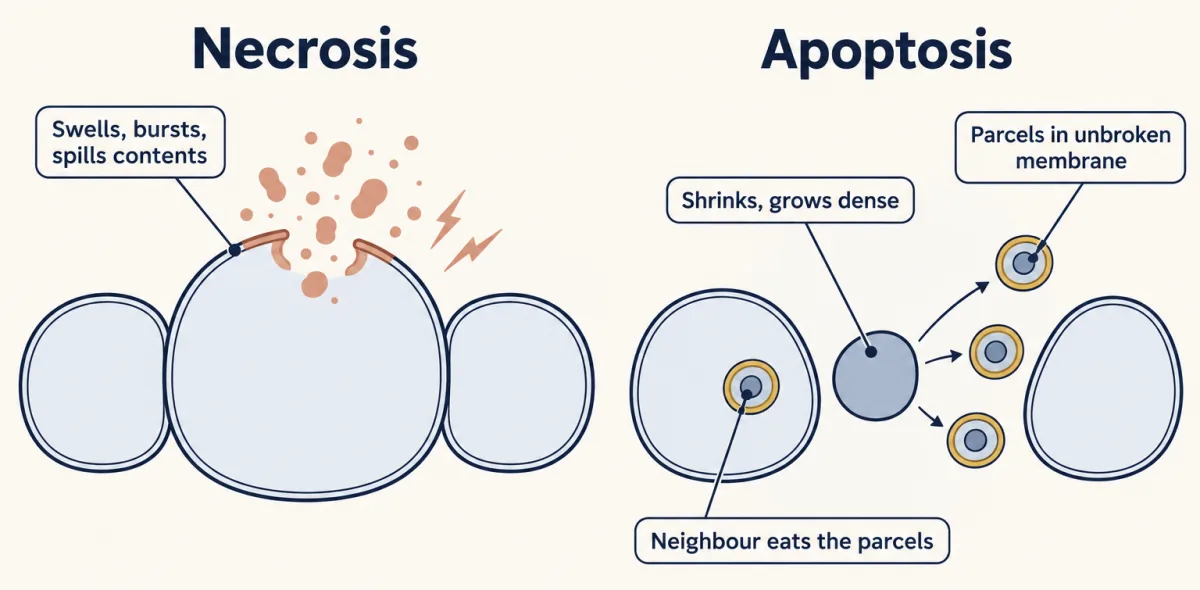
Two deaths in one tissue. A necrotic cell swells, bursts and spills, and the spill often causes inflammation. An apoptotic cell shrinks, grows dense and breaks into membrane-wrapped parcels that neighbours eat, and usually no inflammation follows. AI-generated illustration 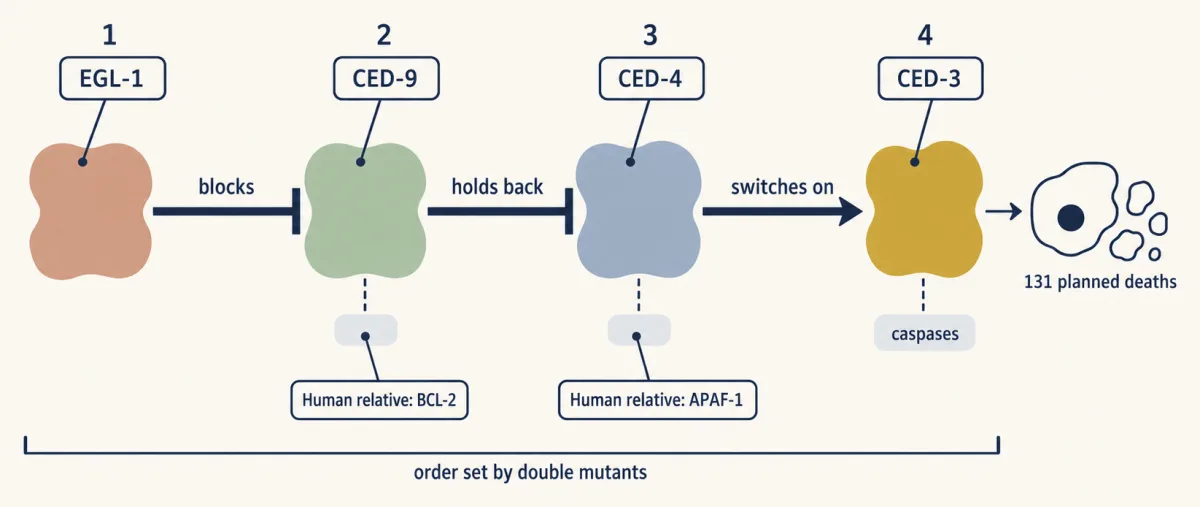
In the worm, EGL-1 blocks CED-9, CED-9 holds back CED-4, and CED-4 switches on CED-3. Double mutants set that order, and each gene has human relatives. AI-generated illustration -
The killer is an enzyme kept as a precursor
-
Killed from outside: a death receptor gathers caspase-8
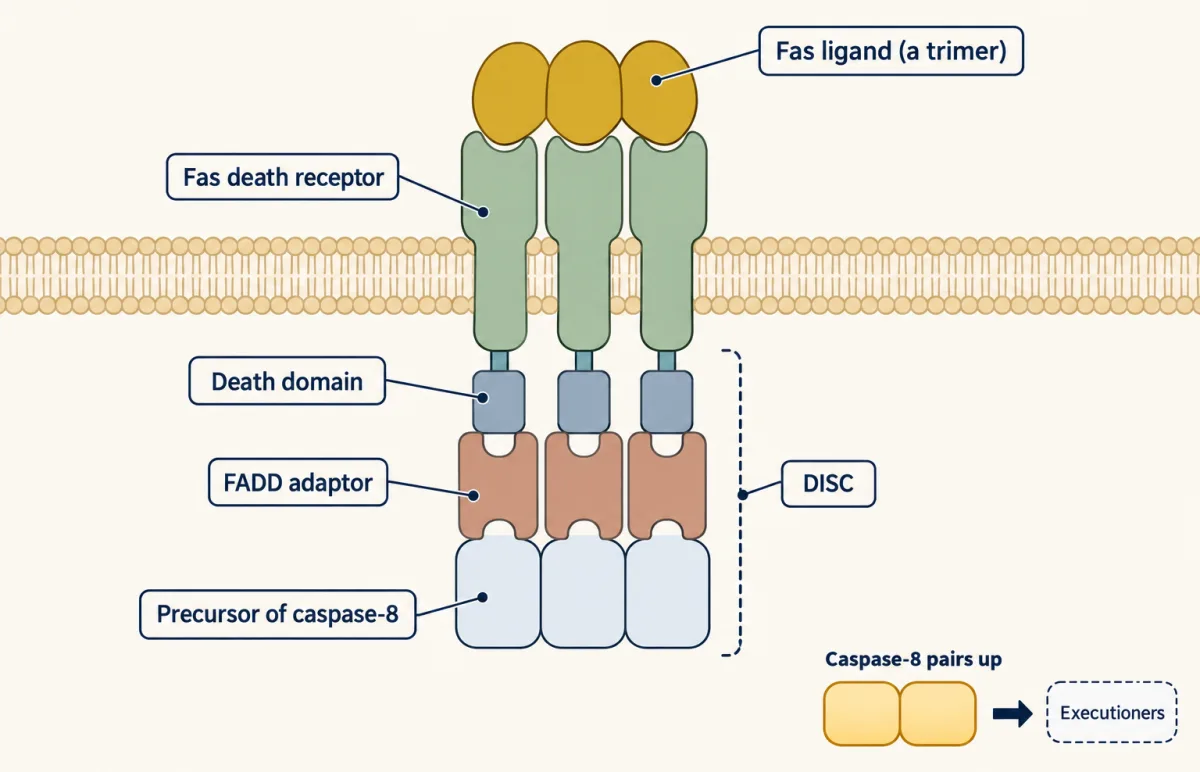
A trimeric Fas ligand clusters Fas. FADD, with a death-domain end and a death-effector-domain end, joins the clustered tails to the precursor of caspase-8, and copies of caspase-8 side by side pair up and become active. Counts here are schematic. AI-generated illustration -
Killed from inside: a series of checks and balances
-
When the brakes are too strong, or the machinery is missing
Where this lesson fits
Before thisReview first
- Stress Signals: p38 and JNK, p53, Unfolded Proteins and OxidantsThis course · Lesson 33
p53 switching on PUMA and NOXA after DNA damage is the starting signal for the inside route here.
- Adaptors, Docking Proteins and ScaffoldsThis course · Lesson 10
FADD and the DISC work as adaptors with two binding ends, as taught there.
After thisStudy next
- Endocytosis and Signaling EndosomesThis course · Lesson 36
Death receptors such as Fas can be internalised, and this lesson's DISC signal can then continue from endosomes.
- Hacking the Cell: Reporters, Actuators and Genetic ToolsThis course · Lesson 44
Reporters and tools like these are used to watch caspase activation and death in living cells.
- Oncogenes: When the Switch SticksThis course · Lesson 41
Excess BCL-2 in follicular lymphoma is a block on death that turns a cell toward cancer.
Elsewhere on the siteFilms, simulations and method films in other courses
- Cell death assaysMethod film
The lesson tells apoptosis from necrosis, which these assays do with annexin V, propidium iodide and TUNEL.
Suggested by an AI model from the lessons themselves, then checked. How we use AI