Physiology · Skim version
Control of Breathing, Altitude and Diving
Read the full lesson → Skim the whole course →
The guiding idea
Hold your breath and the urge that finally defeats you comes mostly from rising carbon dioxide rather than from falling oxygen. Why is the controller built that way?
Breathing has a rhythm generator in the medulla and a separate chemical controller that sets how fast and how deep that rhythm drives the muscles.
-
The loop: a sensor, a set point, a lever
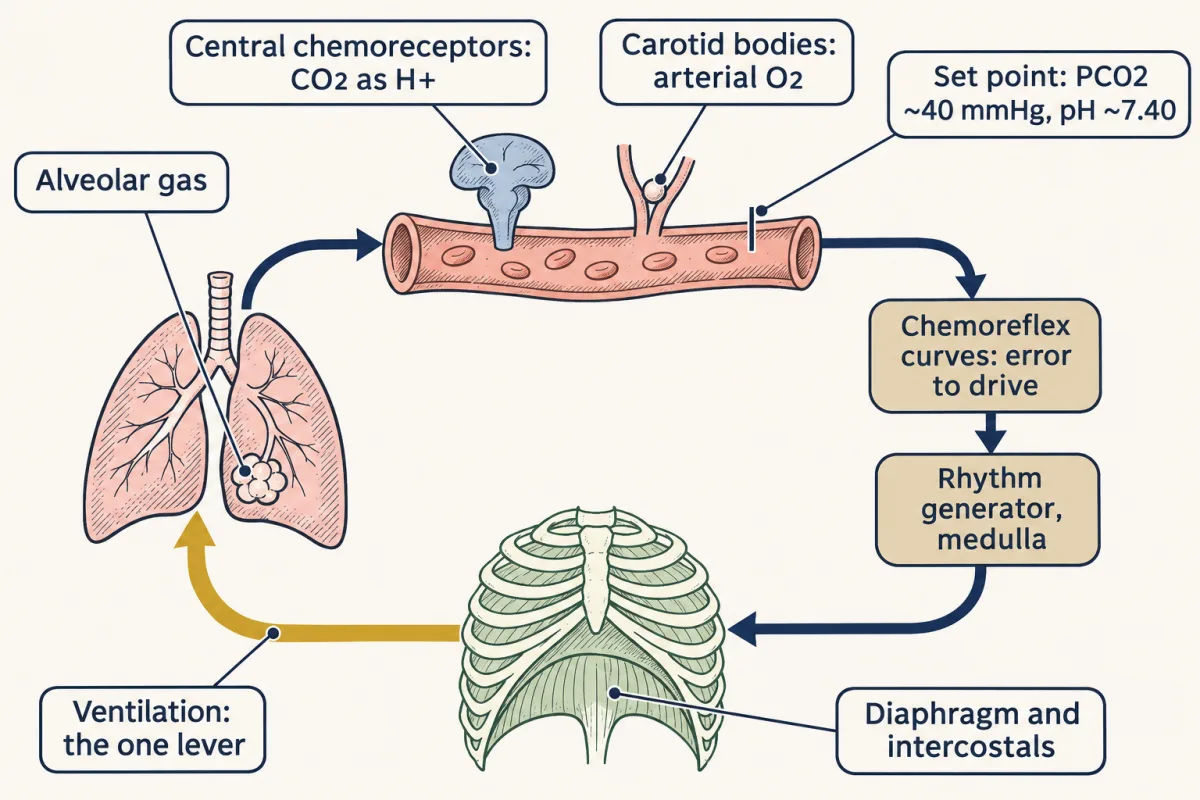
Breathing is a feedback loop whose only lever, ventilation, can change carbon dioxide and pH a great deal and oxygen content very little; each part of this lesson is one box in it. AI-generated illustration -
Why carbon dioxide runs the loop
-
Carbon dioxide is sensed as hydrogen ions, inside the brain
-
The carotid body is the oxygen sensor, and it is fast
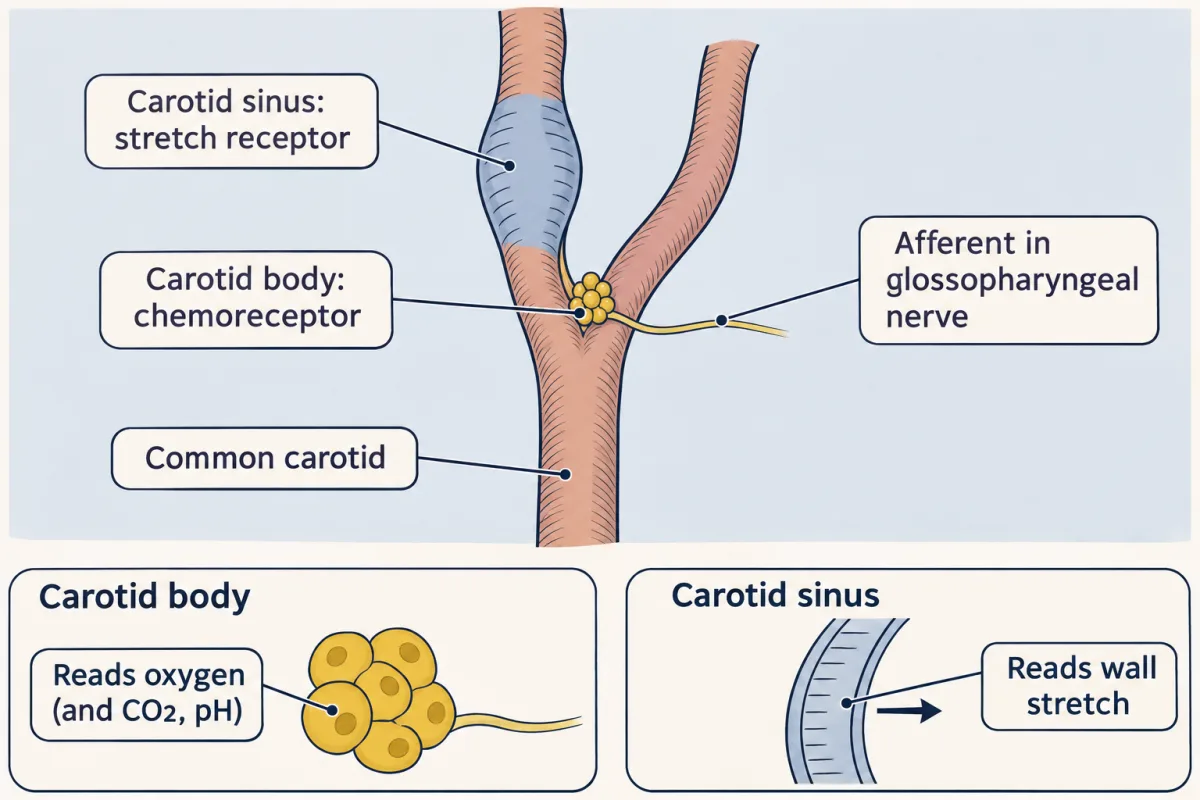
Same fork, same nerve, two organs: the carotid body samples blood gases and drives breathing, while the carotid sinus senses wall stretch and reports pressure. AI-generated illustration -
Reading the response curves: two gains
-
The clock: the rhythm is made in the medulla
-
Altitude: the same lever, in a better place
-
Diving: the loop with the lever taken away
-
Going deeper
Where this lesson fits
Before thisReview first
- Ventilation, Perfusion and Gas ExchangeThis course · Lesson 13
It derives the alveolar gas equation used here to work out alveolar oxygen and what extra ventilation buys.
- Lung Mechanics and SurfactantThis course · Lesson 12
The diaphragm and intercostal muscles it covers are the effectors the breathing controller drives.
After thisStudy next
- Acid-Base BalanceThis course · Lesson 18
Ventilation sets arterial PCO2, one of the two terms that fix pH, which that lesson works out in full.
- Skin, Sweat and Human ThermoregulationThis course · Lesson 26
The diving response from this lesson is taken up there with the thermoregulation story.
- Exercise: The Whole Body at WorkThis course · Lesson 30
It uses this ventilatory control loop to explain how breathing responds to exercise.
Elsewhere on the siteFilms, simulations and method films in other courses
- When the Body Pushes BackFilm · Biology
It shows a sensor, a set point and a lever working as a feedback loop, the same pattern as breathing control.
- Why Blood Needs an S-Shaped CarrierFilm · Organismal Biology
It shows how hemoglobin carries oxygen, which sets how much oxygen falls in the blood at altitude.
- The Last Gas the Blood TouchesFilm · Organismal Biology
It shows how partial pressure drives oxygen and carbon dioxide across the exchange surface, the basis of the alveolar oxygen calculation.
Suggested by an AI model from the lessons themselves, then checked. How we use AI