Biochemistry · Skim version
The Citric Acid Cycle: Harvesting Electrons
Read the full lesson → Skim the whole course →
The guiding idea
The citric acid cycle makes almost no ATP. Its real product is high-energy electrons.
The citric acid cycle makes almost no ATP itself, just one GTP (or ATP) per turn.
From the film
- For net bookkeeping, one acetyl group supplies eight electrons in four pairs.
- Each turn loads three NADH and one FADH2 but makes only one GTP (or ATP) directly.
- Oxaloacetate is regenerated, so it is a reusable platform in the simplest cycle.
- The cycle loads carriers, and the electron transport chain empties them.
- Oxygen is required indirectly because it accepts electrons at the chain's end.
-
Where we are, and what the cycle is for
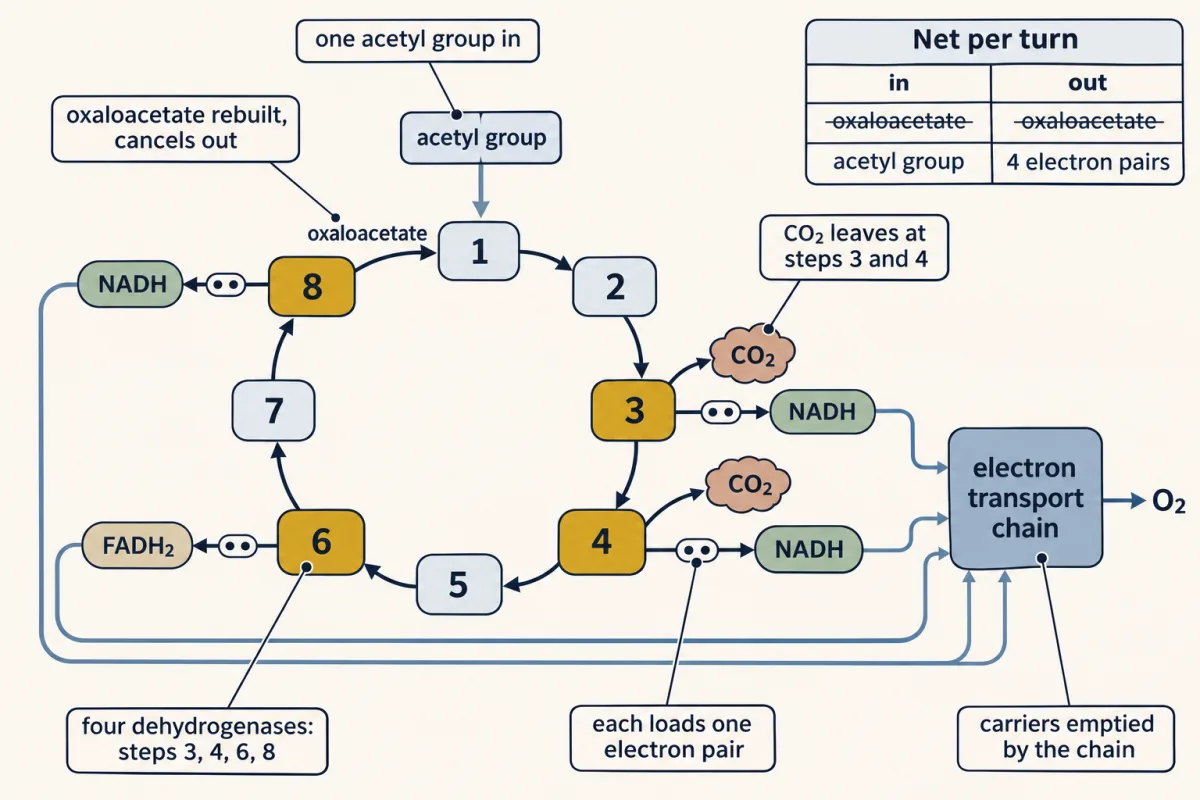
Follow the electrons. Each turn oxidizes one acetyl group: its eight electrons leave as four pairs, one at each dehydrogenase (steps 3, 4, 6 and 8), on three NADH and one FADH2. Oxaloacetate goes in at step 1 and comes back at step 8, so it cancels from the net equation. The carriers must be emptied by the electron transport chain before they can be loaded again. AI-generated illustration -
Burn the fuel, then rebuild the machine
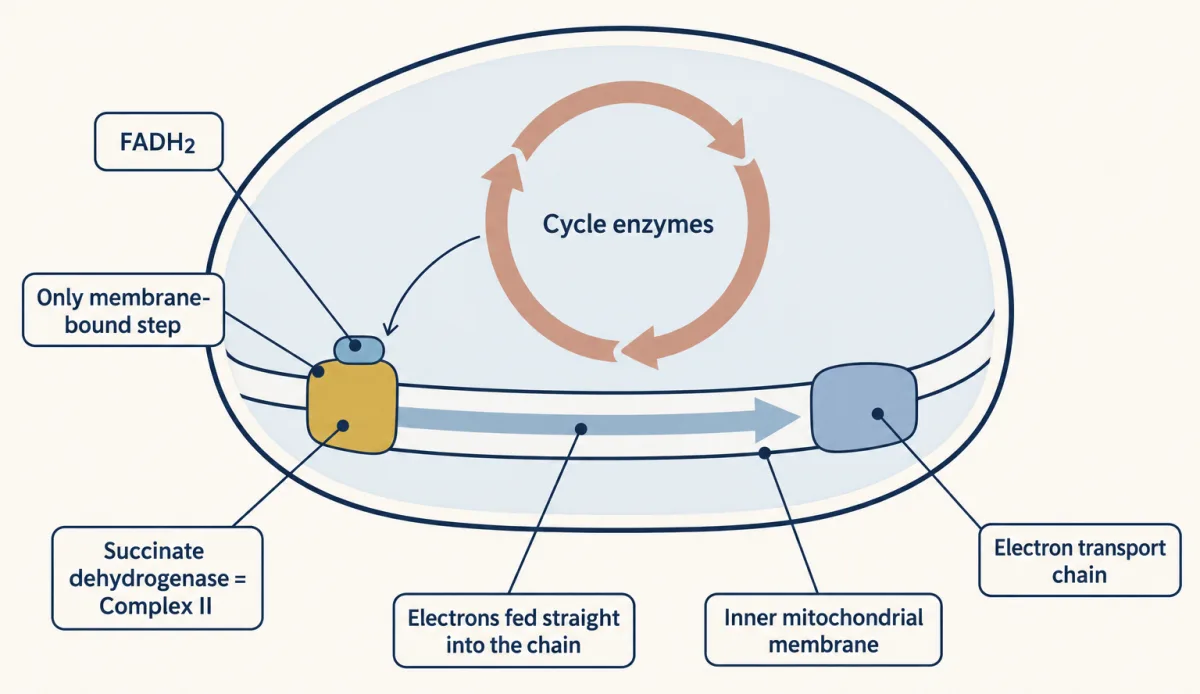
Succinate dehydrogenase is the cycle's only inner-membrane enzyme and is also Complex II of the electron transport chain. Its enzyme-bound FAD passes electrons through the complex to ubiquinone; the other cycle enzymes work in the matrix. AI-generated illustration -
Add it up: oxaloacetate cancels
-
Which carbons leave? A puzzle the net equation cannot answer
-
Oxygen and the throttle: one demand story
-
Cash the carriers
-
Where the catalyst rule stops: amphibolic and anaplerotic
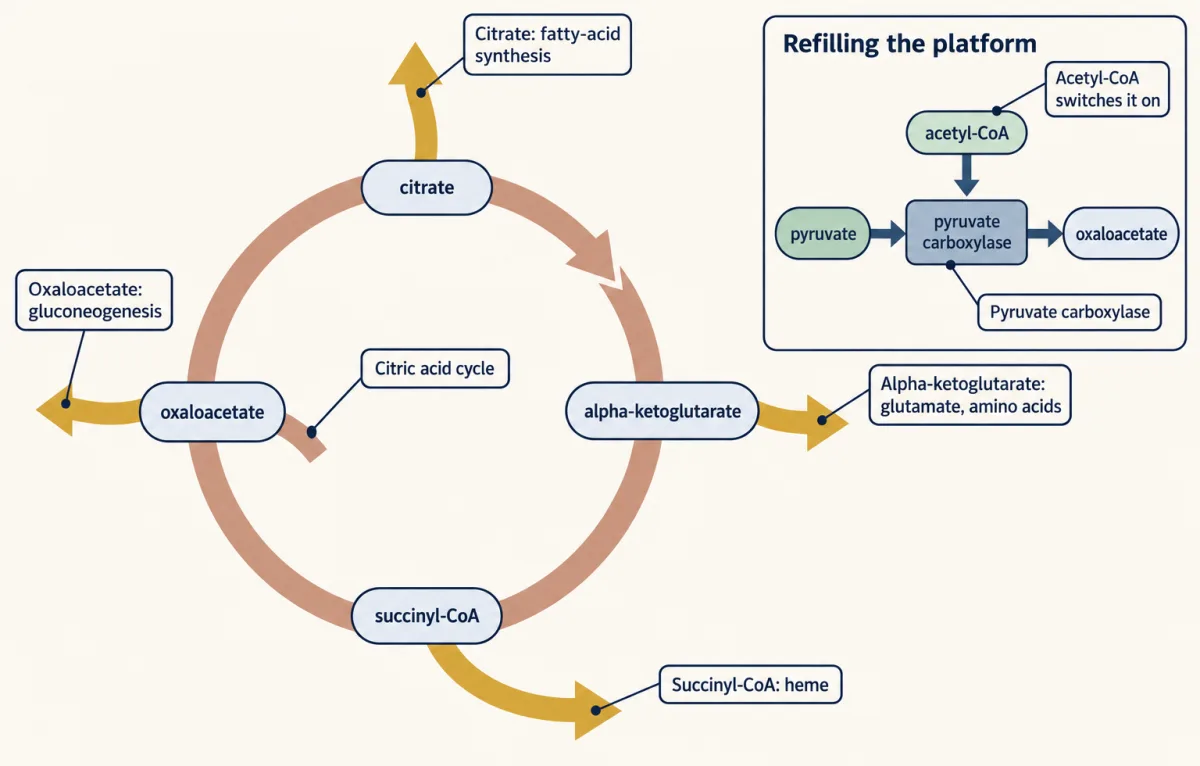
The cycle is amphibolic: its intermediates are siphoned off to build fatty acids, amino acids, heme and glucose. In many tissues pyruvate carboxylase is a major refill route, adding CO2 to pyruvate using ATP and activated by acetyl-CoA; glutamine is a major input in dividing cells. AI-generated illustration -
Going deeper
Where this lesson fits
Before thisReview first
- The Pyruvate Dehydrogenase Complex: The One-Way Gate to the CycleThis course · Lesson 18
It makes the acetyl-CoA that enters the cycle and works the same way as step 4 here.
- Glycolysis: The Investment-and-Payoff PathwayThis course · Lesson 16
It supplies the pyruvate and shows why NAD+ is the bottleneck that the cycle's carriers must solve.
- Metabolism: Basic Concepts and DesignThis course · Lesson 15
You need its ideas of electron carriers, coupling and oxidation state to follow how the cycle banks electrons.
After thisStudy next
- Oxidative Phosphorylation: The Electron-Transport ChainThis course · Lesson 20
The chain empties the NADH and FADH2 loaded here, and oxygen's role at its end is explained there.
- The Proton-Motive Force and ATP SynthaseThis course · Lesson 21
It turns the electrons from the cycle into ATP, completing the count of about 10 ATP per acetyl-CoA.
- Integration of Metabolism: How the Body Switches FuelsThis course · Lesson 30
It shows how the cycle's control points and drawn-off intermediates are set across fed and fasting states.
Suggested by an AI model from the lessons themselves, then checked. How we use AI