Sensory Systems · Skim version
When Pain Persists
Read the full lesson → Skim the whole course →
The guiding idea
After a nerve injury, a touch the animal used to ignore makes it pull away, and it keeps doing so for weeks. Is persistent pain an alarm that never switched off, or a nervous system that has changed?
After a nerve injury, pain can persist because the rules of the system change, and the alarm wiring is part of what changes.
From the film: A Touch That Hurts
- After a nerve injury, pain can persist because the rules of the system change, and the alarm wiring is part of what changes.
- In rodent models, the rodent sign of allodynia is a withdrawal threshold that falls and stays low.
- Most of this comes from rodent nerve-injury models; in people the evidence is association.
From the film: How Microglia Let a Touch Through
- In rats, nerve injury lowers KCC2 in lamina I neurons and shifts the anion reversal potential up, which weakens inhibition without turning it into excitation.
- In rats, a chain of tested links runs from microglial P2X4 to BDNF, TrkB and that shifted potential.
- In mice, the immune route to hypersensitivity can differ with sex, so ask which cell, in which sex, in which compartment.
From the film: A Reflex Is Not the Hurt
- A withdrawal reflex is easy to mistake for pain, because the reflex and the affective behaviour are two measurements that can come apart.
- In male mice, silencing a basolateral amygdala ensemble reduced escape and avoidance while withdrawal reflexes were preserved.
- In people, the evidence is prediction and association: baseline prefrontal-accumbens connectivity predicted persistence, which is not a cause.
-
The signature: a threshold that falls and stays down
-
The ganglion that will not stop firing
-
How a touch could now fire a pain neuron
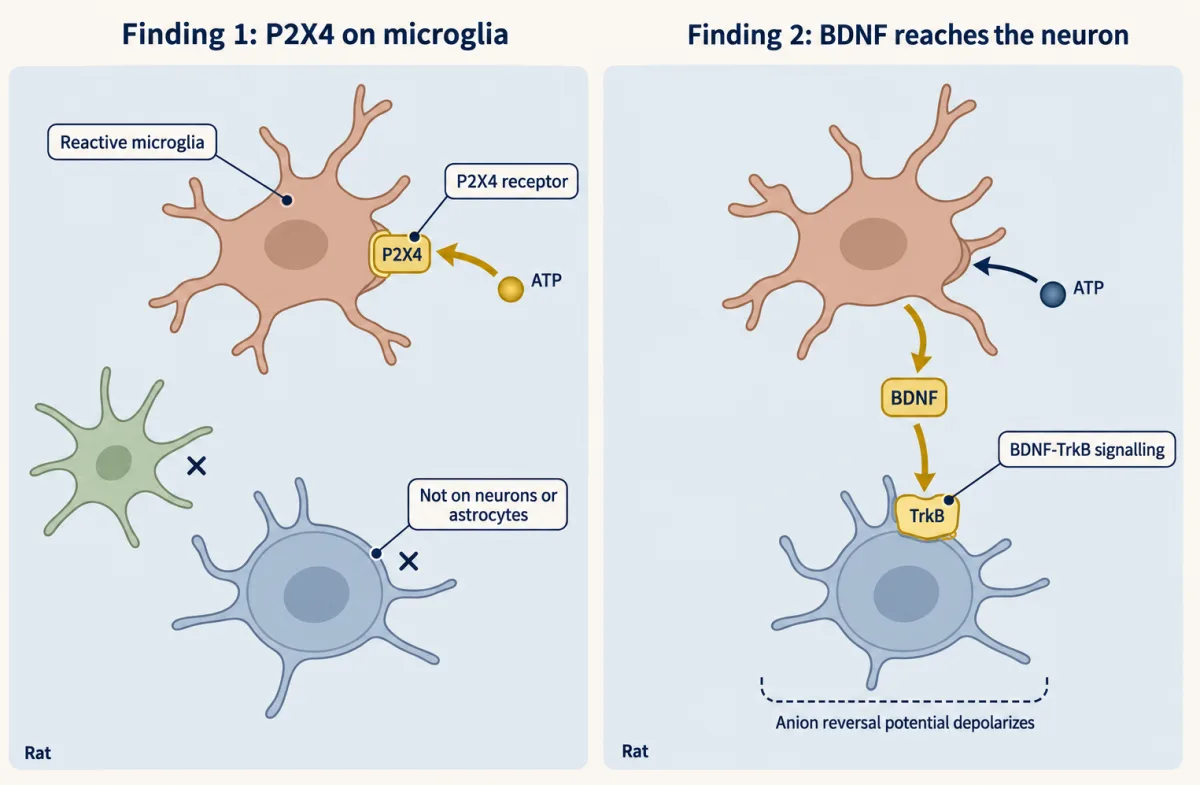
Two separate rat findings. Tsuda and colleagues found injury-induced P2X4 receptors on reactive spinal microglia, with none detected on neurons or astrocytes. Coull and colleagues showed that ATP-stimulated microglia release BDNF, which acts through TrkB to shift the anion reversal potential of lamina I neurons in a depolarizing direction. These findings do not establish the pathway in all rats or in humans. AI-generated illustration -
The twist: the chain depends on sex and compartment
-
A reflex is not the hurt
-
Predicting who stays in pain
-
Four words for pain, now that they mean something
-
Going deeper
Where this lesson fits
Before thisReview first
- Spinal Circuits That Gate PainThis course · Lesson 12
It teaches the dorsal-horn cell types and the KCC2 shift that this lesson builds its chain on.
- Nociceptors and the Sodium Channels of PainThis course · Lesson 11
You need to know what Nav1.7 does in nociceptors to read the ganglion expression changes here.
- Where Touch Is First Processed: Dorsal Horn and Dorsal Column NucleiThis course · Lesson 8
It explains how touch input is first processed in the dorsal horn, the route a light touch takes to a pain neuron.
After thisStudy next
- Proprioception: Sensing the Body's Own PositionThis course · Lesson 15
It continues the unit's study of how body signals are sensed, now for body position rather than pain.
- Combining Senses and Predicting ThemThis course · Lesson 29
It takes up how the brain predicts and weighs sensory reports, which bears on pain being more than reflex withdrawal.
Elsewhere on the siteFilms, simulations and method films in other courses
- One More RopeFilm · Neuroscience
It shows how an inhibitory synapse pulls voltage toward its reversal potential, the rule used here for the shifted anion reversal.
Suggested by an AI model from the lessons themselves, then checked. How we use AI