Physiology · Skim version
Cardiac Output and Venous Return
Read the full lesson → Skim the whole course →
The guiding idea
The heart cannot pump out more blood than flows back in. So what sets cardiac output: the heart, or the veins?
The heart cannot pump out more blood than flows back to it, so neither the heart nor the veins set cardiac output alone: output and right atrial pressure settle where the heart's line and the veins' line cross.
-
A first look at the two lines
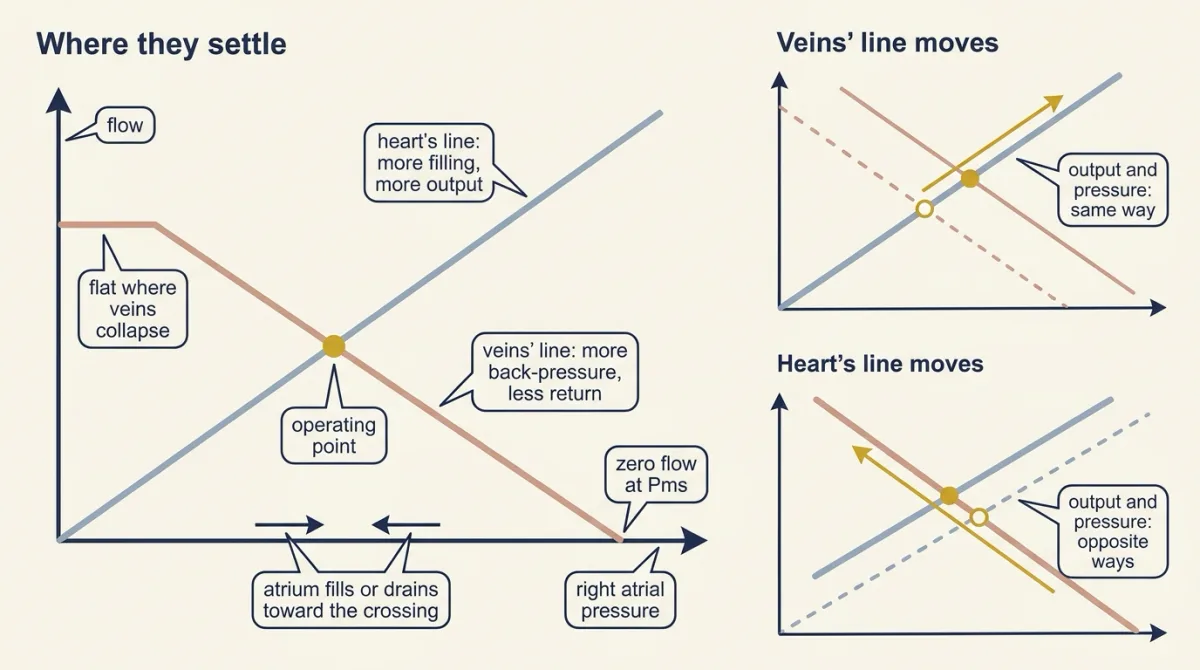
Output and right atrial pressure settle where the heart's rising line crosses the veins' falling line; move only the veins' line and the crossing slides along the heart's line (both change the same way), move only the heart's line and it slides along the veins' line (they change opposite ways). AI-generated illustration -
The veins’ line
-
Where the pump meets the veins
-
Moving the operating point
-
Counting the flow: where the 5 litres comes from
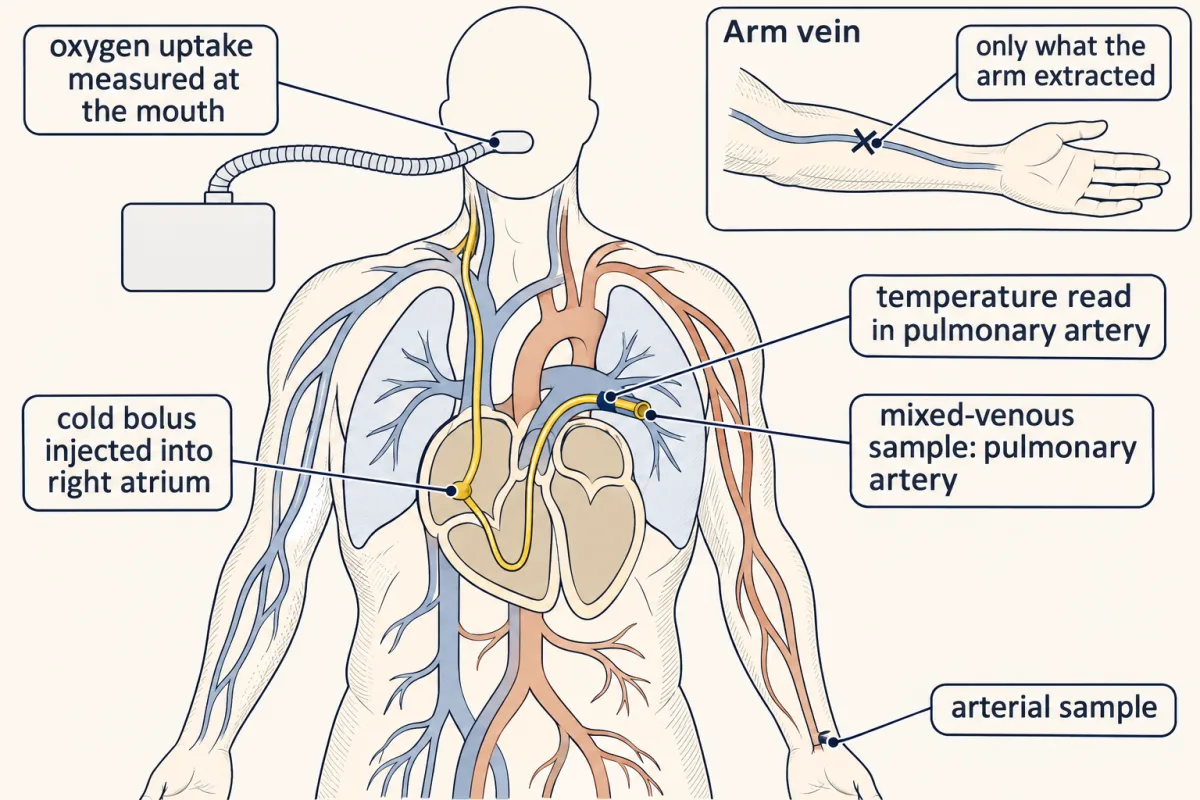
Both methods count litres from what the blood carries: the Fick method needs oxygen uptake, arterial blood and mixed-venous blood from the pulmonary artery (an arm vein reports only the arm), and thermodilution injects cold into the central veins (here the right atrium) and reads it in the pulmonary artery. AI-generated illustration -
Design problem: cause or consequence?
-
Going deeper
Where this lesson fits
Before thisReview first
- The Cardiac Cycle and Pressure-Volume LoopsThis course · Lesson 6
You need preload, contractility and afterload from there to draw the heart's line.
- Smooth Muscle and the Myogenic ResponseThis course · Lesson 4
Venoconstriction by smooth muscle raises stressed volume, which moves the veins' line here.
- Circulation and the HeartOrganismal Biology · Starting college
It gave cardiac output as heart rate times stroke volume and the Frank-Starling relation used here.
After thisStudy next
- Regulating Arterial PressureThis course · Lesson 10
Reflex changes in heart and vessels move these two lines to hold arterial pressure steady.
- Resistance, Compliance and Local Blood FlowThis course · Lesson 8
It develops resistance and compliance in the vessels that set Rvr and Pms.
- Exercise: The Whole Body at WorkThis course · Lesson 30
Exercise output is explained by moving both lines, and its oxygen uptake is counted by the Fick principle.
Suggested by an AI model from the lessons themselves, then checked. How we use AI