Physiology · Skim version
Blood Cells, Hematocrit and Clotting
Read the full lesson → Skim the whole course →
The guiding idea
An endurance athlete can have a lower hematocrit than an untrained friend and more red cells. How?
What sets the fraction of your blood that is red cells, and how does a cut stop bleeding without the whole circulation clotting?
-
Hematocrit is a ratio, not a cell count
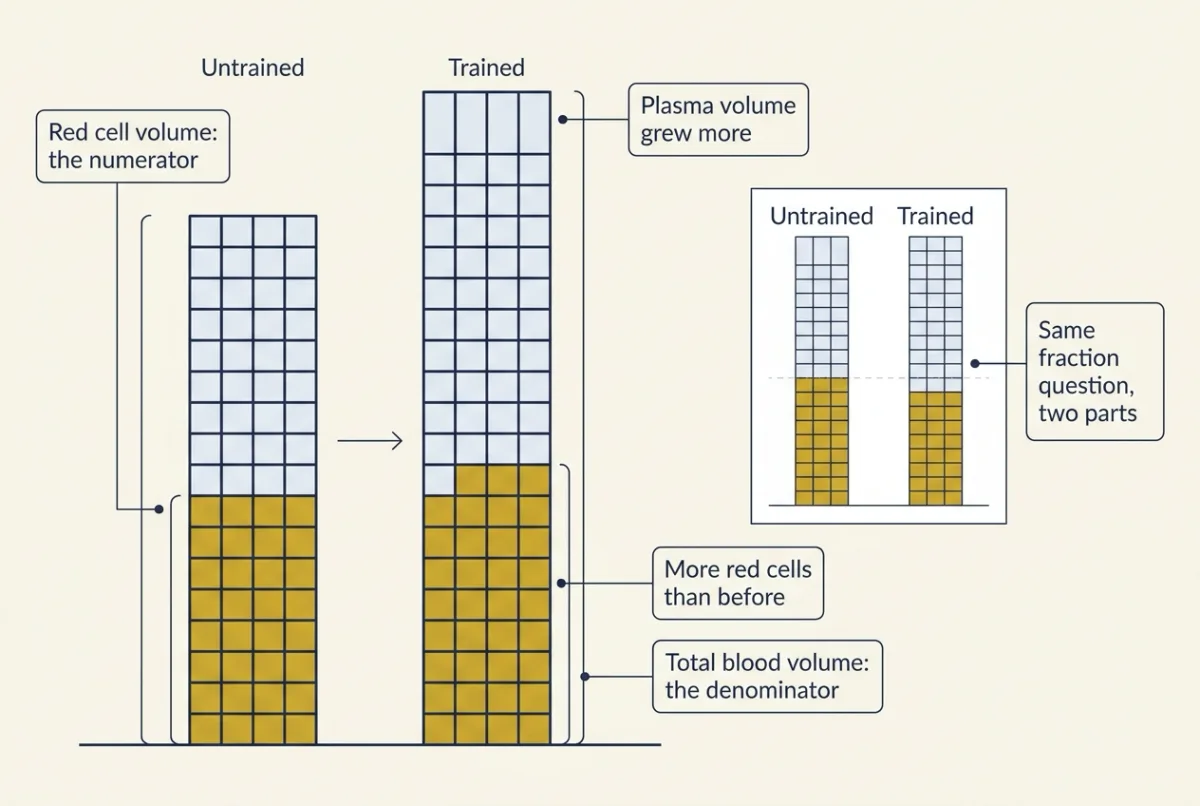
Training adds red cells and adds even more plasma, so the hematocrit falls while the red cell mass rises: the ratio answers to its numerator and its denominator separately, and nothing in the body regulates the ratio itself. AI-generated illustration -
The kidney senses oxygen, not red cells
-
Red cells wear out and their iron comes back
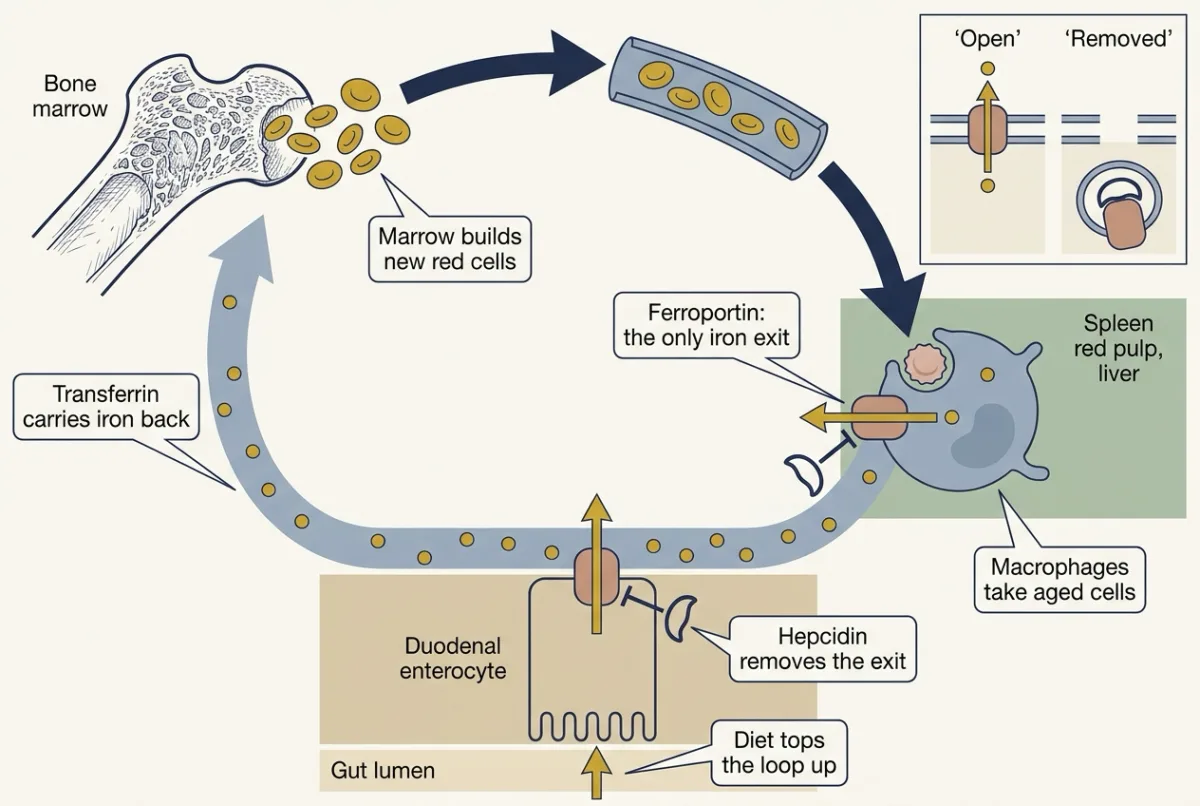
Iron runs in a loop from worn-out red cells back to the marrow, and hepcidin controls the whole loop through its one exporter, ferroportin, which sits at both exits. AI-generated illustration -
Two highland peoples, two answers to thin air
-
A cut seals while the circulation does not
-
Trickle, then burst: why thrombin is made twice
-
Two tubes, then hemophilia
-
One drug, one target
-
Going deeper
Where this lesson fits
Before thisReview first
- Body Water and Its CompartmentsThis course · Lesson 1
You need plasma volume and how it is measured there to separate dilution from a true change in red cell mass.
After thisStudy next
- Pregnancy, Birth and LactationThis course · Lesson 29
Pregnancy expands plasma more than red cells, which is the dilution case of hematocrit applied here.
- Control of Breathing, Altitude and DivingThis course · Lesson 14
The early altitude rise in hematocrit from shrinking plasma is worked through there, along with the oxygen signals driving it.
- Exercise: The Whole Body at WorkThis course · Lesson 30
Hemoglobin mass by carbon monoxide rebreathing and oxygen delivery in training take the red cell mass idea further.
Elsewhere on the siteFilms, simulations and method films in other courses
- Why Blood Needs an S-Shaped CarrierFilm · Organismal Biology
It shows how hemoglobin in red cells raises the oxygen the blood carries.
- Bomb-pulse carbon-14 dating of cellsMethod film
It dates when cells were born, which bears on how long red cells last.
- Oxygen content and the Fick principleSimulation · Organismal Biology
It lets you vary oxygen content of blood, which depends on red cell hemoglobin.
Suggested by an AI model from the lessons themselves, then checked. How we use AI