Neuroscience · Skim version
Descending Control and the Basal Ganglia
Read the full lesson → Skim the whole course →
The guiding idea
A stroke deep in the left hemisphere weakens the right side. A cut in the right half of the neck weakens the right side too. Why?
Follow a motor chain from a lesion or a drug toward the muscle and count two things: crossings of the midline set the side of the effect, and inhibitory links set its sign.
From the film: Two Counts: Side and Sign
- Count the midline crossings between a lesion and the muscle: each crossing flips the side of the effect.
- Each inhibitory link flips the sign, so an even number keeps the direction and an odd number reverses it, and inhibiting an inhibitor releases its target.
- The counts give the direction of a change along one chosen path, not its size, and they fail when routes pull in opposite directions.
From the film: The Brake and Its Two Routes
- In the classic model, GPi fires steadily and holds the thalamus down like a brake, and movement needs the brake lifted.
- The direct route has two inhibitions and pushes toward movement, and the indirect route has three and pushes away from it.
- In the classic model, dopamine loss weakens the direct route and strengthens the indirect one, so the brake fires more and movement is hard to start.
From the film: The Test: Silence the STN
- In the classic model, silencing the STN lifts the brake, so movement should improve on the side opposite the lesion.
- In MPTP-treated monkeys, lesioning the STN improved parkinsonian signs on the side opposite the lesion, as the count predicted.
- The count has limits: in mice both pathways become active together at action onset, and the model gives no account of rest tremor.
-
Three puzzles
-
Counting crossings: the corticospinal tract
-
Counting inhibitions: the basal ganglia brake
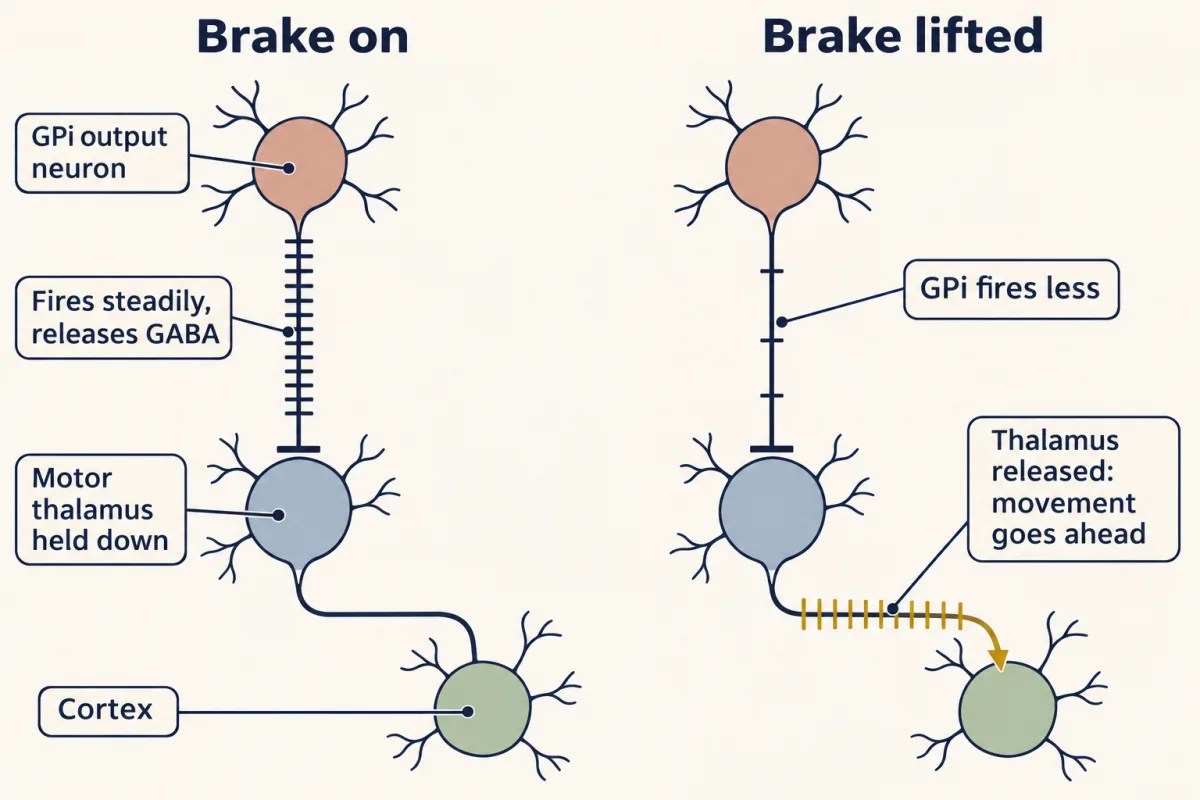
In the classic model, GPi fires steadily and holds the motor thalamus down; when GPi fires less, the thalamus is released and movement goes ahead. AI-generated illustration -
Both counts together: silencing the STN
-
Parkinson’s and Huntington’s through the circuit
-
Where the box model breaks
-
Going deeper
Where this lesson fits
Before thisReview first
- Motor Units, Reflexes and LocomotionThis course · Lesson 15
It teaches lower motor neurons and the reflex arc, which you need to tell upper from lower motor neuron signs.
- Integration, Inhibition and NeuromodulationThis course · Lesson 7
It explains how inhibitory inputs lower a cell's firing, which the inhibition count along each route relies on.
- Transmitter Systems and DrugsThis course · Lesson 6
It covers GABA, glutamate and dopamine receptors, which set the sign of each link in the circuit.
After thisStudy next
- The CerebellumThis course · Lesson 17
It adds the other big loop that shapes movement, and uses the same habit of following a motor chain by side.
- Feeding, Motivation and RewardThis course · Lesson 19
It takes the dopamine and striatum circuit further, from allowing movement to choosing actions by their value.
- When Mature Neurons Fail: NeurodegenerationThis course · Lesson 26
It asks why the dopamine neurons lost in Parkinson's disease die, which this lesson only assumes.
Elsewhere on the siteFilms, simulations and method films in other courses
- Adding up a reflexSimulation · Organismal Biology
The reflex route there lets you trace receptor, neuron and effector, the lower motor neuron end of the chain.
Suggested by an AI model from the lessons themselves, then checked. How we use AI