Organismal Biology · Skim version
Animal Reproduction
Read the full lesson → Skim the whole course →
The guiding idea
A monkey's pituitary, cut off from the brain's drive, was given its missing hormone either as a steady drip or once an hour, the drip giving at least as much. Only one schedule kept it working. Why would timing matter?
A mammal's gonads run on a loop the brain times: GnRH pulses from the hypothalamus drive LH and FSH, the pituitary answers the pulses and not only the total amount, and the gonads' hormones brake the loop except when estradiol stays high for long enough, becomes an accelerator and sets off ovulation.
From the film: A Loop That Keeps Time
- The hypothalamus releases GnRH in pulses, and the pituitary answers with two hormones, LH and FSH, that act on the gonads.
- In the testis, LH reaches Leydig cells, which make testosterone, and FSH reaches Sertoli cells, which support the developing sperm.
- Testosterone brakes the hypothalamus and pituitary, and inhibin B from Sertoli cells brakes FSH, so removing the testes makes LH and FSH rise.
- In the ovary, estradiol from the growing follicle brakes the loop through most of the cycle's first half; when it stays high for long enough, it becomes an accelerator. After ovulation, progesterone brakes.
From the film: Pulses, Not Amount
- Knobil's laboratory gave GnRH by pump to rhesus monkeys whose hypothalamus could no longer drive the pituitary.
- Brief infusions once an hour restored LH and FSH; a steady infusion, at rates giving at least as much GnRH each day, did not sustain them.
- Returning to hourly pulses brought secretion back, so the pituitary itself was still able to respond.
- In these monkeys the pituitary reads the timing of GnRH, not only its total; where the pulses come from, and why a steady supply fails, are separate questions.
-
Making sperm and eggs
-
The axis and its pulses
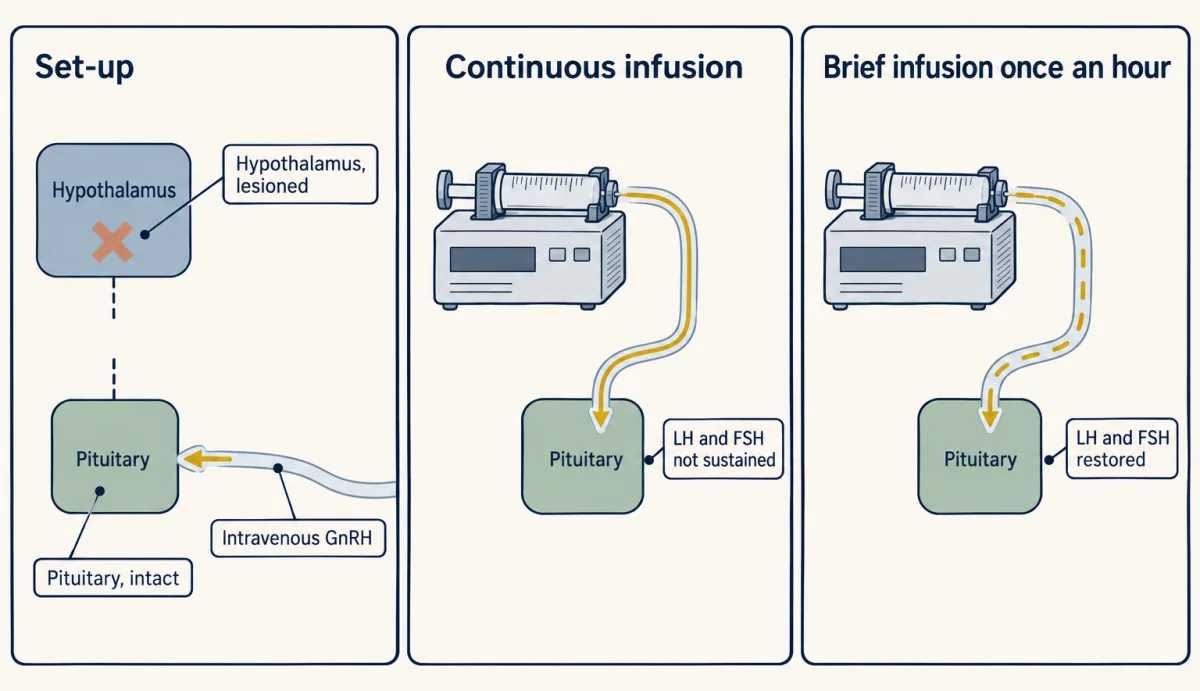
With the hypothalamic drive removed and the pituitary intact, only the experimenters set the GnRH pattern, so any difference between schedules is the pituitary reading that pattern. AI-generated illustration -
The cycle and pregnancy
-
The same job across animals
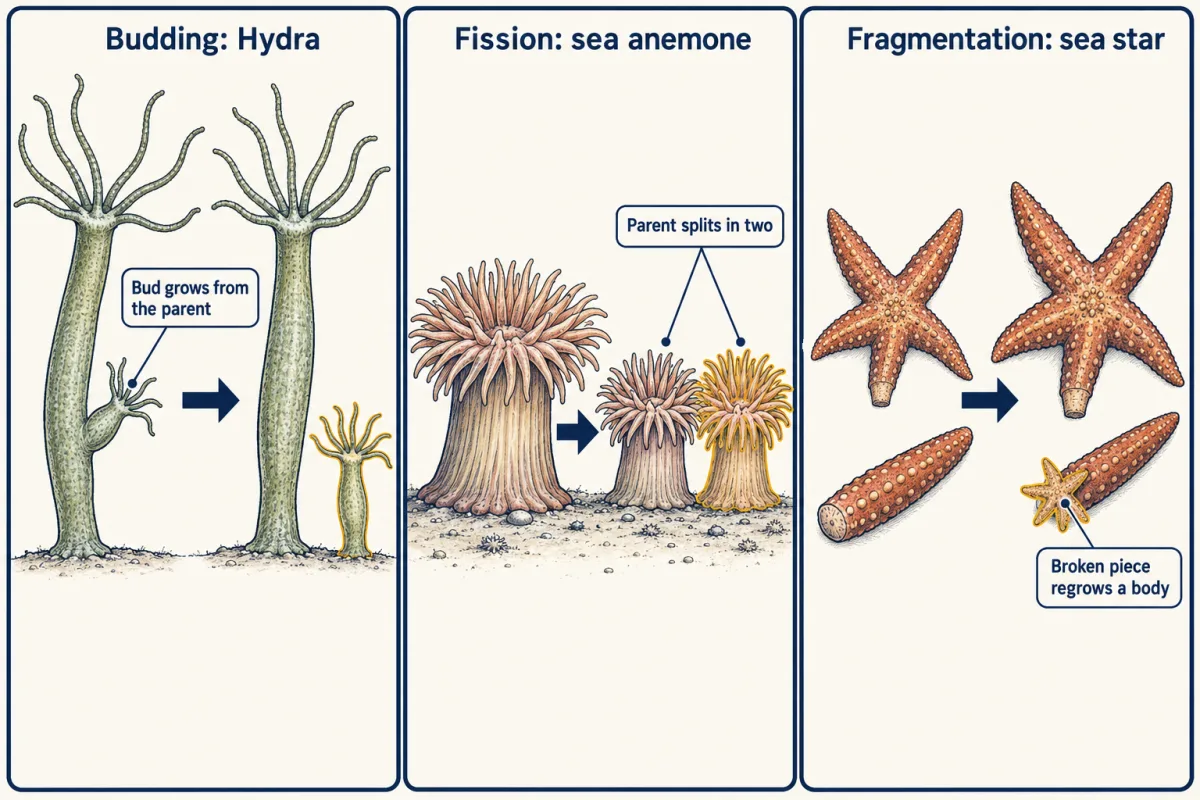
Three asexual modes, each with an animal the lesson names: budding in Hydra, fission in some sea anemones, and fragmentation in some sea stars. In each the new individual comes from one parent and carries its genes. AI-generated illustration 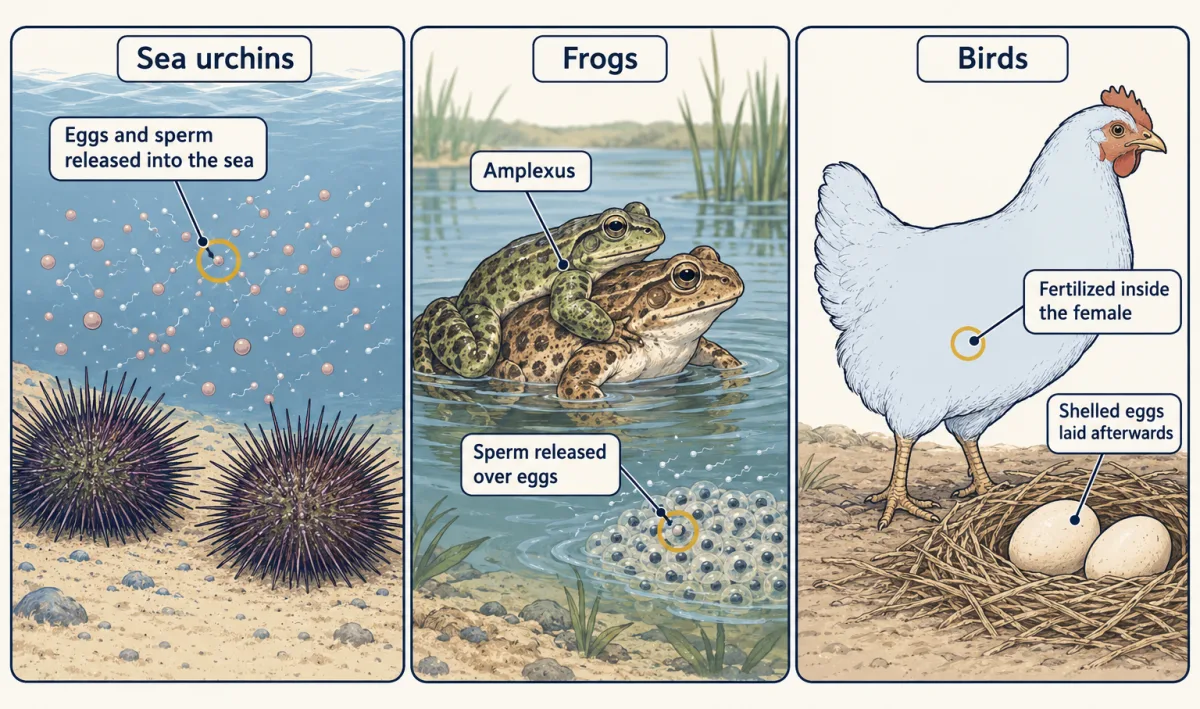
Fertilization can happen in open water, as when sea urchins broadcast-spawn, or over eggs laid by a clasped frog, or inside the female, as in birds, where the shell is added afterward. Where sperm meet egg does not decide where the young develop. AI-generated illustration -
Going deeper
Where this lesson fits
Before thisReview first
- Hormones and the Endocrine SystemThis course · Lesson 8
You need hormone feedback, brakes and releasing hormones from there to follow the GnRH, LH and FSH loop here.
- Tissues, Organs and HomeostasisThis course · Lesson 6
Negative feedback loops are set up there, and this lesson uses them for the gonad brake.
- Meiosis and VariationBiology · High school
Counting gametes from each meiosis here relies on the meiosis steps taught there.
After thisStudy next
- Animal DevelopmentThis course · Lesson 21
It picks up at fertilization and follows how the zygote divides and cells take their fates.
- Double Fertilization: How a Flower Makes a SeedThis course · Lesson 26
It shows how plants do the same job of making gametes and joining them, for comparison with animal fertilization.
Elsewhere on the siteFilms, simulations and method films in other courses
- Copies, Halves, and PairsFilm · Life Science
It contrasts one-parent copying with two-parent sex cells, the asexual and sexual comparison made here.
- How One Set Becomes TwoFilm · Biology
It covers how a cell copies its chromosomes before dividing, which sets up the divisions in making gametes.
- Set Up: Mealworms to BeetlesFilm · Biology Together
It shows one animal's life cycle from egg to adult, the offspring side of animal reproduction.
Suggested by an AI model from the lessons themselves, then checked. How we use AI