Organismal Biology · Skim version
Adaptive Immunity
Read the full lesson → Skim the whole course →
The guiding idea
How can your body already hold cells that fit a virus you have never met?
Lymphocytes multiply a few gene segments into millions of receptor shapes before any antigen arrives; antigen picks the cells that fit, and that clone doubles until there are enough, so memory, a larger clone left behind, makes the next response faster.
From the film: Receptors First, Antigen Chooses
- Nearly every lymphocyte makes receptors of one shape, and it makes them before it meets the antigen they fit.
- A developing B cell joins one V, one D and one J gene segment for its antibody heavy chain, so the choices multiply: 40 x 23 x 6 gives 5,520 V-D-J combinations for the heavy chain's variable region, from illustrative human counts.
- An antigen is bound only by the few cells whose receptors already fit (T cells need it shown on another cell), and those cells divide into a clone.
- The antigen chooses among receptors; it does not shape them.
From the film: Why Is the Second Time Faster?
- A chosen clone grows by doubling, so a few cells need many rounds of division, and a first response takes days to build.
- When the response ends, most expanded cells die, but memory B and T cells remain, a larger population than the clone started with.
- A second response starts from that larger clone, so it needs fewer doublings and arrives sooner: in this simplified model a thousandfold head start saves about ten doublings, not a thousandfold of the time.
- A vaccine or an infection leaves your own memory cells (active immunity); injected antibody protects at once but fades and leaves no memory (passive immunity).
-
Receptors first: clonal selection
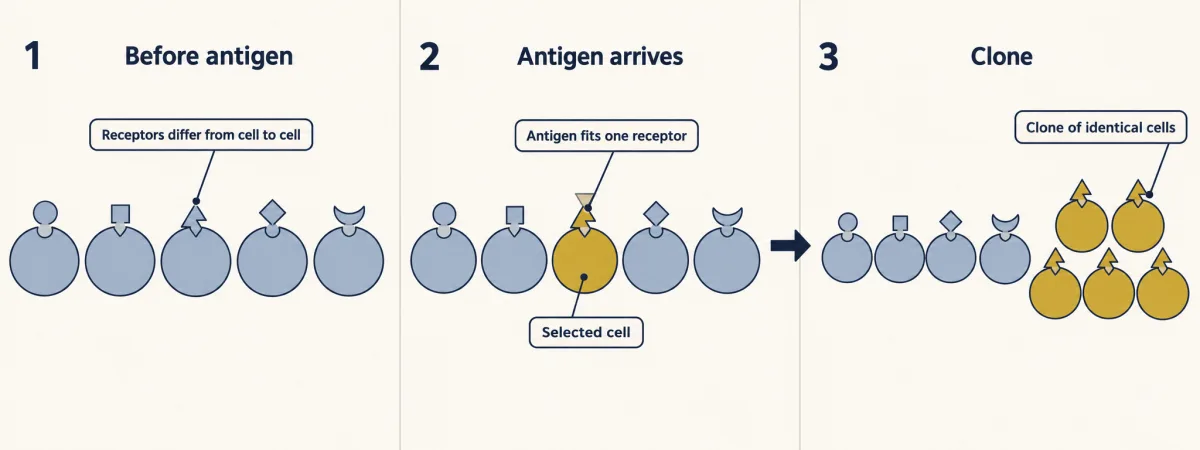
Receptors are made before antigen arrives. The antigen binds only the cell whose receptor already fits, and that cell divides into a clone. AI-generated illustration -
Making the variety: segments, joins and pairs
-
Where B and T cells come from: a chicken’s bursa
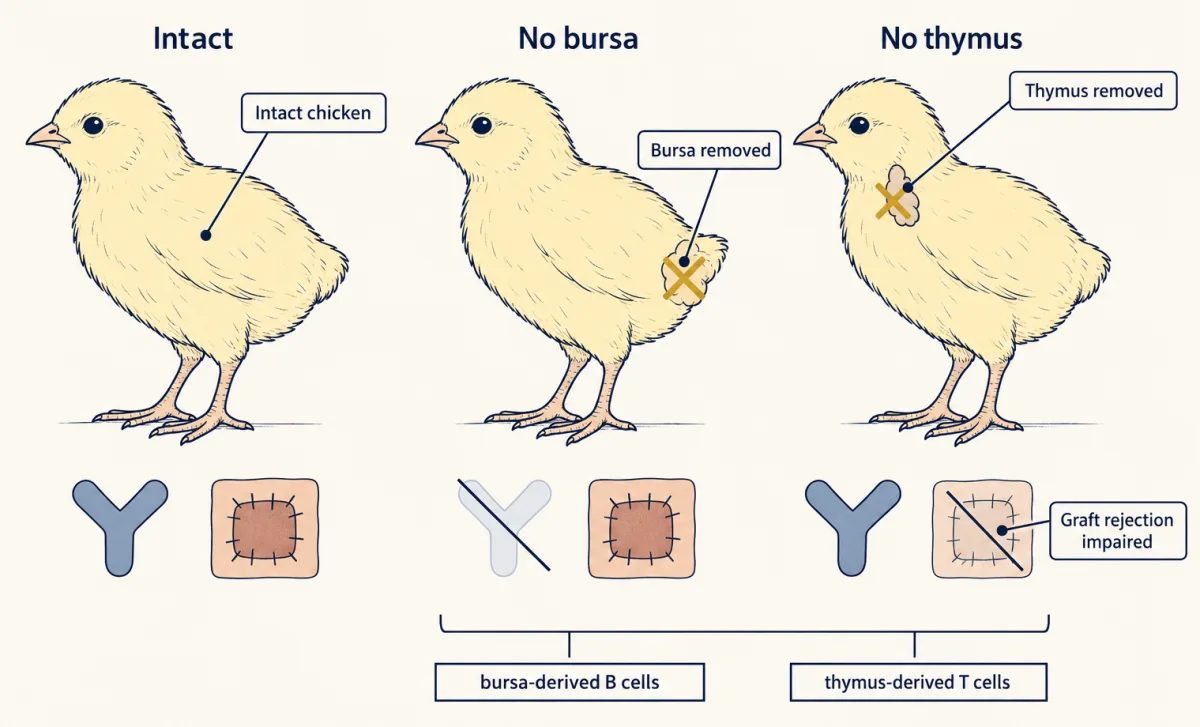
Removing the bursa from newly hatched chickens, followed by irradiation, largely removed antibody but grafts were still rejected, only more slowly; removing the thymus impaired graft rejection. Two lineages: bursa-derived B cells and thymus-derived T cells. AI-generated illustration -
Antibodies and killer T cells: class I and class II
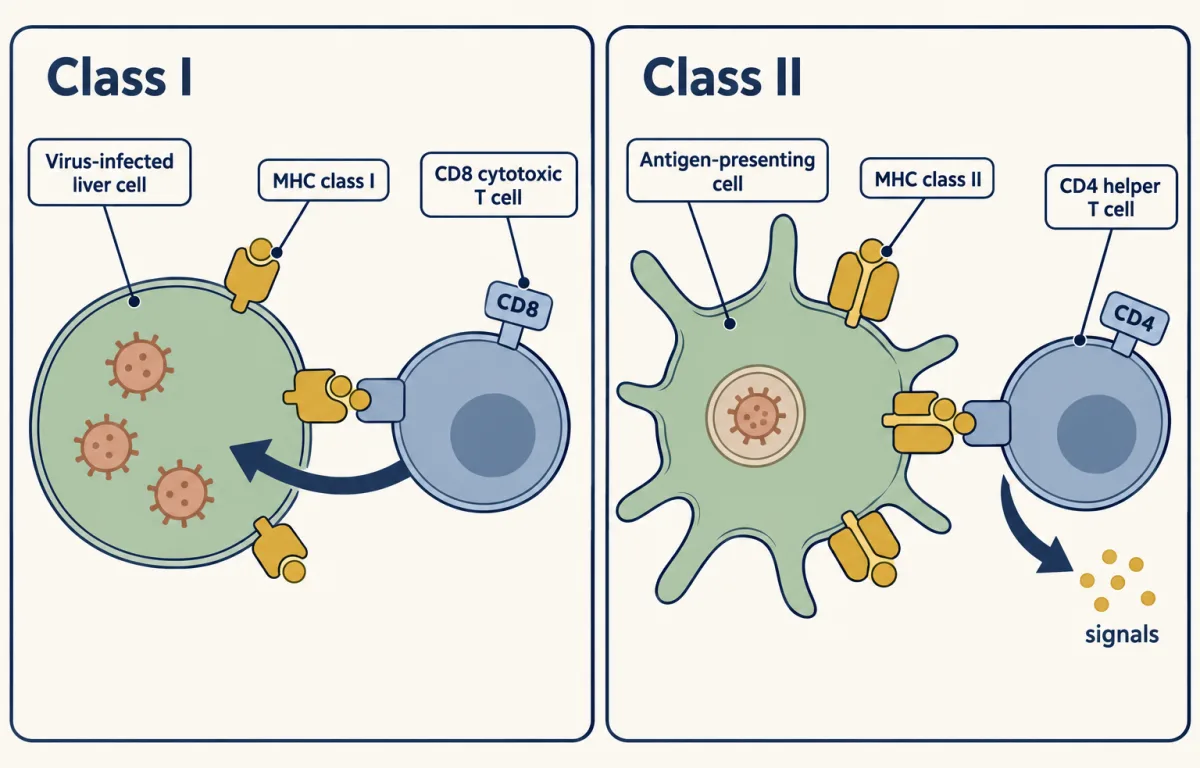
CD8 cytotoxic T cells read peptide on MHC class I, found on almost all nucleated cells; CD4 helper T cells read peptide on MHC class II, found on antigen-presenting cells. The split by peptide source is not absolute: in cross-presentation, some antigen-presenting cells put peptides from engulfed material on class I. AI-generated illustration -
Memory, vaccines, mothers’ antibodies and blood groups
-
Adaptive immunity compared: lampreys and jawed vertebrates
-
Going deeper
Where this lesson fits
Before thisReview first
- Innate Immunity: Recognize and RespondThis course · Lesson 17
You need the innate layer, its broad receptors and complement, to see what adaptive immunity adds.
- Germs, Vaccines and AntibioticsBiology · High school
It introduces vaccines and how the body fights infection, which this lesson explains through memory and clonal selection.
After thisStudy next
- Animal ReproductionThis course · Lesson 20
It continues the mother-to-offspring antibody transfer and the Rh problem of pregnancy raised here.
- Animal DevelopmentThis course · Lesson 21
It shows how cells commit to one fate, which is a useful comparison with each lymphocyte committing to one receptor.
Suggested by an AI model from the lessons themselves, then checked. How we use AI