Physiology · Skim version
Acid-Base Balance
Read the full lesson → Skim the whole course →
The guiding idea
Plasma holds 24 mmol/L of bicarbonate and only 40 nanomoles of free H+ per litre, and metabolism adds acid every day. pH stays put because one ratio, bicarbonate to dissolved CO2, stays near 20 to 1. What holds it there?
Adult human plasma holds about 24 millimoles of bicarbonate per litre and only about 40 nanomoles of free hydrogen ions, while metabolism adds tens of milliequivalents of non-volatile acid every day.
-
pH follows a ratio
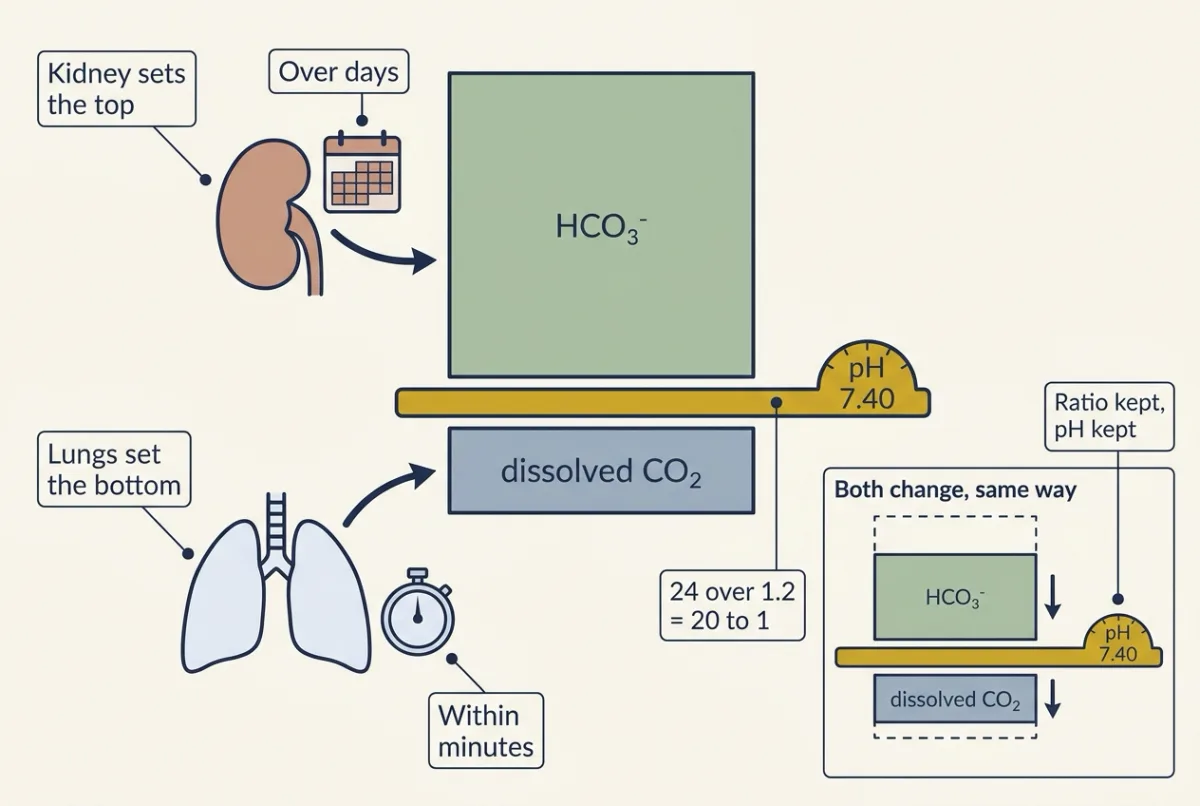
pH reads one ratio, bicarbonate over dissolved CO2 (20 to 1 at pH 7.40): the lungs start moving the bottom within minutes, the kidney sets the top over days, and changing both in proportion leaves pH where it was. AI-generated illustration -
Why this buffer works: it is open
-
Buffering is not removal: from seconds to days
-
The kidney’s two jobs
-
Reading a blood gas
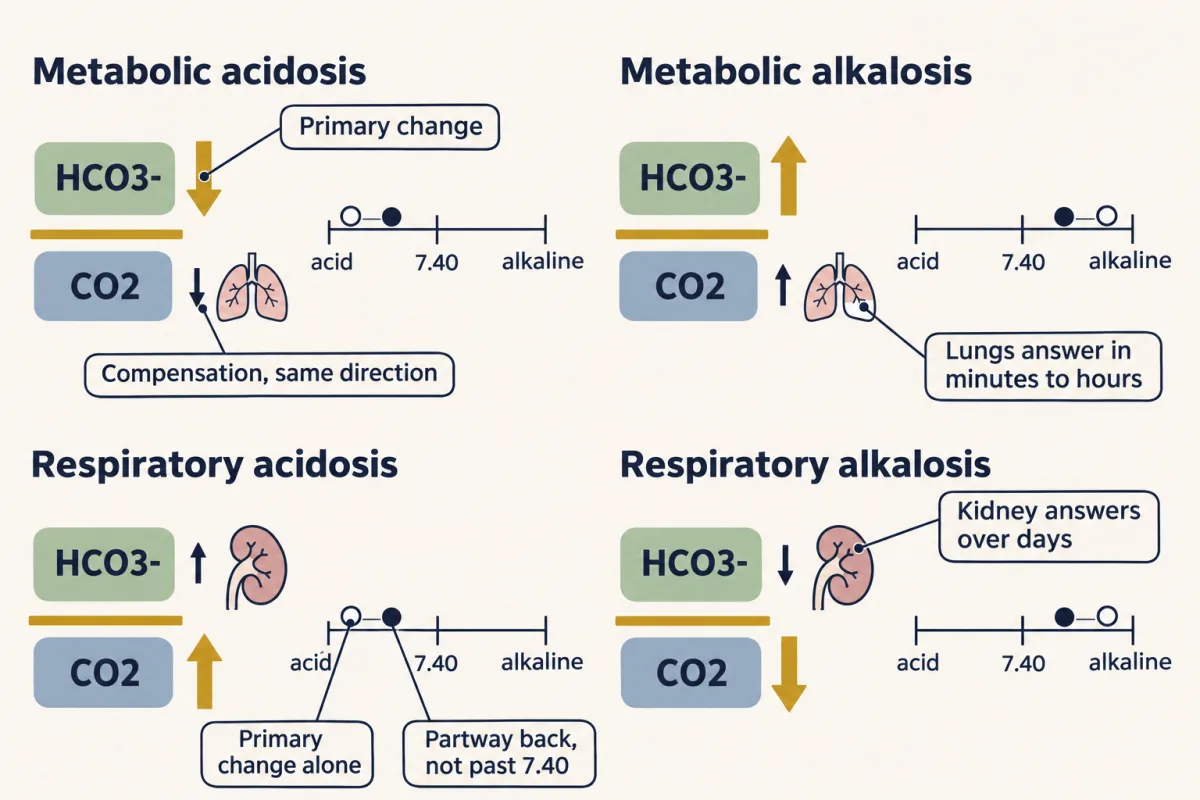
In every simple disorder the compensating organ moves the other term the same way as the first, so the ratio heads back toward 20 to 1: usually partway, near-normal in some chronic respiratory cases, and never past pH 7.40 to the other side. AI-generated illustration -
Going deeper
Where this lesson fits
Before thisReview first
- Glomerular Filtration and Renal Blood FlowThis course · Lesson 15
You need the daily filtered volume from there to see how much bicarbonate the kidney must reclaim.
- Ventilation, Perfusion and Gas ExchangeThis course · Lesson 13
Alveolar ventilation sets the CO2 term of the ratio, which this lesson takes as given.
- Tubular Transport, Segment by SegmentThis course · Lesson 16
The proximal tubule transporters and carbonic anhydrase inhibition from there are used in the bicarbonate reclaiming job.
After thisStudy next
- Exercise: The Whole Body at WorkThis course · Lesson 30
Lactate and acid load during hard exercise put the buffering and compensation ideas to work.
- Insulin, Glucagon and Blood GlucoseThis course · Lesson 21
Ketoacid production from missing insulin is a main cause of the added-acid acidosis read here with the anion gap.
Elsewhere on the siteFilms, simulations and method films in other courses
- Why Blood Needs an S-Shaped CarrierFilm · Organismal Biology
Hemoglobin's role as a red-cell buffer carrying carbon dioxide is shown there.
Suggested by an AI model from the lessons themselves, then checked. How we use AI