Physiology · Skim version
Absorption, the Liver and Enterohepatic Circulation
Read the full lesson → Skim the whole course →
The guiding idea
Nine to eleven litres enter your gut lumen each day and a couple of hundred grams of stool leave. Which transporters decide the difference?
About nine to eleven litres of water enter the lumen of an adult gut each day and a couple of hundred grams of stool leave it, and a bile acid pool of a few grams goes round the gut several times a day with only a few hundred milligrams lost.
-
Eleven litres in, about a tenth of a litre out
-
Crypts secrete, villi absorb, and the stool is the difference
-
Cholera, and why a sugar-and-salt drink works
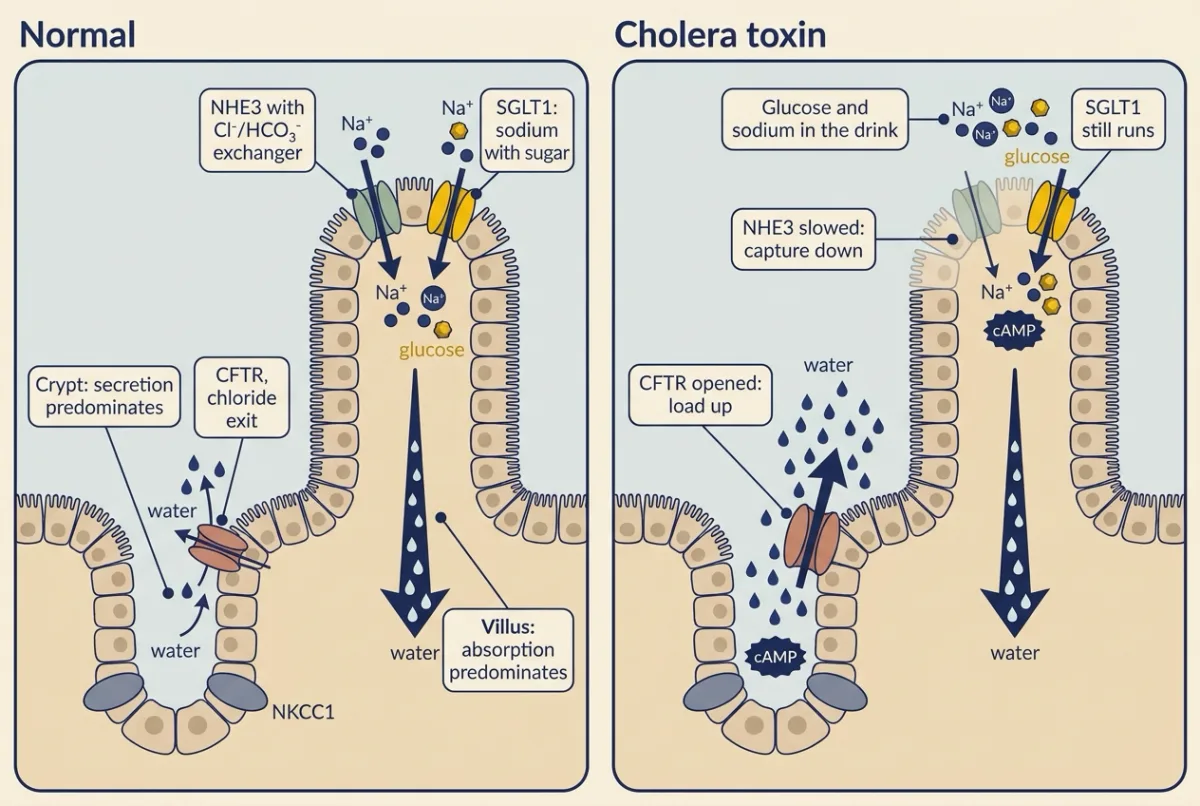
Cholera toxin raises the load by opening CFTR in the crypts and lowers the fraction captured by slowing NHE3 on the villi, but SGLT1 keeps carrying sodium in with glucose, which is the door a sugar-and-salt drink uses. Crypts and villi differ in which process predominates; both can run in one cell. AI-generated illustration -
Fat takes the other door
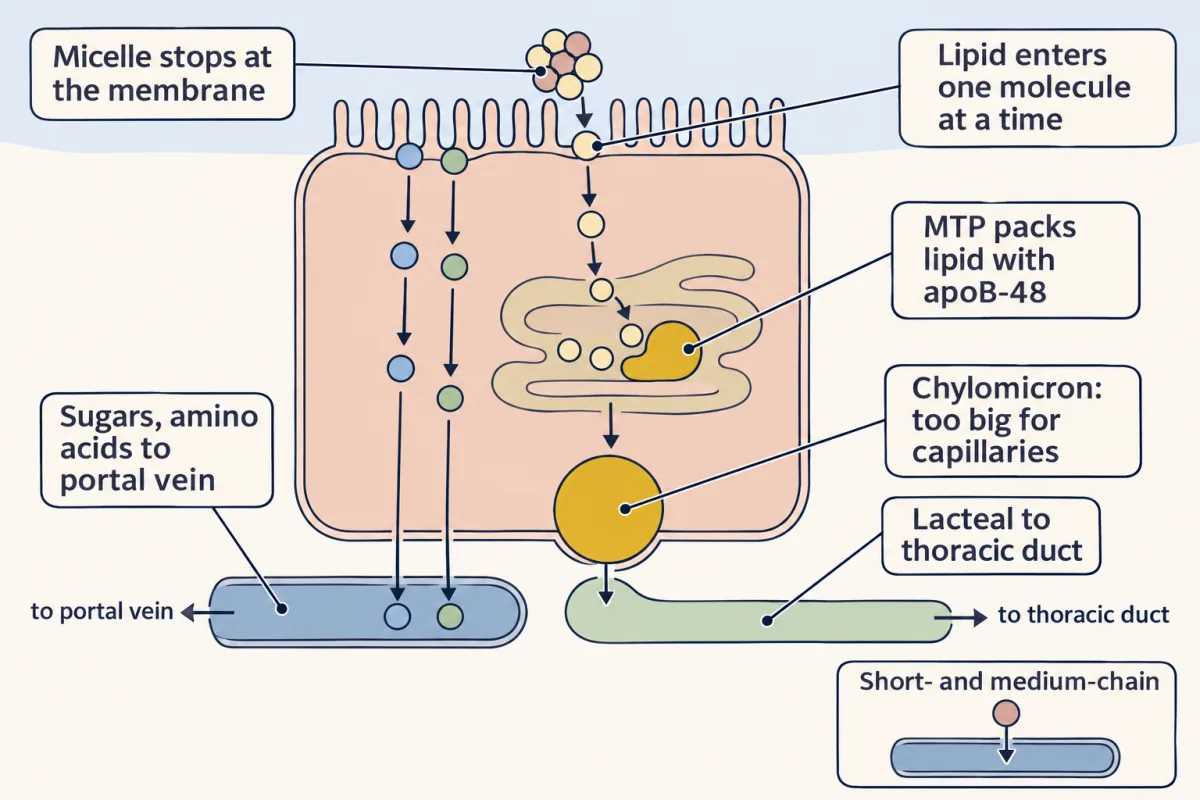
Sugars and amino acids leave the enterocyte into capillaries that drain to the portal vein, but most long-chain fat is packed into chylomicrons too big for capillaries and leaves through the lacteal, skipping the liver's first pass and reaching it only later as remnants. AI-generated illustration -
A pool used five times a day
-
The liver as the first organ downstream
-
Going deeper
Where this lesson fits
Before thisReview first
- Gut Motility, Secretion and Gut HormonesThis course · Lesson 23
You need the gut's secretions and transit from there to know the load that enters the lumen each day.
- Capillary Exchange, Lymph and EdemaThis course · Lesson 9
Chylomicrons leave through the lacteal, so you need to know how lymph drains fluid and large particles from tissue.
- Body Water and Its CompartmentsThis course · Lesson 1
The water balance here treats the gut lumen as a fluid space and uses osmotic water movement from that lesson.
After thisStudy next
- Exercise: The Whole Body at WorkThis course · Lesson 30
It uses whole-body fuel supply, including liver glucose output, to ask which link limits the body at work.
Elsewhere on the siteFilms, simulations and method films in other courses
- The master switch of digestionFilm · Biochemistry
It shows how enzymes cut a meal into pieces the gut wall then absorbs.
- Which Way Does the Water Go?Film · Organismal Biology
It shows water moving toward the side with more dissolved particles, as in gut sodium absorption.
- The Two-Carbon LedgerFilm · Biochemistry
It follows the fat that reaches cells after chylomicron delivery, as beta-oxidation.
Suggested by an AI model from the lessons themselves, then checked. How we use AI