Press play to start at .
Context and Brakes: How Cells Read TGF-β
From the film
- Partner factors choose Smad targets, and layered brakes restrain the signal.
- Smads grip a short four-base DNA sequence weakly, so cell-specific partners and open chromatin decide which genes respond.
- Many healthy epithelial cells arrest via p15, p21 and Myc repression, fibroblasts make collagen, and late tumours that escape arrest can repurpose TGF-β.
- Three layered brakes hold the signal back: a latent precursor wrapper in the matrix, negative-feedback Smad7, and Smurf ubiquitin ligases.
Read the transcript of “Context and Brakes: How Cells Read TGF-β”
Film transcript: Context and Brakes: How Cells Read TGF-β
Tap a sentence to play from there.
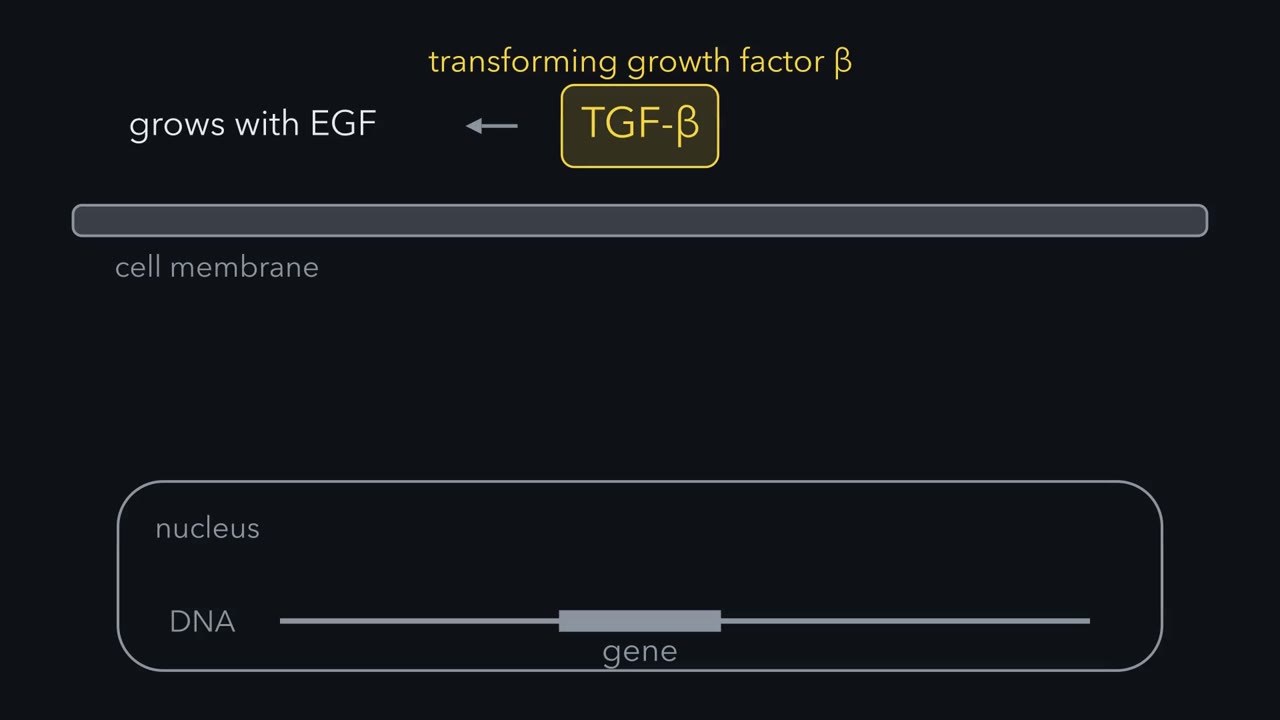
- 0:02 In the first film, TGF-β -beta bridged two kinases and sent a Smad complex into the nucleus. Yet that same complex halts many healthy epithelial cells and can help late tumours spread. How can one signal give opposite answers, and what holds it back?
- 0:22 Watch how a Smad complex meets DNA.
- 0:25 Its DNA-binding domain reads a tiny four-base tag, such as GTCT, and grips it weakly. Each base is one of four letters, so a four-base tag appears by chance about once every 256 bases.
- 0:42 That is millions of times across a human genome.
- 0:46 A Smad complex alone cannot pick a gene.
- 0:49 Each cell type makes its own partner transcription factors and keeps its own chromatin open. A Smad complex usually locks onto DNA firmly only beside a partner reading a nearby sequence.
- 1:04 The Smad carries one message: TGF-β beta is here.
- 1:09 The partners decide what that means.
- 1:12 In many epithelial cells, partners turn on p15 and p21 to stop division, and shut off Myc. In fibroblasts, different partners switch on collagen genes.
- 1:26 Early in cancer, TGF-β -beta restrains tumours because cells obey the stop order.
- 1:32 Later, in cells that escape arrest, TGF-β -beta can push them to move, and it quiets nearby immune cells.
- 1:40 Pause and predict.
- 1:43 Suppose a tissue's matrix holds plenty of TGF-β -beta protein, yet nearby cells show no Smad signal. What could keep that protein away from its receptors?
- 1:59 A signal this powerful must stay off most of the time.
- 2:04 Three layered brakes hold it back.
- 2:07 First, TGF-β -beta is made with a wrapper piece.
- 2:11 The wrapper is cut free but stays clamped around it, tethered to the extracellular matrix. Active dimer is freed locally, for example when an integrin pulls or a protease cuts.
- 2:24 Second, the active signal makes its own inhibitor inside the cell.
- 2:30 Active Smads switch on the gene for inhibitory Smad7.
- 2:34 Smad7 returns to cap the active type I receptor, blocking incoming Smads in negative feedback. Smad6 plays a similar role, preferring the BMP branch.
- 2:47 Third, Smad7 recruits ubiquitin ligases called Smurfs to the active receptor.
- 2:54 Smurfs tag the receptor, and some Smads, with ubiquitin for destruction.
- 3:00 Together, these layered brakes keep signaling local and brief.
- 3:04 Breaking a key part, like Smad4 or the GS safety catch, can drive human disease.
- 3:11 So one short relay depends on both context and control.
- 3:16 Inside the nucleus, partner factors and open chromatin decide which genes respond to TGF-β. beta. Outside and at the membrane, layered brakes decide where and how long the signal lasts.
TGF-beta and Smads: the same idea, other levels
A level is a place to start, not a rank. If this loses you, the rung below teaches the same idea, told more simply.
Graduate · the level you chose
TGF-β and Smads · this lesson
Type II tags type I, type I tags a Smad: brake early, help late.
Cell Signaling · about 17 min · film 3:28 · 3 practice questions
Next door
- How an embryo begins: Divided, Not Grown · 3:20 · Starting college Smad signals help set up the body axes in the early embryo.
- Neural induction: The Map and the Question · 2:54 Blocking BMP, a member of this family, makes embryo tissue become nervous system.
- Transcription factors: Two Phosphate Switches That Flip Waiting Factors · 3:22 Smads work with other transcription factors to decide which genes are read.
More films from this lesson
Continue in the lesson: TGF-β and Smads →
Free, with captions and a transcript. The lesson has the full text, the questions and the sources.
How this film was made. Narration: an AI narrator voice (Kokoro, af_heart) reading narration written from this lesson's text. Animation: AI-generated in code (Manim) by Claude, a schematic with no drawn molecular structures. Captions come from the narration script. See something wrong? Report it.