Divided, Not Grown
Read the transcript of “Divided, Not Grown”
Film transcript: Divided, Not Grown
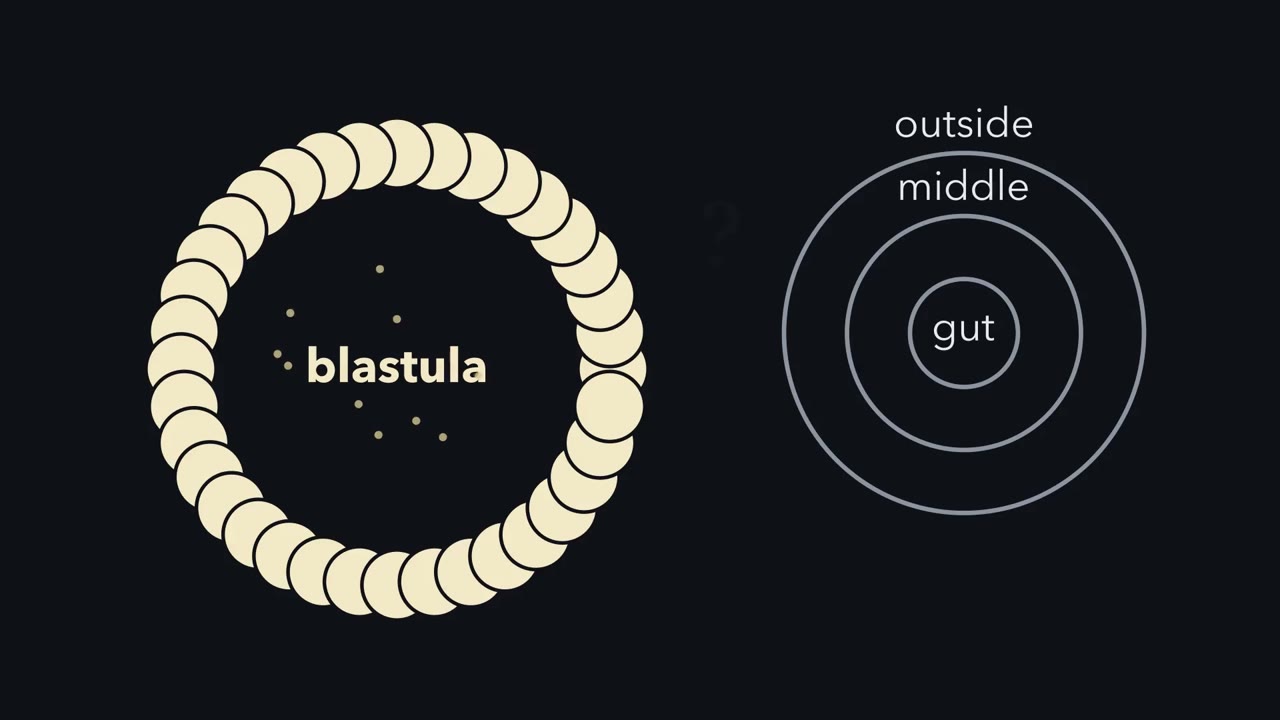
A frog egg divides into thousands of cells without growing at all. So where do the cells come from, and what does each one get? Development starts at fertilization. A sperm fuses with the egg, and a wave of calcium crosses it. A frog egg was paused partway through meiosis, and the calcium wakes it. Only one sperm should get in, and the egg keeps the rest out. Next comes cleavage, a run of divisions with no growth between them. Each new cell is called a blastomere. One cell becomes two, then four, then eight.
Watch the outline. It never gets bigger. Each division cuts the same egg into more, smaller pieces. The egg is divided, not grown. Suppose every division is equal. After five divisions there are thirty-two cells. Is each cell one thirty-second as wide as the egg?
No. In this equal model, each cell holds one thirty-second of the volume. But volume is shared out in three dimensions: length, width and depth. So each cell is about a third as wide as the egg. Something else has changed. There are now thirty-two nuclei, but no new cytoplasm. Each nucleus has far less cytoplasm around it.
Now suppose the egg is not the same all through. Mark one region in purple. This stands for inherited material, placed in the egg before it divides. Suppose the purple is anchored, so it stays put. The furrows cut through the egg around it. After a few divisions, only some cells hold it. Their neighbours have none. That is what a cell inherits: the slice of egg it was cut from. If an anchored molecule helps set fate, it is a cytoplasmic determinant. Yolk changes the cutting. Yolk is stored food, and it slows the furrows. A frog egg divides completely, with bigger cells in its yolky half. A chick divides only a disc on top of its yolk. A fly first divides its nuclei in shared cytoplasm, with no membranes between them.
Edwin Conklin watched the egg of a sea squirt. Part of its cytoplasm is yellow, and it gathers into a crescent. He followed it cell by cell. It ended up mainly in the cells that build the larva's tail muscle. But following a colour shows where it goes, not what it does. Does the crescent make muscle, or just ride along? That takes a different test. So cleavage shares out one fixed egg. Each cell gets its own slice, and anchored material comes with it.
A frog egg divides into thousands of cells without growing at all. How does each cell come to its fate?
Continue in the lesson: Animal Development →
3:20 · Free, with captions and a transcript. The lesson has the full text, the questions and the sources.
More films from this lesson
How this film was made. Narration: written from this lesson's text and read by an AI narrator voice (Kokoro, af_heart). Animation: AI-generated in code (Manim) by Claude, a schematic with no drawn molecular structures. Captions come from the narration script. See something wrong? Report it.