The Ligand Only Introduces Two Kinases
Read the transcript of “The Ligand Only Introduces Two Kinases”
Film transcript: The Ligand Only Introduces Two Kinases
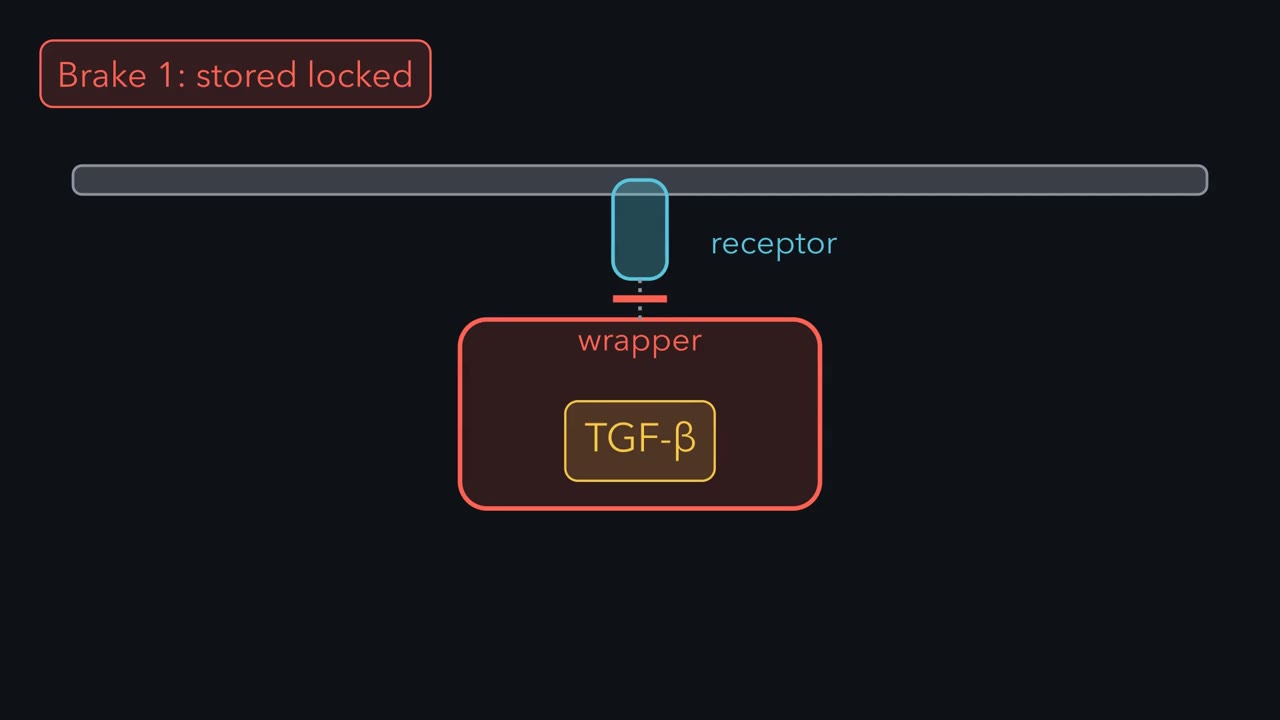
Scientists purified a protein that, with EGF, made normal cells grow like tumour cells. They named it transforming growth factor beta. Then the same protein was caught holding other cells back. What does TGF-β beta do to a cell once it lands? Follow its message from the membrane to a gene. The receptors for TGF-β -beta are kinases of two types. The type 2 kinase is active before any ligand arrives. TGF-β -beta is a dimer, two chains joined together. It binds two type 2 receptors. Then the ligand and type 2 together recruit two type 1 receptors. Four receptor chains now surround one ligand. Type 2 adds phosphate to a stretch of type 1 just inside the membrane, called the GS domain. At rest, the GS domain holds the type 1 kinase in an inactive shape.
Phosphate ends that arrangement. The kinase turns on, and the stretch becomes a docking site for a Smad. Think of type 2 as a lit match, and type 1 as a fuse. The ligand only holds the match to the fuse. The active type 1 kinase phosphorylates a Smad. A Smad is itself a transcription factor, a protein that binds DNA. TGF-β beta receptors phosphorylate Smad2 and Smad3, on two serines at the end of the tail. A phosphorylated tail fits a pocket on a neighbouring Smad. So the Smads leave the receptor, and typically two of them join one Smad4. The complex collects in the nucleus and binds DNA. But it reads a sequence just a few base pairs long, and holds it weakly.
That sequence turns up millions of times in a human genome, so a Smad complex alone cannot pick a gene. It binds firmly mostly next to partner proteins, and each cell type makes its own partners. In many epithelial cells, the partners turn on p15 and p21, and the cell stops dividing. In a fibroblast, the same pathway turns on collagen genes. The ligand brings two kinases together. Type 2 phosphorylates type 1 and type 1 phosphorylates a Smad. The steps run one way. In each cell, the partners decide what the message of the Smad means. Keep this rule: the ligand only introduces two kinases.
Why does the protein that tells healthy cells to stop dividing end up helping late tumours?
Continue in the lesson: TGF-β and Smads →
3:00 · Free, with captions and a transcript. The lesson has the full text, the questions and the sources.
More films from this lesson
How this film was made. Narration: an AI narrator voice (ElevenLabs, Sarah) reading narration written from this lesson's text. Animation: AI-generated in code (Manim) by Claude, a schematic with no drawn molecular structures. Captions come from the narration script. See something wrong? Report it.