Press play to start at .
Which Direction Did the Work?
From the film
- To separate bidirectional signals, disable one inner route while keeping binding.
- A full gene knockout removes forward signaling, reverse signaling, and cell-to-cell grip all at once.
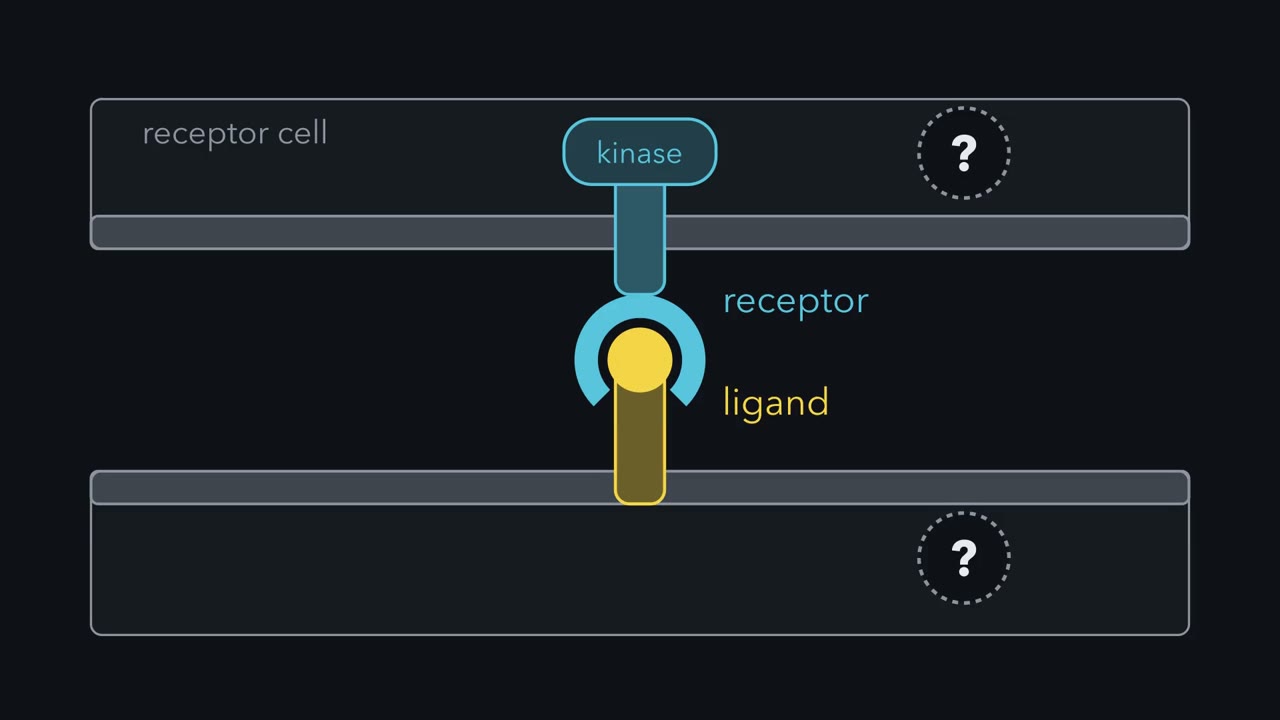
- Replacing a receptor's inner kinase with an inert marker tests whether its outer tip acts as a ligand without forward signaling.
- A soluble receptor body tests whether reverse signaling is sufficient with no receptor cell present, while proteolytic release of the ligand breaks that inward link.
Read the transcript of “Which Direction Did the Work?”
Film transcript: Which Direction Did the Work?
Tap a sentence to play from there.
- 0:02 In the first film, a membrane ligand signaled inward through a tail or partner.
- 0:09 Now suppose you delete that ligand's gene and an organ fails to form.
- 0:14 How can you tell which direction caused the defect?
- 0:18 One knockout removes too much at once.
- 0:21 Watch what vanishes when you delete the ligand gene completely.
- 0:26 First, the receptor cell loses its forward signal.
- 0:30 Second, the ligand cell loses its reverse signal.
- 0:34 Third, both cells lose the physical grip holding them together.
- 0:39 Deleting the receptor gene creates the exact same tangle.
- 0:43 To separate bidirectional signals, disable one inner route while keeping binding.
- 0:50 Leave the outer binding tip on the cell surface so the two cells still grip.
- 0:55 Then cut or swap only one cell's intracellular signaling part, keeping the other side intact.
- 1:02 Watch this rule solve a brain wiring puzzle.
- 1:07 Growing axons carrying B-type ephrins cross floor cells carrying the receptor EphB2.
- 1:14 In mice lacking EphB2 completely, those axons veer off course.
- 1:19 A second mouse keeps EphB2's outer tip on the surface.
- 1:23 In that second mouse, an inert bacterial enzyme replaces the receptor's inner kinase. That change removes the receptor's own kinase signal.
- 1:34 Yet the axons still stay right on course.
- 1:38 Pause and think: which cell was receiving the guidance signal?
- 1:47 The axons carrying the ephrin received the signal, because the only working part left was the receptor's outer tip.
- 1:55 That tip stayed on the floor cells and gripped the axons' ephrins, so the message ran inward there. Here the protein named receptor acted as the ligand.
- 2:06 Mutant animals test whether one direction is needed.
- 2:11 A second tool tests whether reverse signaling is enough on its own.
- 2:17 Scientists fuse a receptor's outer tip to an antibody handle, making a soluble receptor body. With no receptor cell present, a response that needs the ligand must have entered through it.
- 2:30 For example, developing sympathetic axons carry uncut membrane TNF.
- 2:37 Adding soluble TNF receptor 1 makes those axons branch more.
- 2:43 That growth requires membrane TNF on the axon.
- 2:47 If a protease cuts TNF loose, that inward link breaks.
- 2:52 Released TNF can still float off and signal forward.
- 2:56 Full knockouts erase forward signaling, reverse signaling, and cell contact all at once. Keep outer binding intact and disable one inner route at a time.
- 3:08 Only then can you prove which cell received the message.
Reverse signaling: the same idea, other levels
A level is a place to start, not a rank. If this loses you, the rung below teaches the same idea, told more simply.
Graduate · the level you chose
Reverse Signaling: When the Ligand Is Also a Receptor · this lesson
Ephrin tails borrow Src kinases, so both touching cells get a message.
Cell Signaling · about 19 min · film 3:15 · 3 practice questions
Next door
- Synapses: The Muscle Proposes, the Nerve Disposes · 2:51 At many synapses the receiving cell also sends a message back to the cell that signalled it.
- Cell adhesion: A Grip That Signals and Feels Force · 3:18 Ephrin and its receptor hold two cells together while each one receives a signal.
- How axons find their way: A Route in Legs · 2:24 Ephrins and Eph receptors help growing axons choose a path and both sides respond.
More films from this lesson
Continue in the lesson: Reverse Signaling: When the Ligand Is Also a Receptor →
Free, with captions and a transcript. The lesson has the full text, the questions and the sources.
How this film was made. Narration: an AI narrator voice (Kokoro, af_heart) reading narration written from this lesson's text. Animation: AI-generated in code (Manim) by Claude, a schematic with no drawn molecular structures. Captions come from the narration script. See something wrong? Report it.