A Grip That Signals Both Ways
Read the transcript of “A Grip That Signals Both Ways”
Film transcript: A Grip That Signals Both Ways
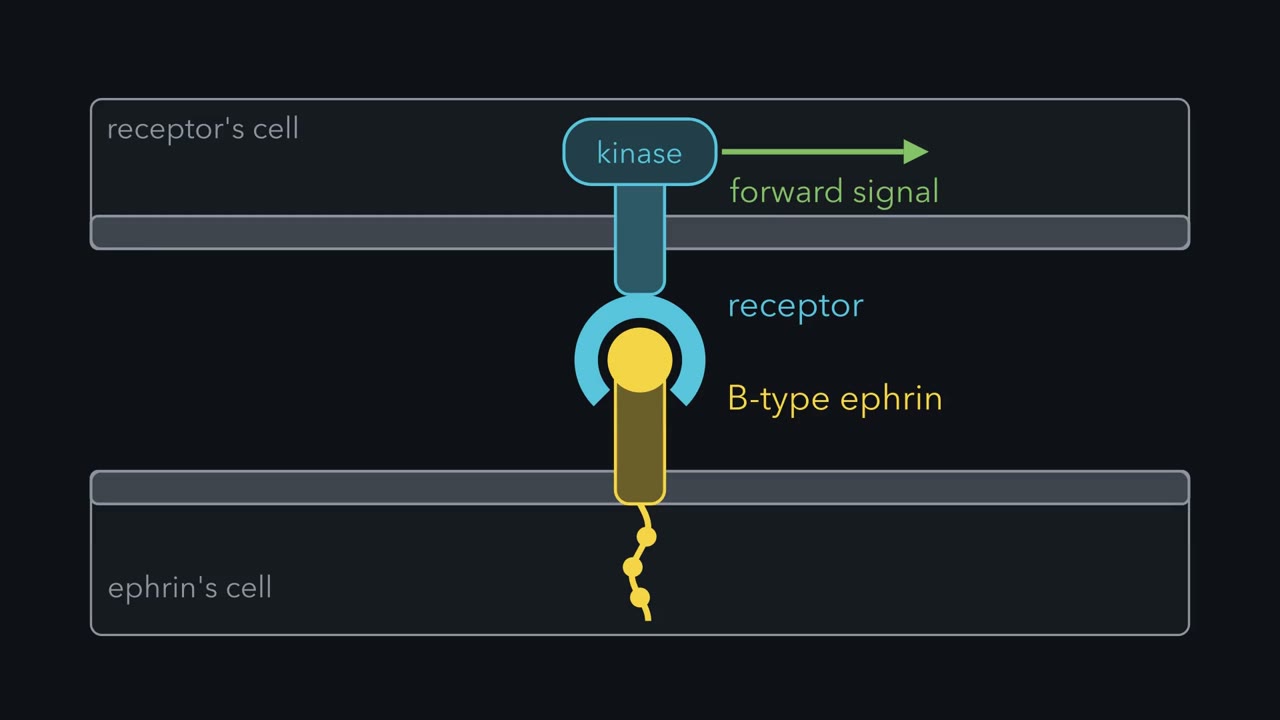
When a receptor grips a ligand that is stuck to another cell, which cell gets the message? The receptor sits in the upper cell. Its ligand is held in the membrane of the lower cell. Does the message reach one of them, or both? Often, both. Many ligands are made as membrane proteins. Such a ligand can have a tail inside its own cell. A tail in the cytosol is what you expect of a receptor. When the two proteins bind, the receptor signals into its own cell. That is the forward signal. A second message passes into the cell that carries the ligand. That is reverse signaling.
Ephrins are the clearest case of reverse signaling. A B -type efren crosses the membrane once and ends in a short tail. The tail contains no enzyme. Yet when the efren meets the outer part of its receptor, its tail gains a phosphate on a tyrosine. That outer part has no kinase, and neither does the efren, So a kinase in the ephrin's own cell must do the work. Which kinase? SARC family kinases gather where B -type ephrins cluster, and they help to put phosphate on the tail. An adaptor then binds the phosphorylated tyrosines. It connects the ephrin to proteins that reshape the actin skeleton. This is one route; PDZ proteins offer another.
Suppose you delete the gene for a B -type ephron, and an organ fails to form. You have removed the forward signal, the reverse signal, and the grip that held the cells together. The knockout cannot tell you which loss caused the defect. So change the ephrin instead. Keep its outer part and its membrane segment, and remove only the tail. Check that it reaches the surface, then measure the forward signal. Reverse signaling through the tail is gone.
Other ligands work this way too. Membrane bound TNF acts as a receptor, and so does a fly semaphorin. In each pair, the protein named receptor also gives a signal. The protein named ligand also receives one. The names were fixed by history. So keep this rule: a membrane ligand can receive a signal as well as give one.
When a receptor grips a ligand that is stuck to another cell, which cell gets the message? Often both.
Continue in the lesson: Reverse Signaling: When the Ligand Is Also a Receptor →
2:44 · Free, with captions and a transcript. The lesson has the full text, the questions and the sources.
More films from this lesson
How this film was made. Narration: an AI narrator voice (ElevenLabs, Sarah) reading narration written from this lesson's text. Animation: AI-generated in code (Manim) by Claude, a schematic with no drawn molecular structures. Captions come from the narration script. See something wrong? Report it.