Films · Developmental Neuroscience
A Route in Legs
Read the transcript of “A Route in Legs”
Film transcript: A Route in Legs
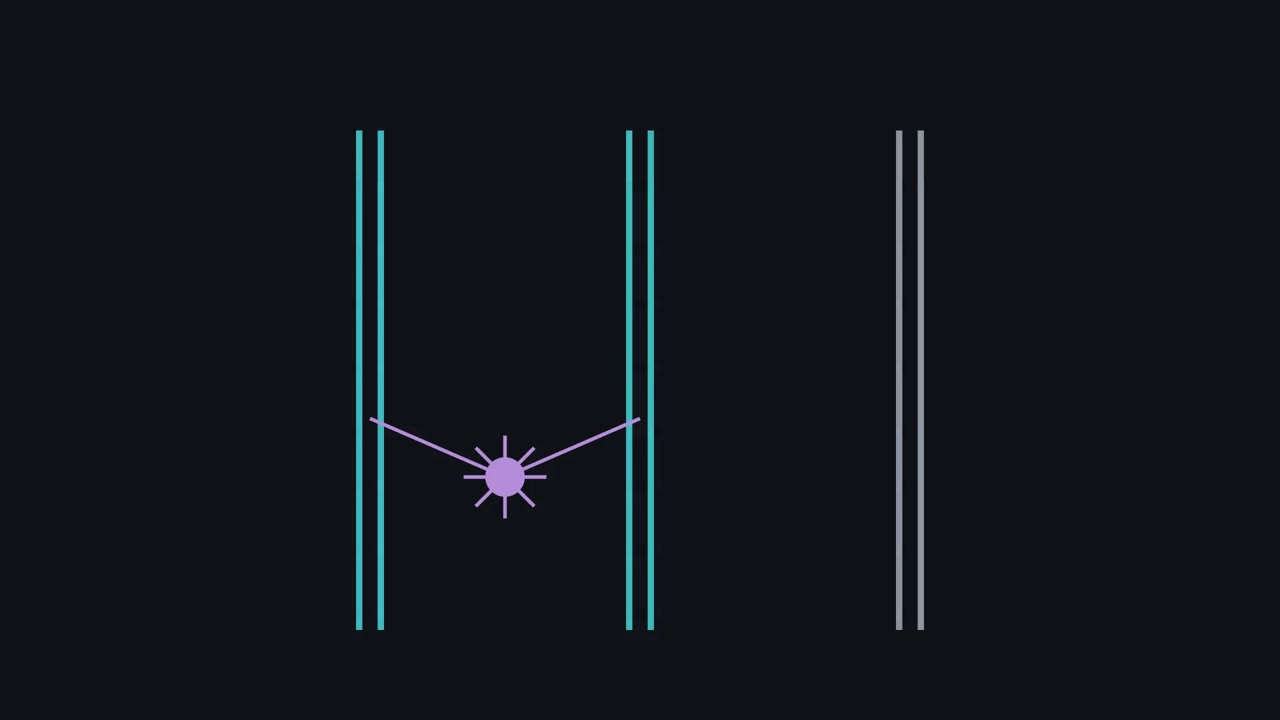
The first axons start out through the far end of a growing leg. No earlier axons lie ahead of them. How do they find the way? The moving tip of a growing axon is the growth cone. It does not carry a map. It is roughly 10 µm across, and its filopodia reach farther. It can touch what lies against it. And it can compare how much of a cue reaches its two sides. Take the simplest case. One cell releases an attractant into uniform tissue. The growth cone heads straight up its gradient. What shape is the path?
straight line to the source. In this ideal case, the cue falls off equally in every direction. So uphill always points at the source. And at the source, the climb ends. Add a second source, and the path can curve. Where it ends depends on where it starts. Either way, an attractant gives a destination, not a list of stops.
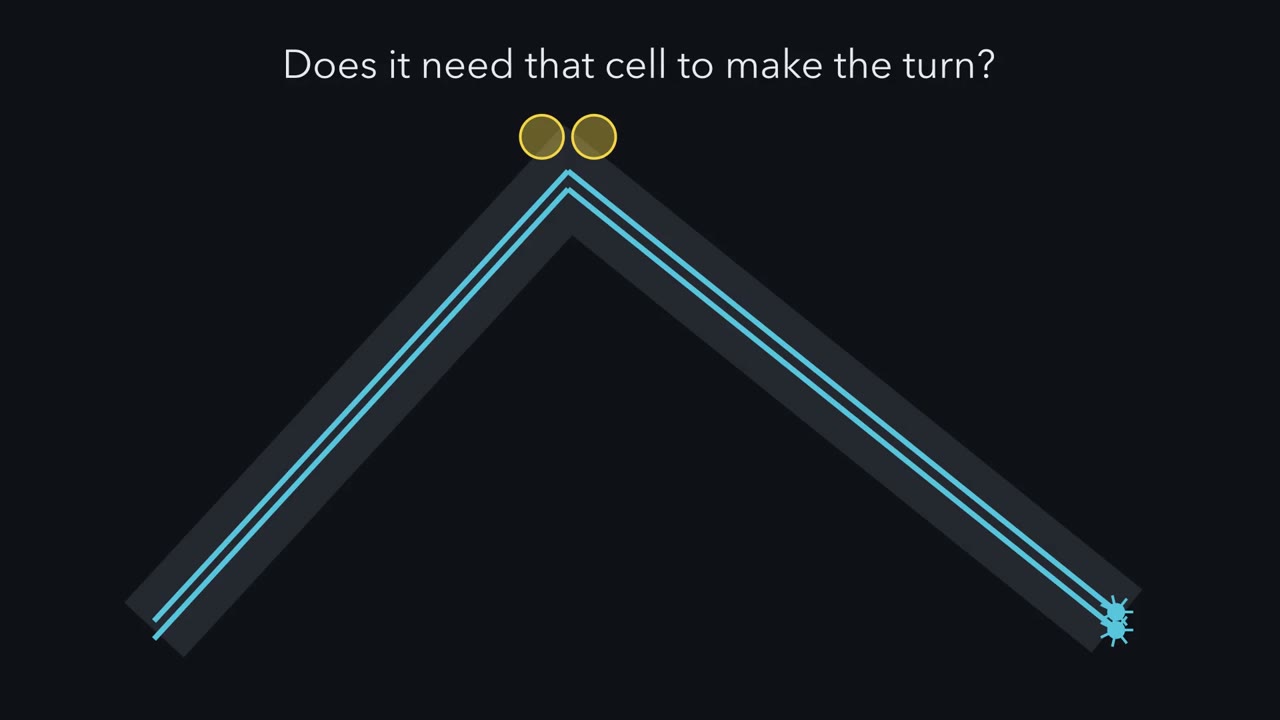
Real routes reach a place and go on from it. The first axons out of an insect leg make several sharp turns. A turn like that usually means the growth cone has started reading something new. A cell it touches, a boundary in the tissue, or a different cue. Reach adds a second limit. A secreted cue thins as it spreads. Far enough away, the difference across a growth cone is lost in noise. Simple models with plausible values put that at hundreds of micrometres to a few millimetres. It is an estimate, not a fixed range. So here is the rule. A growth cone reads only what is within its reach. So a long route is usually built as a chain of legs. Each leg ends at a choice point, where the growth cone picks its next path.
There it reads something new, or reads the same thing differently. At many choice points, growth cones pause and spread out before they choose. Not every bend needs a new reading. A pioneer axon can lead followers around long curves.
Kill a guidepost cell on a grasshopper embryo's leg, and the first axons to grow past it lose their way.
Continue in the lesson: Pioneers, Guideposts and the Logic of Guidance Cues →
2:24 · Free, with captions and a transcript. The lesson has the full text, the questions and the sources.
More films from this lesson
How this film was made. Narration: an AI narrator voice (Kokoro, af_heart) reading narration written from this lesson's text. Animation: AI-generated in code (Manim) by Claude, a schematic with no drawn molecular structures. Captions come from the narration script. See something wrong? Report it.