Reading a Trace, Predicting a Drug
Read the transcript of “Reading a Trace, Predicting a Drug”
Film transcript: Reading a Trace, Predicting a Drug
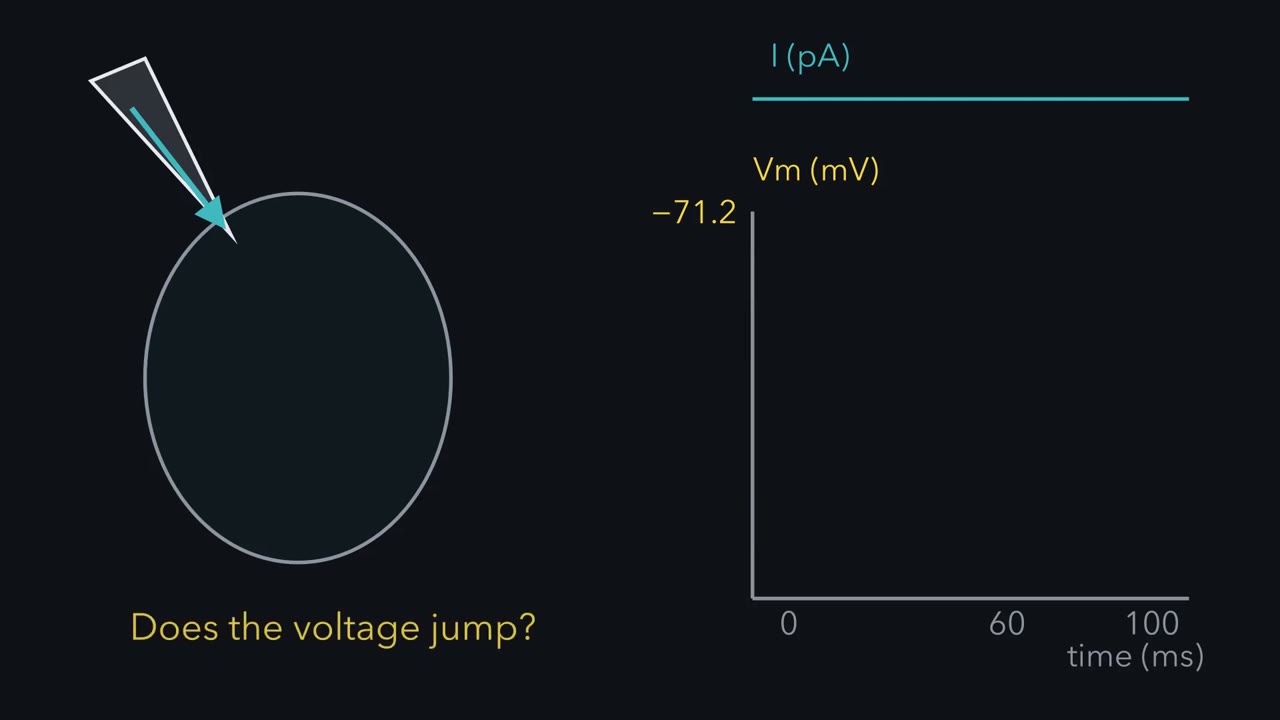
One small step of current, one voltage trace. What can it tell you about the cell? For a compact, passive cell, it gives three numbers. First, input resistance: the plateau divided by the current. Second, the time constant: the time to reach 63% % of the plateau. Third, capacitance: the time constant divided by the input resistance. The word compact matters. In a cell with big dendrites, that last step underestimates the capacitance. Give several small steps below threshold. Plot each plateau against its current. The slope is the input resistance. A straight line fits a passive membrane. But it does not prove one. Now check the trace's shape.
A pure resistor and capacitor gives a smooth rise to a plateau. If the voltage overshoots and sags back during a hyperpolarizing step, a conductance is turning on with voltage. Often it is the HCN current. And if the plot of plateau against current bends, input resistance depends on voltage. Either way, a single resistor and capacitor fit will mislead you. To predict a drug, ask two questions. Which ion's conductance changed, and which way? That moves rest. And did the total conductance go up or down? That moves input resistance and the time constant. A drug opens more potassium leak channels, and does nothing else. What happens to rest, input resistance, and the time constant?
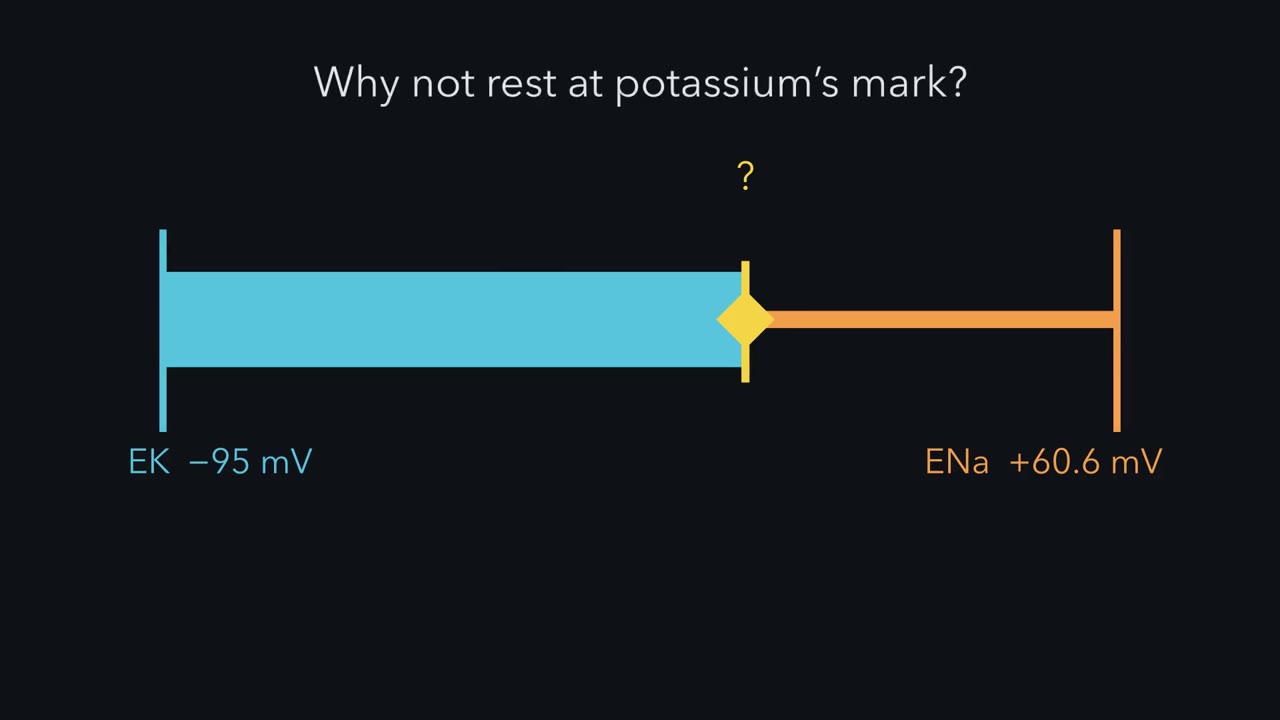
Potassium's rope gets thicker, so rest moves toward potassium's mark. The cell hyperpolarizes. Total conductance rises. So input resistance falls, and the time constant shortens. Closing a leak does the reverse. Input resistance and the time constant rise, and rest moves away from that leak's reversal potential. One case surprises most students. Suppose the new channels reverse right at rest. Chloride channels do this when chloride sits at equilibrium. Their rope is anchored exactly where the marker sits. The rope is not stretched, so it adds no pull. Rest does not move. But the marker is now harder to move. Any other current shifts the voltage less, and faster.
That is shunting. It lowers input resistance without moving the resting potential. So here is the whole rule, for our passive model. With no injected current, and the pump's own current set aside, rest is where the leaks balance. And the leak, with capacitance and the core, decides how big, how fast, and how far a nudge goes.
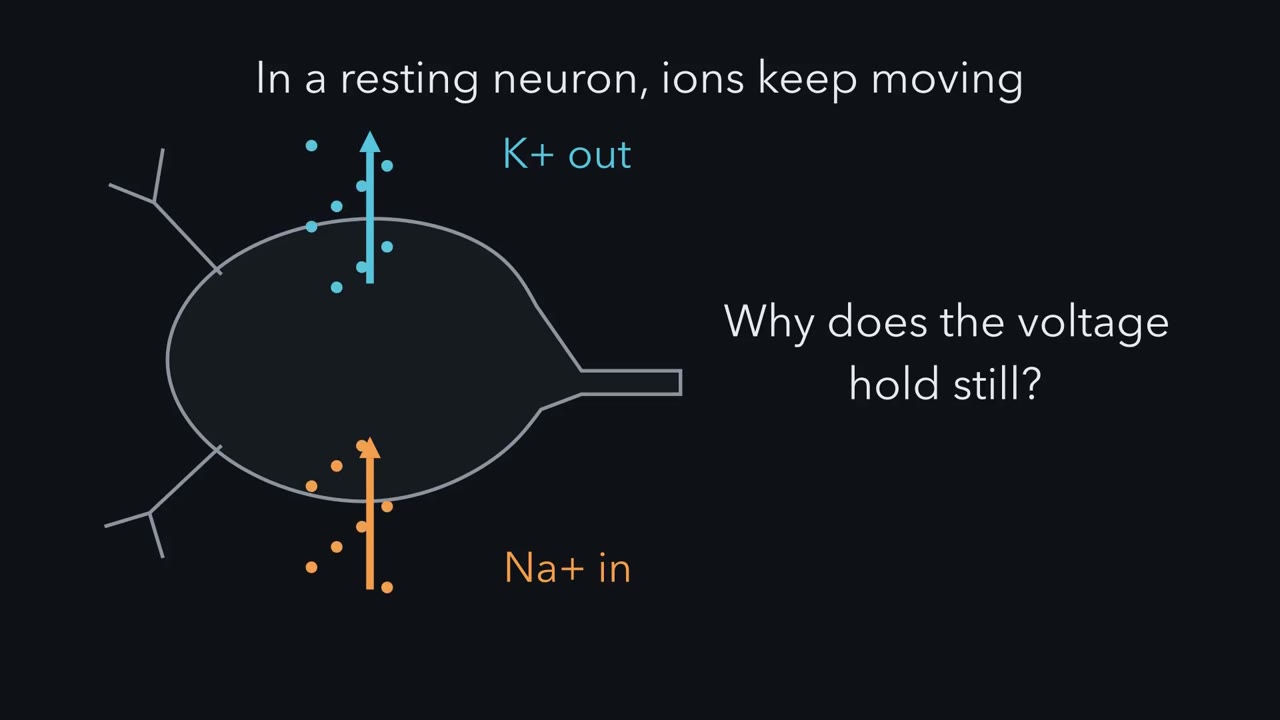
In a resting neuron potassium leaks out and sodium leaks in all the time. Why does the voltage hold still?
Continue in the lesson: The Resting Membrane and Passive Signals →
3:08 · Free, with captions and a transcript. The lesson has the full text, the questions and the sources.
More films from this lesson
How this film was made. Narration: an AI narrator voice (Kokoro, af_heart) reading narration written from this lesson's text. Animation: AI-generated in code (Manim) by Claude, a schematic with no drawn molecular structures. Captions come from the narration script. See something wrong? Report it.