A Nudge Fades with Distance
Read the transcript of “A Nudge Fades with Distance”
Film transcript: A Nudge Fades with Distance
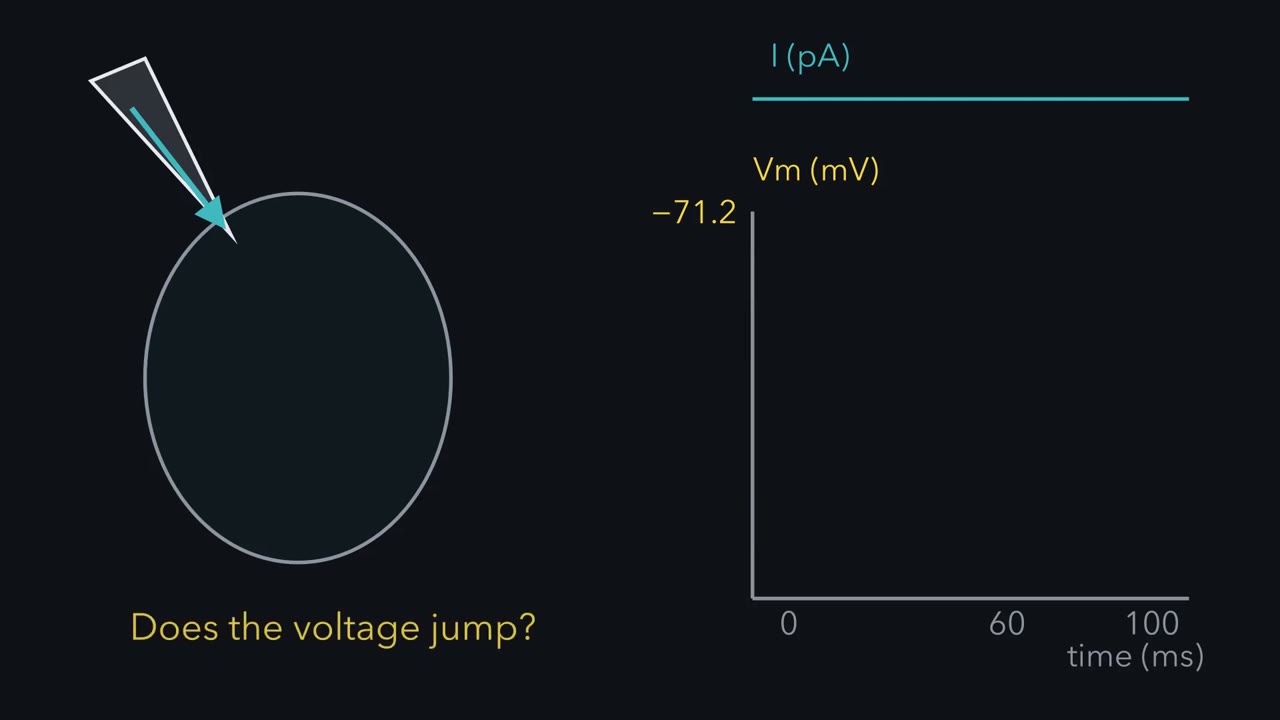
A small, steady input arrives at one point on a dendrite. How much of it survives the trip along the branch? A dendrite is a thin tube of salty cytoplasm, wrapped in leaky membrane. Current injected at one point has two paths. It can flow along the core, or out through the membrane. Think of a garden hose full of small holes. Some water leaks out at every hole. So the farther along you go, the less is left. How far the current gets depends on which path is easier. A wide core carries it farther. A tight wall loses less. The length constant puts that contest into one number. It is the length of cable whose core resistance equals the resistance of its own membrane.
Along a long, uniform cable, a steady signal falls exponentially with distance. So, one length constant away from the source, is the signal gone? No. About 37% percent remains. Smaller, not gone. Two length constants away, about 14% % remains. The signal keeps shrinking, but it never simply stops. Here is the lesson's worked example. Watch the steady signal shrink at each length constant along the cable. The length constant sets the scale of the decay. It is not a cutoff. A leakier membrane shortens it. So does a narrower core. Try it in the lesson's simulation. Make the membrane leakier, and watch the 37% % point move toward the source. With the same membrane and cytoplasm, the length constant grows as the square root of the diameter.
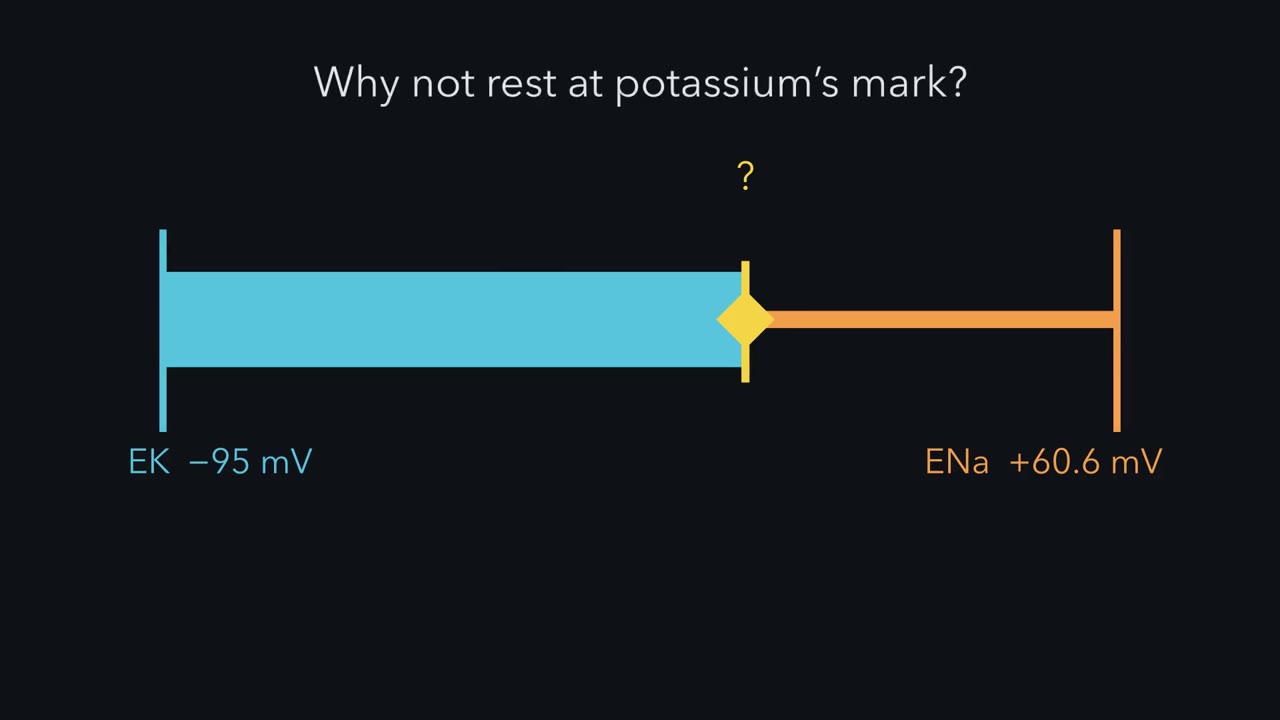
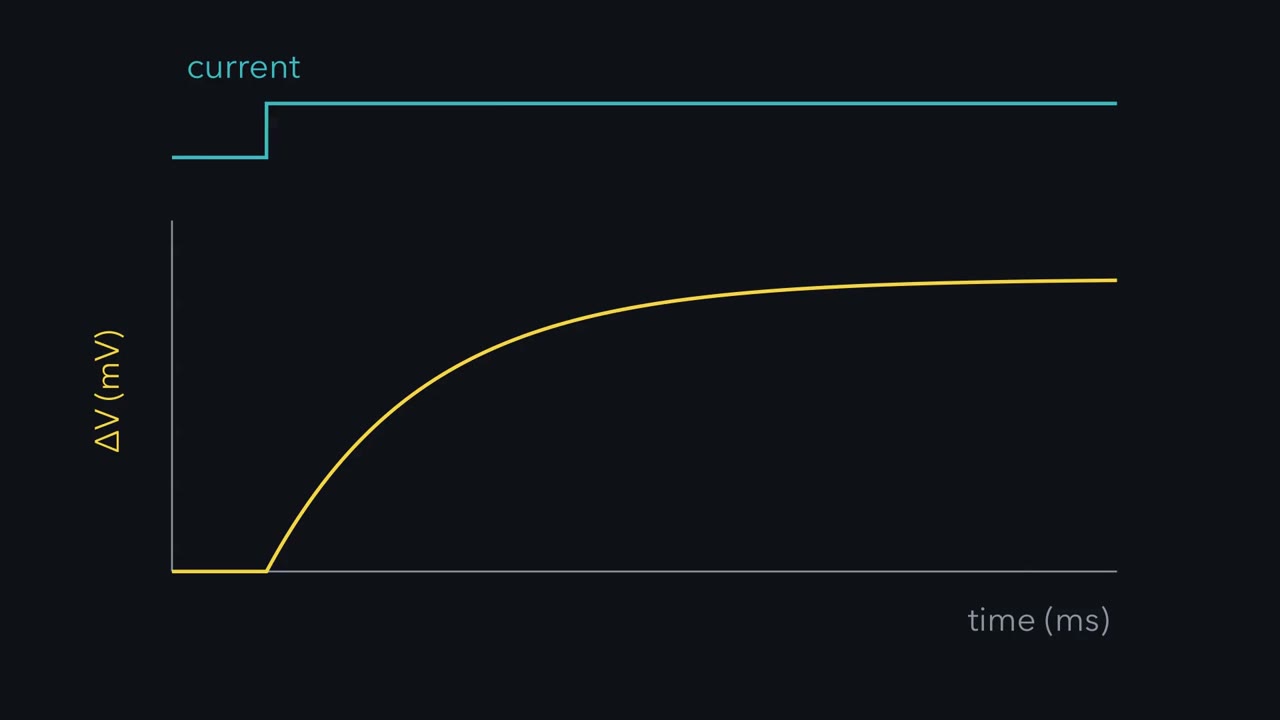
Capacitance does not change the shape. It only sets how fast the steady state arrives. Now double the leak, with everything else the same. In a compact cell, input resistance halves. The same current gives half the change. The time constant halves too, so the voltage gets there sooner. And along the cable, the length constant shrinks. Signals reach less far. Does the passive balance point move? That depends on the added leak's reversal potential. With no applied current, and the pump's own current set aside, doubling every leak in proportion leaves it unchanged. More leak makes a cell faster. But its responses are smaller, and they reach less far.
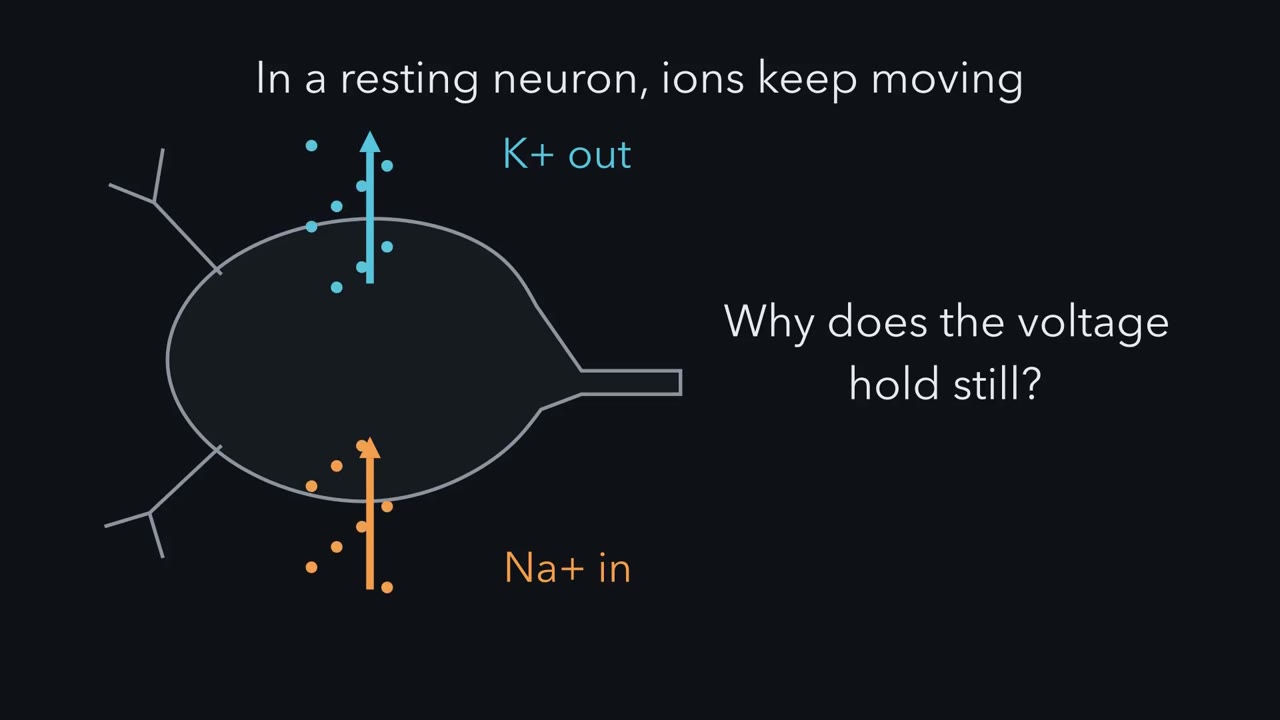
In a resting neuron potassium leaks out and sodium leaks in all the time. Why does the voltage hold still?
Continue in the lesson: The Resting Membrane and Passive Signals →
2:45 · Free, with captions and a transcript. The lesson has the full text, the questions and the sources.
More films from this lesson
How this film was made. Narration: an AI narrator voice (Kokoro, af_heart) reading narration written from this lesson's text. Animation: AI-generated in code (Manim) by Claude, a schematic with no drawn molecular structures. Captions come from the narration script. See something wrong? Report it.