A Nudge Takes Time
Read the transcript of “A Nudge Takes Time”
Film transcript: A Nudge Takes Time
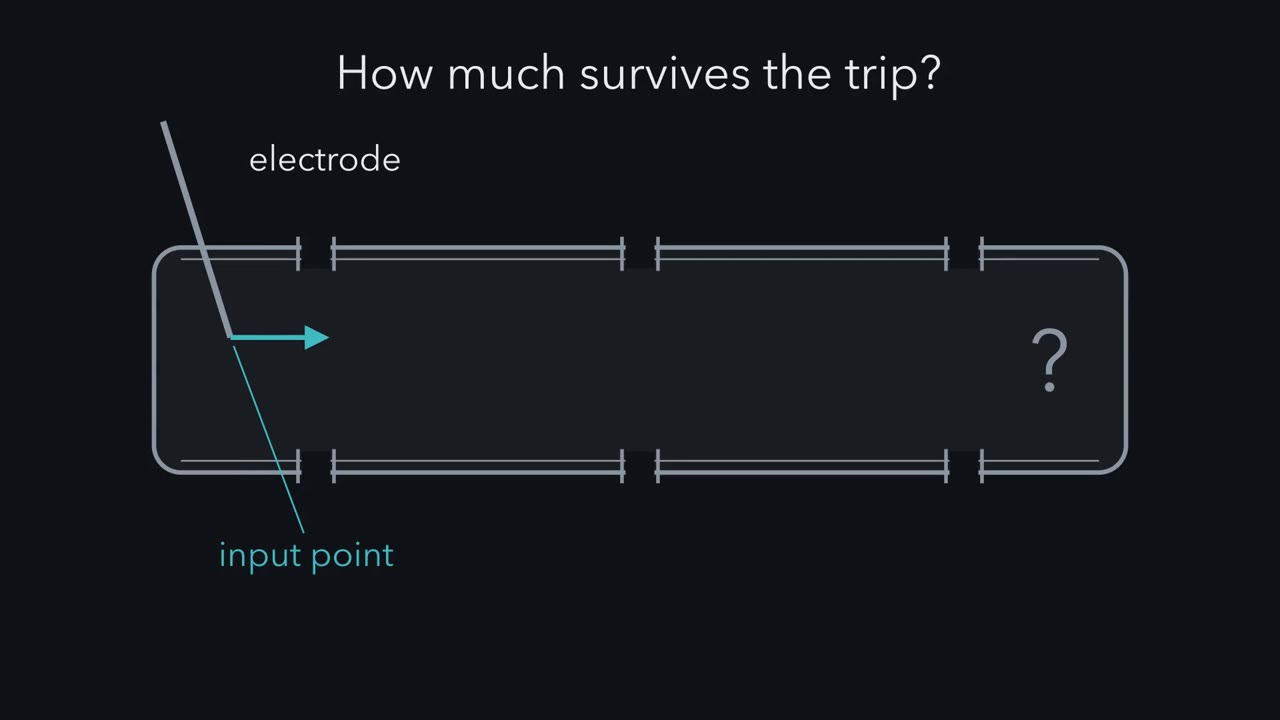
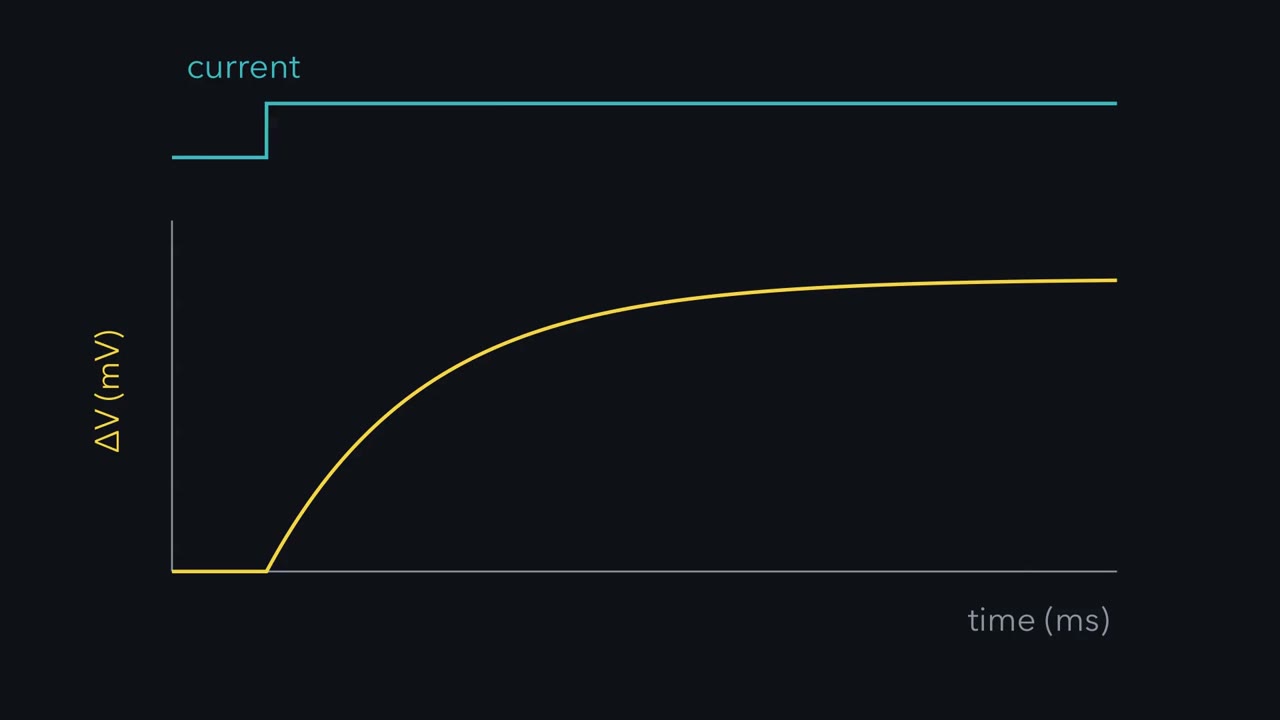
Push a small current into a resting cell. Does the voltage jump to its new level? In current clamp, you set the current flowing into the cell, and you record its voltage. Give our cell a small negative step of current. It pushes the voltage down, away from threshold. So does the voltage jump, the instant the current switches on?
No. It starts moving at once, but smoothly. Steeply at first, then bending over toward a plateau. When the step ends, it relaxes back to rest along the same kind of curve. The reason is that the membrane stores charge. The thin bilayer between two salty solutions is a capacitor. The leak channels are resistors, side by side with it. Picture a straight-sided tank with a drain. The water level is the size of the voltage change. The tank's width is the capacitance. The drain is the leak, and its outflow grows with the level. The injected current is a hose pouring in. At first the level has not risen, so nothing extra drains away. All the inflow raises the level.
That sets the starting slope: current divided by capacitance. As the level rises, more water drains out, so the level rises more slowly. stops rising when the drain carries all the inflow. That is the plateau. Now back to the ropes. The injected current is a steady extra pull on the marker. The ropes stretch until together they cancel it. So the balance point shifts by the current divided by the total leak, That shift for each unit of current is the input resistance. It is one over the total leak. For our cell, that is 100 MΩ. The balance point moves at once. The voltage follows it, at a pace set by capacitance and leak. That pace is the time constant.
It equals capacitance divided by total leak. In one time constant, the voltage gets about 63% % of the way. Not all of it. For our cell, the time constant is 20 ms. More leak means a smaller change, reached sooner. A change also lingers after its input ends. So inputs close together in time overlap and add. That is temporal summation. A longer time constant widens the window for overlap. The total leak sets how big a nudge is, and how fast the voltage gets there.
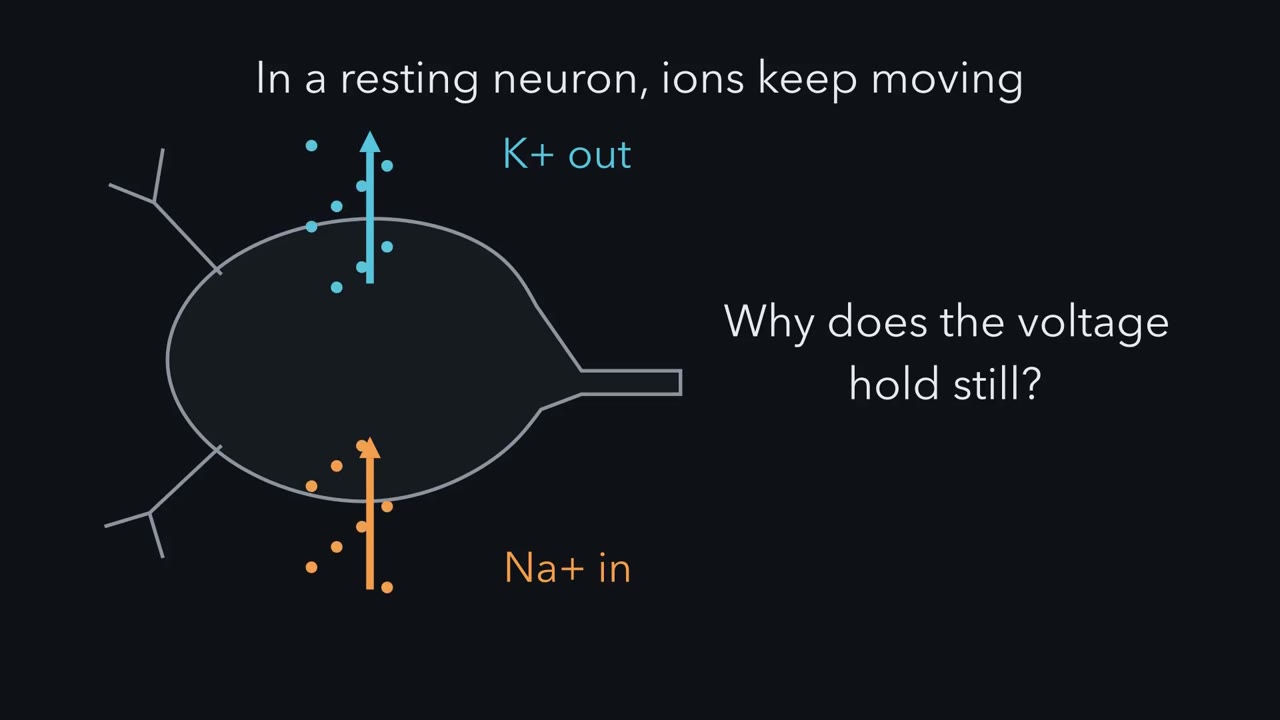
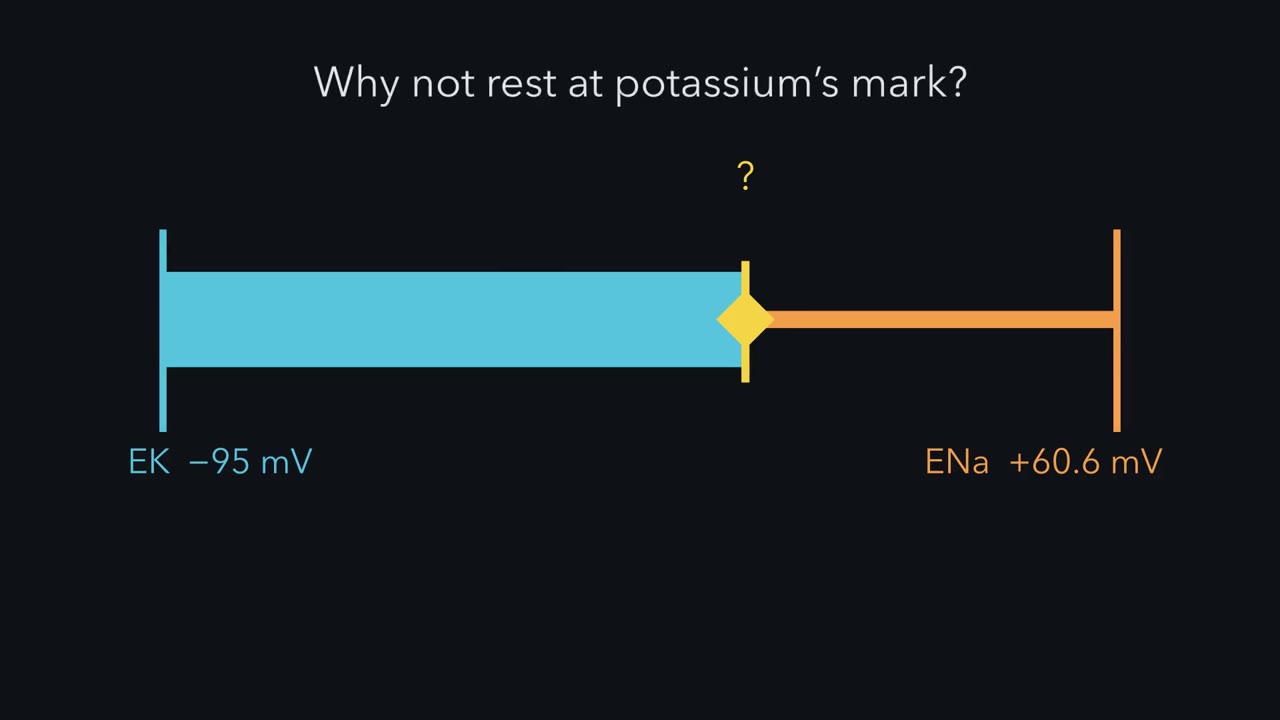
In a resting neuron potassium leaks out and sodium leaks in all the time. Why does the voltage hold still?
Continue in the lesson: The Resting Membrane and Passive Signals →
2:53 · Free, with captions and a transcript. The lesson has the full text, the questions and the sources.
More films from this lesson
How this film was made. Narration: an AI narrator voice (Kokoro, af_heart) reading narration written from this lesson's text. Animation: AI-generated in code (Manim) by Claude, a schematic with no drawn molecular structures. Captions come from the narration script. See something wrong? Report it.