Where the Leaks Balance
Read the transcript of “Where the Leaks Balance”
Film transcript: Where the Leaks Balance
Potassium has far more conductance than sodium. So why doesn't the cell rest right at potassium's mark? Back to the scale. Potassium's rope is thick. Sodium's rope is thin. The marker slides until the two pulls are equal and opposite. That spot is the balance point. Which end does the marker settle nearer? And roughly how far along?
Nearer potassium. The pulls are equal, so the thin rope must be stretched farther. Potassium's rope is about five and a half times stronger. So the marker sits about five and a half times closer to its mark. That puts rest at about minus −71 mV. And the two gaps are the sizes of the driving forces from before. The algebra says the same thing. Set the currents to add up to zero, and solve for the voltage. The resting potential comes out as an average of the equilibrium potentials. Each one is weighted by its conductance. More ions just add more terms, above and below the line. Do not shorten this to a rule about the biggest conductance. With three or more conductances, that shortcut can fail.
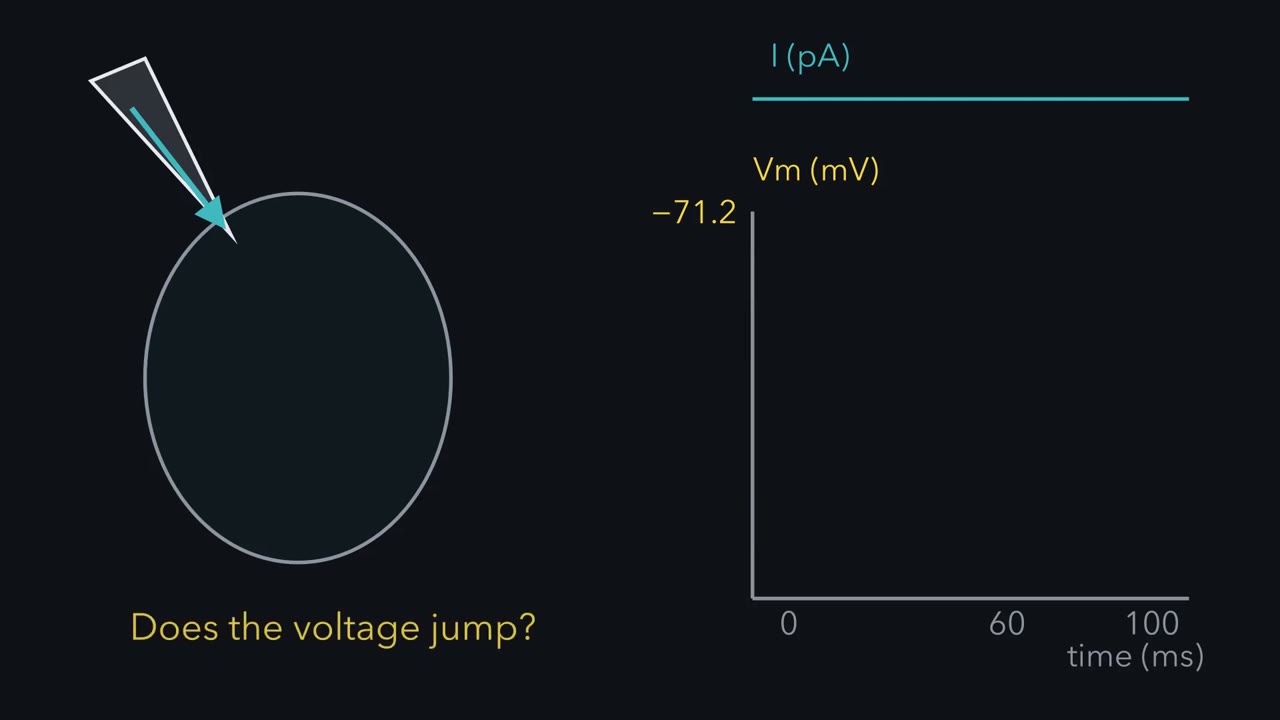
Three consequences follow. Open more of one ion's channels, and the balance point slides toward that ion's mark. Close some, and it slides away. Scale every leak up together, and the passive balance point stays put. But something else changes, as later chapters show. Double the sodium conductance, and rest moves toward sodium. But only partway, because potassium's rope is still stronger. Keep one number from this cell: its total leak, 10 nS. It comes back in the next chapter. Often you know concentrations and permeabilities, not conductances. Then you calculate with the Goldman-Hodgkin-Katz equation. It writes the same zero net current condition in those terms.
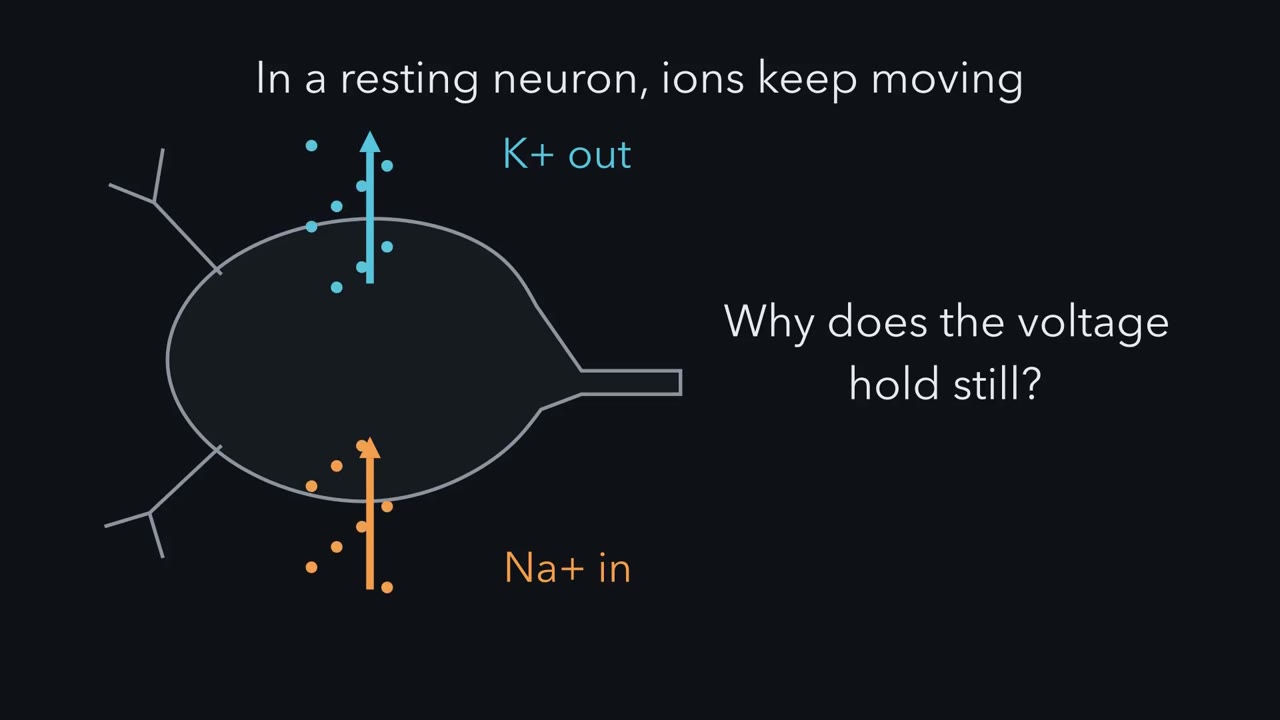
Each ion counts in proportion to its permeability. For our cell, it gives the same rest, about minus −71 mV. Permeability and conductance are different measures of the same channels. Permeability describes the pathway. Conductance here is the current divided by its driving force, the gap between the voltage and the ion's equilibrium potential. It also depends on the ions on each side, and the voltage. So reason with the balance point. Calculate with the Goldman-Hodgkin-Katz equation when you have concentrations and permeabilities. One more piece. Left alone, these leaks would run the gradients down. The sodium-potassium pump puts the ions back.
Three sodium go out and two potassium come in, for each ATP. So rest is a steady state, kept up by the pump. It is not an equilibrium. The pump's own current can also shift rest a little more negative. In many cells that shift is small, but it varies. With no current injected, and the pump's own current set aside, rest is where the leaks balance: the conductance-weighted average of the reversal potentials.
In a resting neuron potassium leaks out and sodium leaks in all the time. Why does the voltage hold still?
Continue in the lesson: The Resting Membrane and Passive Signals →
3:35 · Free, with captions and a transcript. The lesson has the full text, the questions and the sources.
More films from this lesson
How this film was made. Narration: an AI narrator voice (Kokoro, af_heart) reading narration written from this lesson's text. Animation: AI-generated in code (Manim) by Claude, a schematic with no drawn molecular structures. Captions come from the narration script. See something wrong? Report it.