Press play to start at .
Timing, Context, and Jammed Relays
From the film
- Duration, cell context, and pathway state shape what the cascade does.
- ERK limits its own signal through fast feedback on SOS and Raf and slower induction of dual-specificity phosphatases.
- In PC12 cells a brief ERK pulse goes with division and a sustained plateau with differentiation, while the same always-on MEK transforms fibroblasts.
- ATP-pocket Raf inhibitors block B-Raf V600E but can paradoxically activate normal Raf pairs when Ras is active, which MEK inhibition blocks below Raf.
Read the transcript of “Timing, Context, and Jammed Relays”
Film transcript: Timing, Context, and Jammed Relays
Tap a sentence to play from there.
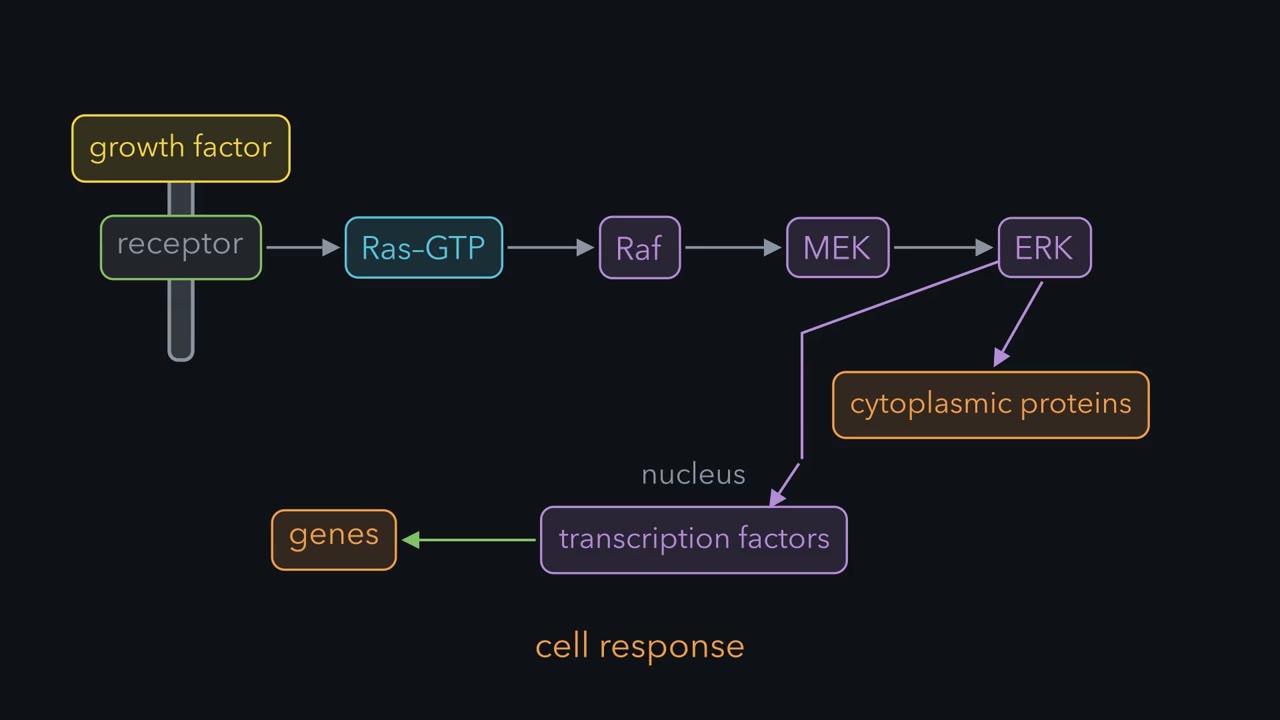
- 0:02 The first film traced how Ras, Raf, MEK, and ERK carry a membrane signal to genes.
- 0:10 How can that same relay tell one cell to divide and another to stop dividing?
- 0:15 In PC12 cells, EGF drives division, while NGF grows nerve-like fibres.
- 0:22 A signal carries duration as well as strength, and ERK helps set its own clock.
- 0:29 Active ERK sends fast negative feedback upstream, phosphorylating SOS and Raf to weaken them. ERK also induces phosphatases that strip both of its own phosphates.
- 0:42 They act slowly because new protein must be made.
- 0:46 How long the receptor stays active, plus this feedback, sets how long ERK stays on.
- 0:52 In PC12 cells, EGF sparks a brief ERK pulse fading within an hour.
- 0:59 NGF holds ERK high for hours.
- 1:02 Brief ERK goes with division, and sustained ERK with differentiation.
- 1:07 How widely other cells use this clock stays open.
- 1:11 Cell context matters just as much as timing.
- 1:15 Researchers placed the same permanently active MEK into two cell types and got opposite answers. PC12 cells grew neurites with no growth factor at all.
- 1:28 Mouse fibroblasts instead piled into disordered foci, a hallmark of transformation toward cancer.
- 1:35 Human tumours jam this relay higher up.
- 1:39 Ras normally shuts itself off by cutting GTP to GDP, helped by GAP proteins.
- 1:46 A single base change, glycine 12 to valine, blunts that cut, so Ras stays on.
- 1:52 One tier down, many melanomas carry mutant B-Raf V600E.
- 1:58 It signals without Ras-GTP, possibly even without a Raf partner.
- 2:04 Now test how pathway state flips a drug.
- 2:08 Vemurafenib plugs the ATP pocket and shuts down B-Raf V600E.
- 2:14 Add that same drug to cells with active Ras and normal B-Raf.
- 2:19 Does ERK fall, stay flat, or rise?
- 2:27 Surprisingly, ERK rises.
- 2:31 Active Ras brings normal Raf molecules into pairs at the membrane.
- 2:36 A drug-bound Raf cannot work itself, yet its contact still pushes the drug-free partner into an active shape.
- 2:44 Trametinib binds a separate pocket beside MEK's ATP site.
- 2:49 Blocking MEK below Raf helps close that escape, so both drugs are often combined.
- 2:55 Milder germline over-activation causes developmental syndromes called RASopathies, including Noonan syndrome and neurofibromatosis type 1.
- 3:07 In neurofibromatosis type 1, losing neurofibromin, one of Ras's GAP proteins, leaves Ras active too long.
- 3:16 Every cell carries the change, yet tissues differ.
- 3:20 Across health and disease, duration, cell context, and pathway state shape what the cascade does.
The Ras to MAPK cascade: the same idea, other levels
A level is a place to start, not a rank. If this loses you, the rung below teaches the same idea, told more simply.
Graduate · the level you chose
Ras to MAPK: The Kinase Cascade · this lesson
Ras-GTP catches Raf, then Raf, MEK and ERK relay it; PC12 cells read duration.
Cell Signaling · about 19 min · film 3:14 · 3 practice questions
Next door
- Cell division (mitosis): Two Jobs, One Division · 2:41 The cascade ends at genes that tell a resting cell to enter the cell cycle.
- Oncogenes: How a Normal Switch Sticks On · 3:10 Hyperactive Ras or its downstream kinases appear in many cancers, as in melanoma with changed BRAF.
- Targeted drugs: Selectivity and Escape at One Pocket · 3:18 Drugs that block one kinase in this relay are used against tumours with a changed member.
More films from this lesson
Continue in the lesson: Ras to MAPK: The Kinase Cascade →
Free, with captions and a transcript. The lesson has the full text, the questions and the sources.
How this film was made. Narration: an AI narrator voice (Kokoro, af_heart) reading narration written from this lesson's text. Animation: AI-generated in code (Manim) by Claude, a schematic with no drawn molecular structures. Captions come from the narration script. See something wrong? Report it.