Press play to start at .
Many Mutations, One Weak Point
From the film
- Tumours usually need several changes, yet often depend on one stuck switch.
- Normal cells read a nonstop growth signal as a fault, so checkpoints such as p53 halt or kill the cell.
- To become a tumour, cells usually collect cooperating changes across growth switches, off-switches and checkpoints.
- Shutting off one driving oncogene can still shrink a multi-mutation tumour, a dependence called oncogene addiction whose exact cause is debated.
Read the transcript of “Many Mutations, One Weak Point”
Film transcript: Many Mutations, One Weak Point
Tap a sentence to play from there.
- 0:02 In the first film, one altered gene copy jammed a growth switch on.
- 0:08 Why does one stuck switch rarely make a tumour?
- 0:12 And why can blocking just one switch shrink a tumour with many mutations?
- 0:17 Let us zoom out from that switch and watch the whole cell.
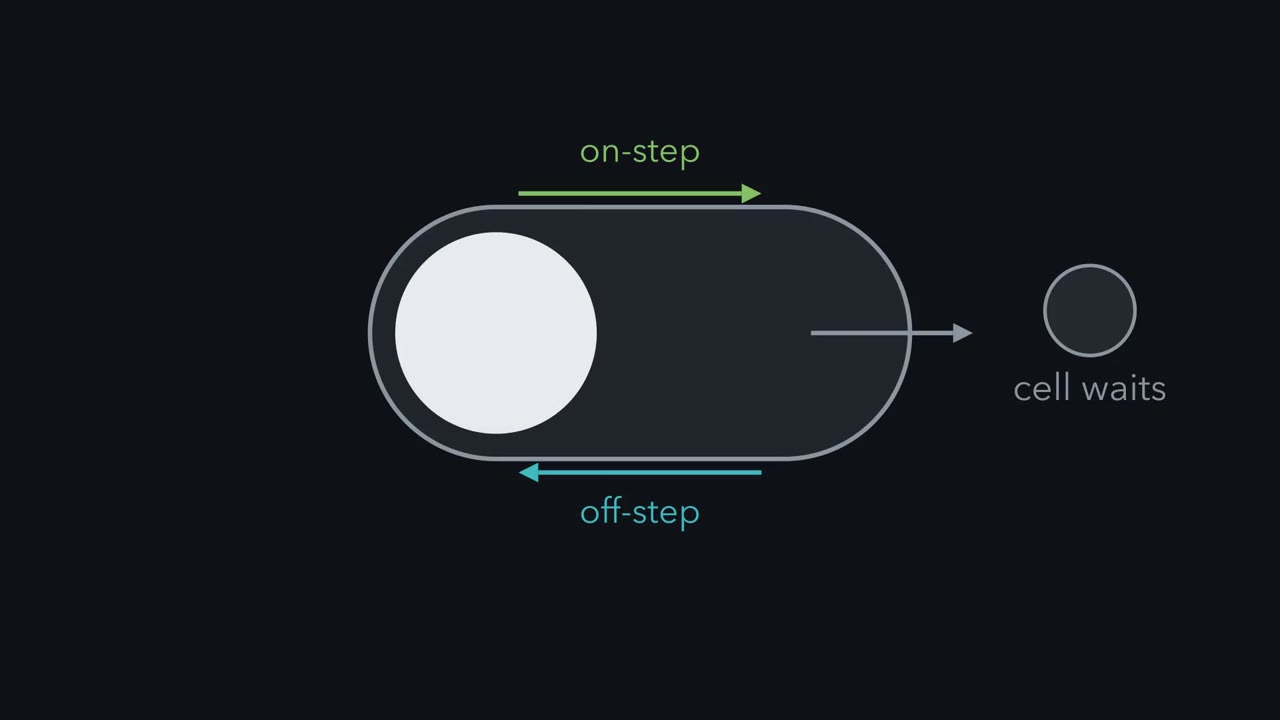
- 0:21 You might expect a stuck growth switch to make a normal cell divide nonstop.
- 0:27 Surprisingly, the cell usually stops instead.
- 0:31 A healthy cell reads a nonstop growth signal as a dangerous fault, not a normal order. Internal safety guards called checkpoints catch the fault before the cell runs away.
- 0:43 One major guard is the checkpoint protein p53.
- 0:48 A nonstop growth signal alarms it much like damaged DNA does.
- 0:53 It halts cell division at once or triggers apoptosis, which is programmed cell death. Even cells that slip past it still need survival signals to stay alive.
- 1:05 That is why one stuck switch is seldom enough for cancer.
- 1:10 To become a tumour, a cell usually collects several cooperating changes over time.
- 1:16 It may pair a stuck on-switch with a lost off-switch, a broken checkpoint, and blocked cell death.
- 1:23 Step by step, those combined faults let a tumour grow.
- 1:27 Now picture a tumour that already carries all of those mutations.
- 1:33 Its checkpoint is gone, its off-switch is missing, and one growth switch is jammed on. Suppose a targeted drug shuts off only that one stuck switch, leaving every other mutation untouched.
- 1:47 Will the tumour keep growing, or will it shrink?
- 1:55 Often, the tumour shrinks, because its cells have come to lean on that one signal.
- 2:01 Their other mutations stay untouched inside every cell, yet the cells stop dividing or die. Scientists call this dependence oncogene addiction.
- 2:11 That is why one targeted drug can sometimes shrink a tumour carrying many mutations.
- 2:18 Why does turning off one switch hit so hard?
- 2:22 The exact cause is still debated, and two ideas lead.
- 2:27 First, a stuck pathway keeps feedback brakes high, which may quiet nearby backup routes. Second, once the signal stops, survival signals may fade faster than death signals. Either way, the cell tips toward death.
- 2:43 Normal checkpoints guard a cell against a single jammed switch, so cancer usually requires several cooperating changes.
- 2:52 Yet a tumour built around one loud driver can stay hooked on that single signal.
- 2:58 Put both halves together clearly: tumours usually need several changes, yet often depend on one stuck switch.
Oncogenes: the same idea, other levels
A level is a place to start, not a rank. If this loses you, the rung below teaches the same idea, told more simply.
Graduate · the level you chose
Oncogenes: When the Switch Sticks · this lesson
A chicken virus's src was the hen's own gene; five ways a switch sticks.
Cell Signaling · about 22 min · film 3:10 · 3 practice questions
College, the core · the level you chose
HRAS Val12 ignores the GAP that switches it off; MYC is amplified or moved.
Genetics and Molecular Biology · about 22 min · film 3:34 · 3 practice questions
Play the ladder · 2 films, about 7 min, from college core to graduate level. Each film waits for you to press play.
Next door
- Cancer: One Cell, Two Routes · 3:34 · College: the core Cancer starts when changes like these let a cell's descendants grow where they should not.
- Mutation: Before the Phage Arrives · 3:37 · College: the core An oncogene begins as a DNA change in a normal growth gene that leaves it stuck on.
- Targeted drugs: Selectivity and Escape at One Pocket · 3:18 Many drugs are designed to block the one overactive protein an oncogene produces.
More films from this lesson
Continue in the lesson: Oncogenes: When the Switch Sticks →
Free, with captions and a transcript. The lesson has the full text, the questions and the sources.
How this film was made. Narration: an AI narrator voice (Kokoro, af_heart) reading narration written from this lesson's text. Animation: AI-generated in code (Manim) by Claude, a schematic with no drawn molecular structures. Captions come from the narration script. See something wrong? Report it.