Films · Developmental Neuroscience
Where Is the Netrin?
Read the transcript of “Where Is the Netrin?”
Film transcript: Where Is the Netrin?
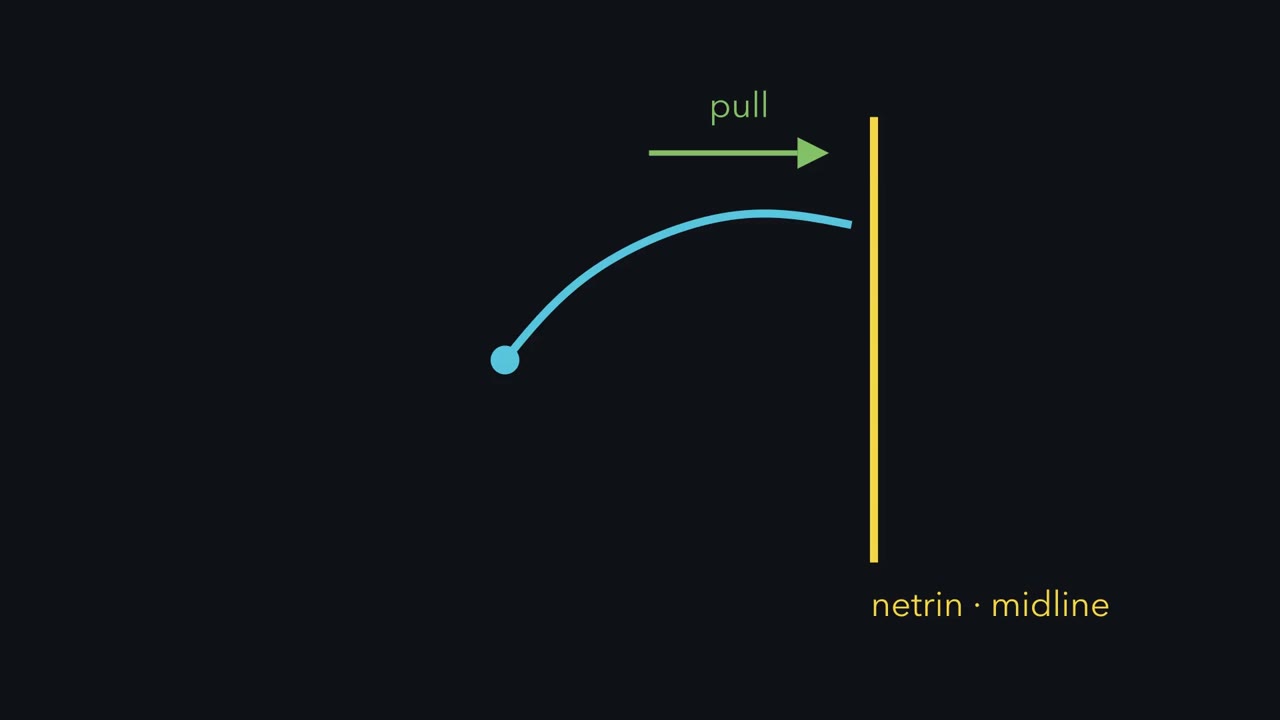
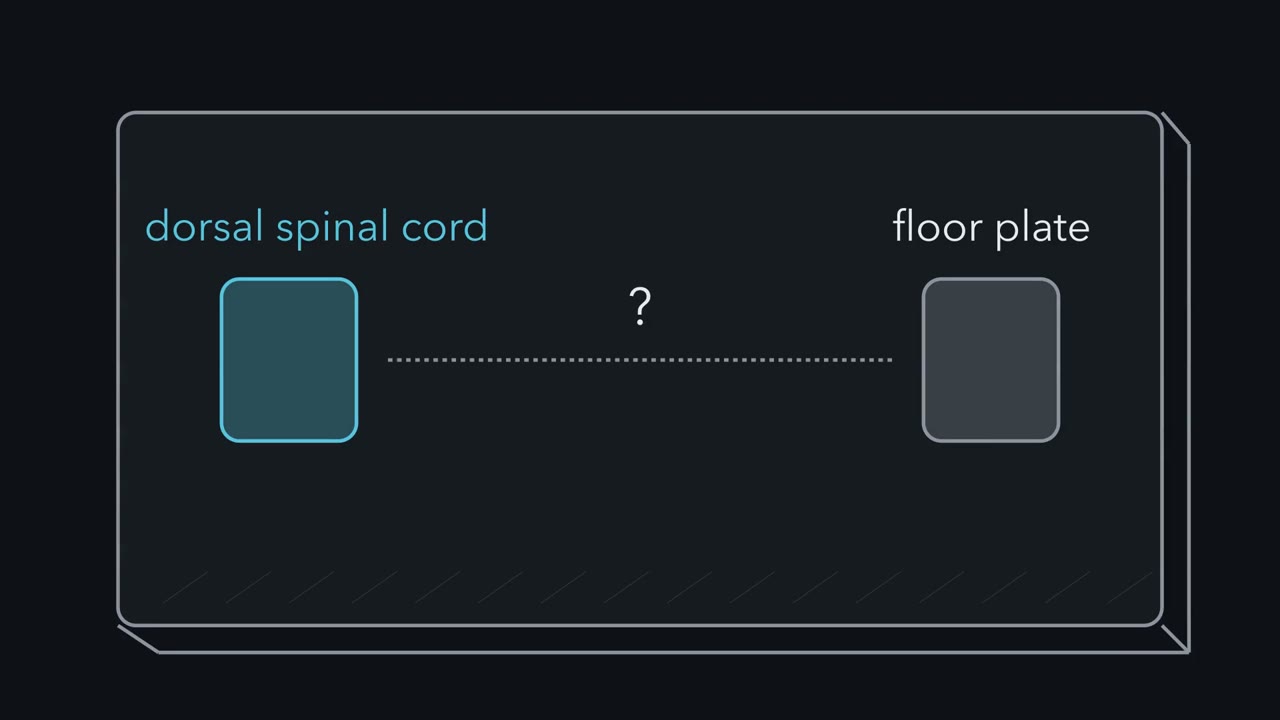
Is netrin a gradient spreading from the midline, or a path laid down along the way? Return to the map: the floor plate at the bottom, the progenitors around the canal. Start in a dish. A growth cone compares the cue on its two sides. Around a small source, like a bead, concentration falls with distance. The fractional difference across a growth cone is roughly its width over its distance from the source. Close in, a growth cone sees about a ten percent difference. A millimetre away, about one percent. But a growth cone measures bound receptors, not netrin itself. The Kd is the concentration that fills half the receptors. Give it the same ten percent difference at three backgrounds: far below the Kd, at it, far above. Where is the bound difference largest?
At the Kd. Far below it, almost no receptors are bound on either side. Far above it, almost all are. Binding is noisy, because molecules arrive and leave at random. A tiny difference is easily lost. A fixed detector gets the most signal near its Kd. Adapting, by resetting its baseline, lets the growth cone respond again as the background changes. It cannot remove the binding limit. Now the embryo, where netrin-1 is made in two places. Floor plate cells make it. So do progenitors across a broad stretch of the ventricular zone. The progenitors send netrin out along their fibres. It builds up at the pial surface, along the commissural axons' path.
So there are two candidate ways to guide. One is a gradient diffusing from the floor plate. That is chemotropism. Guidance by netrin held on a surface is called haptotaxis. In 2017, two groups deleted the netrin-1 gene from one source at a time, in mice. A conditional deletion removes a gene only in chosen cells. If a floor plate gradient did most of the guiding, which deletion should cause more errors?
The floor plate deletion should. It did not. Without floor plate netrin, most commissural axons stayed on course. Without progenitor netrin, many commissural axons went off course. A third study found the same pattern in the hindbrain.
A deletion shows which source the axons need, not how they read it. A path and a short-range gradient both fit. Nor is the floor plate idle. In the spinal cord, later studies found that its netrin still contributes. So, much of the netrin that matters seems to act near where progenitors lay it down. That holds in the mouse spinal cord and hindbrain. In the spinal cord, the floor plate keeps a part. After crossing, the axons do not turn back. What changes in the reader is the next lesson. The takeaway: netrin marks a place, and the growth cone decides what to do there.
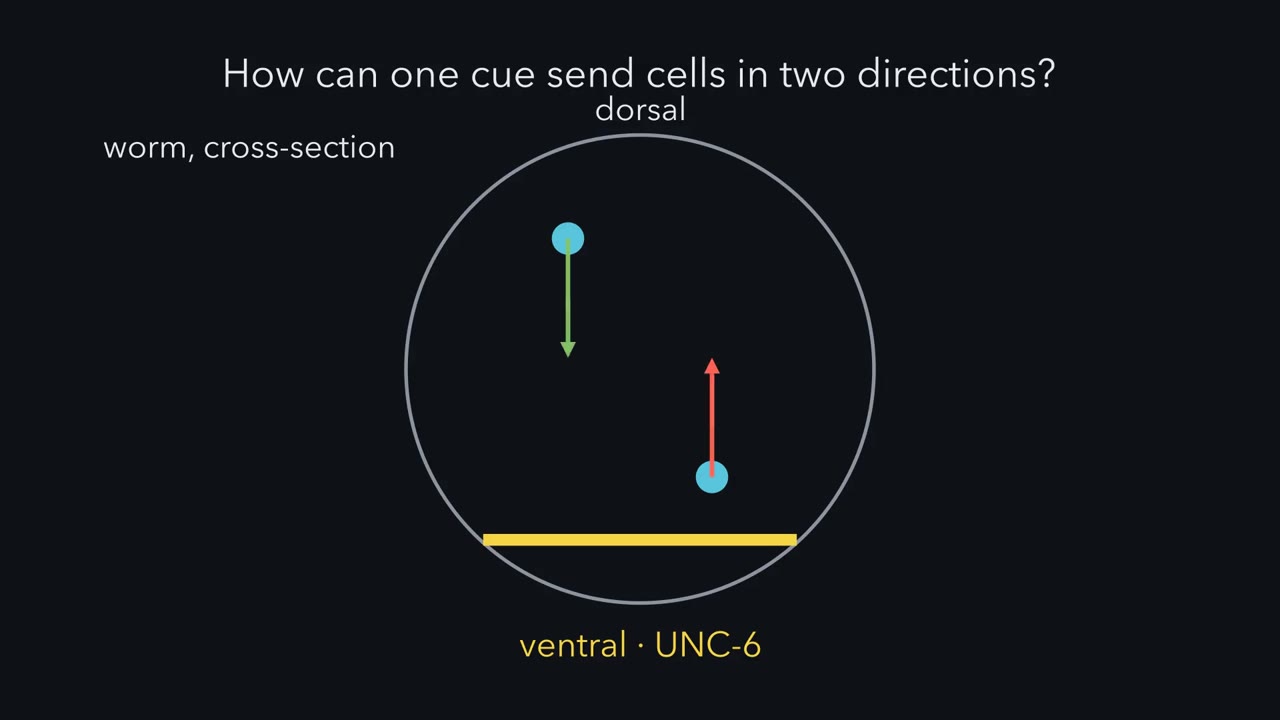
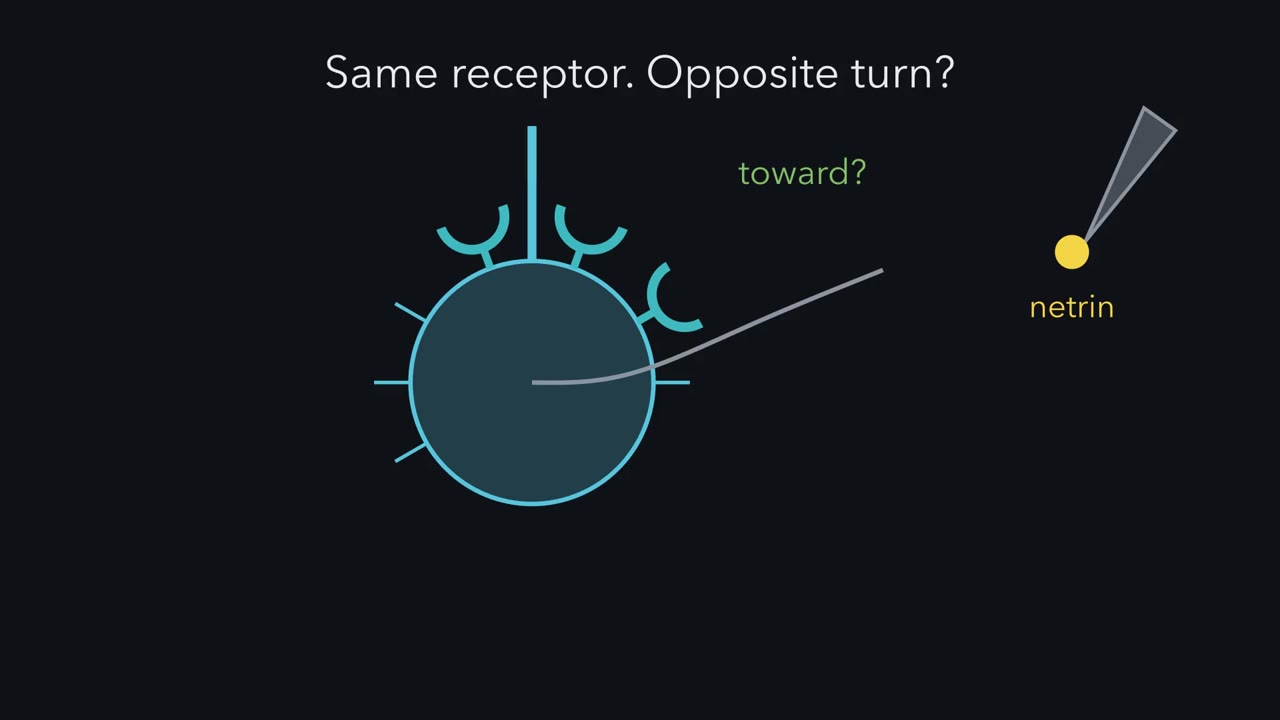
The same protein pulls one axon toward the midline of the embryonic spinal cord and pushes another away. What decides?
Continue in the lesson: Netrin and DCC: One Cue, Two Answers →
3:32 · Free, with captions and a transcript. The lesson has the full text, the questions and the sources.
More films from this lesson

How this film was made. Narration: an AI narrator voice (Kokoro, af_heart) reading narration written from this lesson's text. Animation: AI-generated in code (Manim) by Claude, a schematic with no drawn molecular structures. Captions come from the narration script. See something wrong? Report it.