Films · Developmental Neuroscience
Something Crosses the Gel
Read the transcript of “Something Crosses the Gel”
Film transcript: Something Crosses the Gel
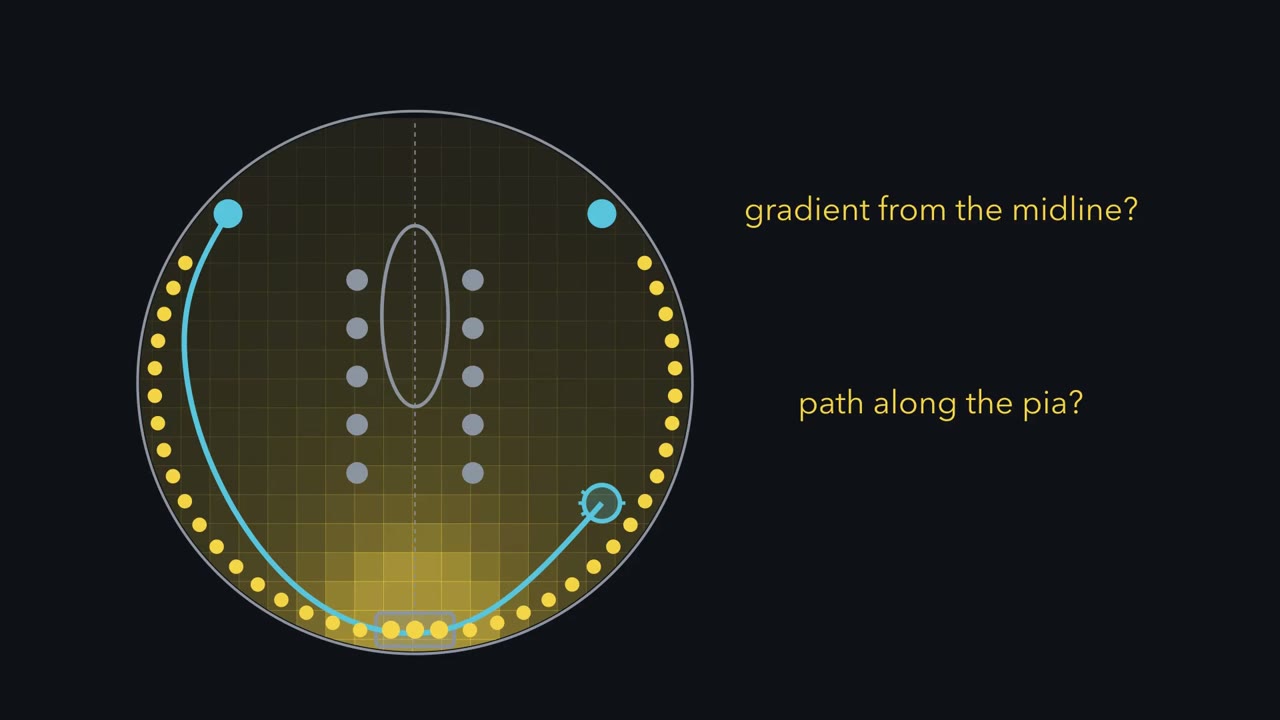
A floor plate and a piece of dorsal spinal cord sit apart in a gel. How could one steer the other? Start on the map: commissural axons grow from the dorsal cord toward the floor plate. In 1988, in Thomas Jessell's laboratory, Marc Tessier-Lavigne and colleagues tested this in a dish. They cut pieces of embryonic rat spinal cord. Each piece was an explant, living tissue cultured outside the embryo. They set the explants in a collagen gel. Some held dorsal spinal cord, others floor plate. First, the control. A dorsal explant sits in the gel on its own. What should it do?
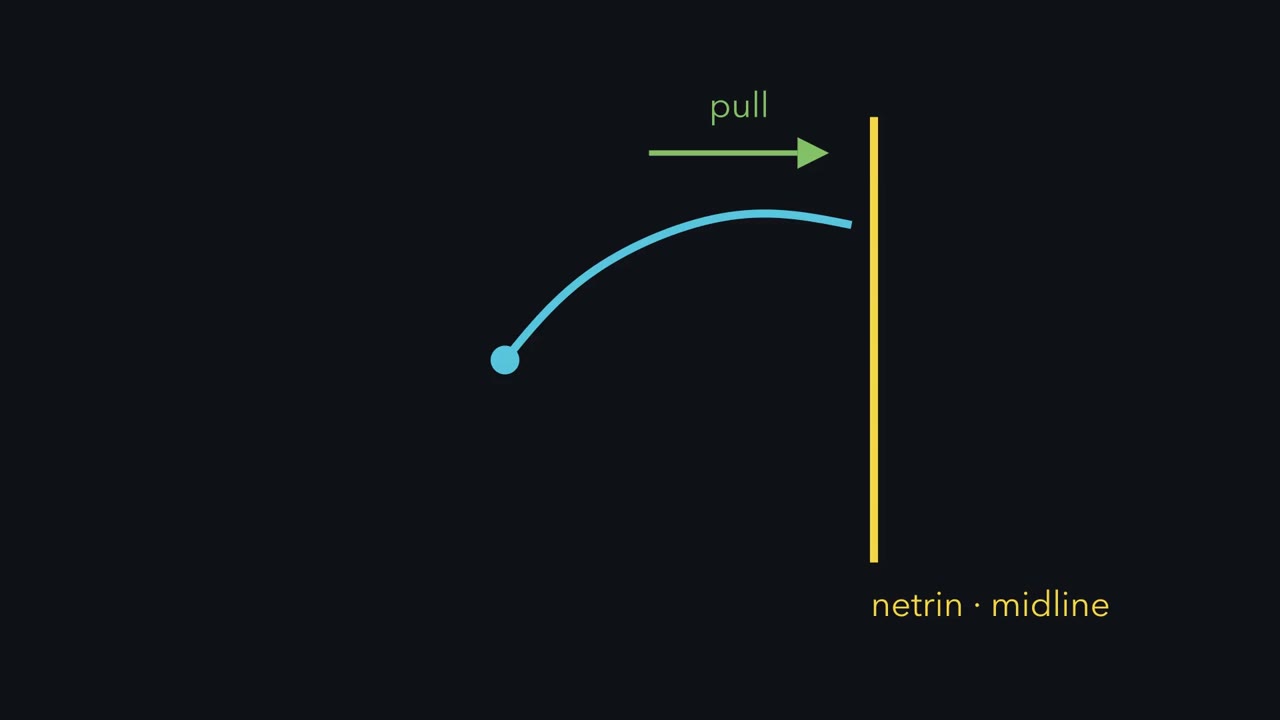
On its own, it sent out few or no axons. Now place a floor plate explant nearby. Bundles of commissural axons grew out of the dorsal explant, toward the floor plate. The explants never touched. So the effect had to cross the gel. A cue that draws axons from a distance is a chemoattractant. Steering by a diffusing cue is chemotropism. Picture smelling bread from down the street. You know which way the bakery is, but not the recipe. Unlike bread, whether netrin draws you in depends on who is smelling it. To name the molecule, you must purify it. Floor plates are far too small. So in 1994, the laboratory kept rat explants as the detector and searched embryonic chick brain.
Thousands of brains went into the work. The extract was separated over several chromatography columns. After each step, every fraction went back onto rat spinal-cord explants. The axons reported which fractions to keep. Two proteins came through. Their sequences were related to laminin, a matrix protein, and to a worm protein, UNC-6. The authors named them netrin-1 and netrin-2. Each promoted commissural outgrowth. Does promoting outgrowth prove that netrin steers axons? Think about what the assay scored.
No. The assay scored whether axons grew out, not which way they pointed. Outgrowth is not direction. A companion paper supplied direction. Floor plate cells make netrin-1 RNA. And cells engineered to secrete netrin attracted commissural axons at a distance in the gel. The takeaway: netrin is what crosses the gel, and it can attract at a distance.
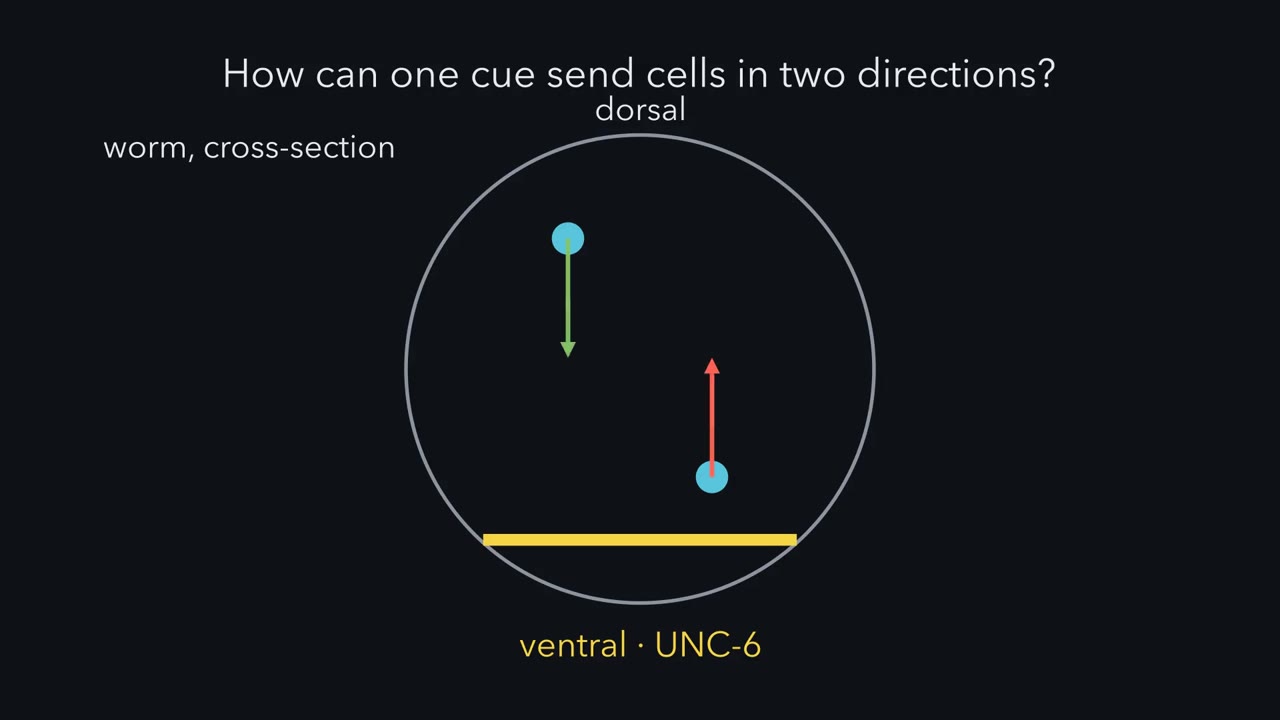
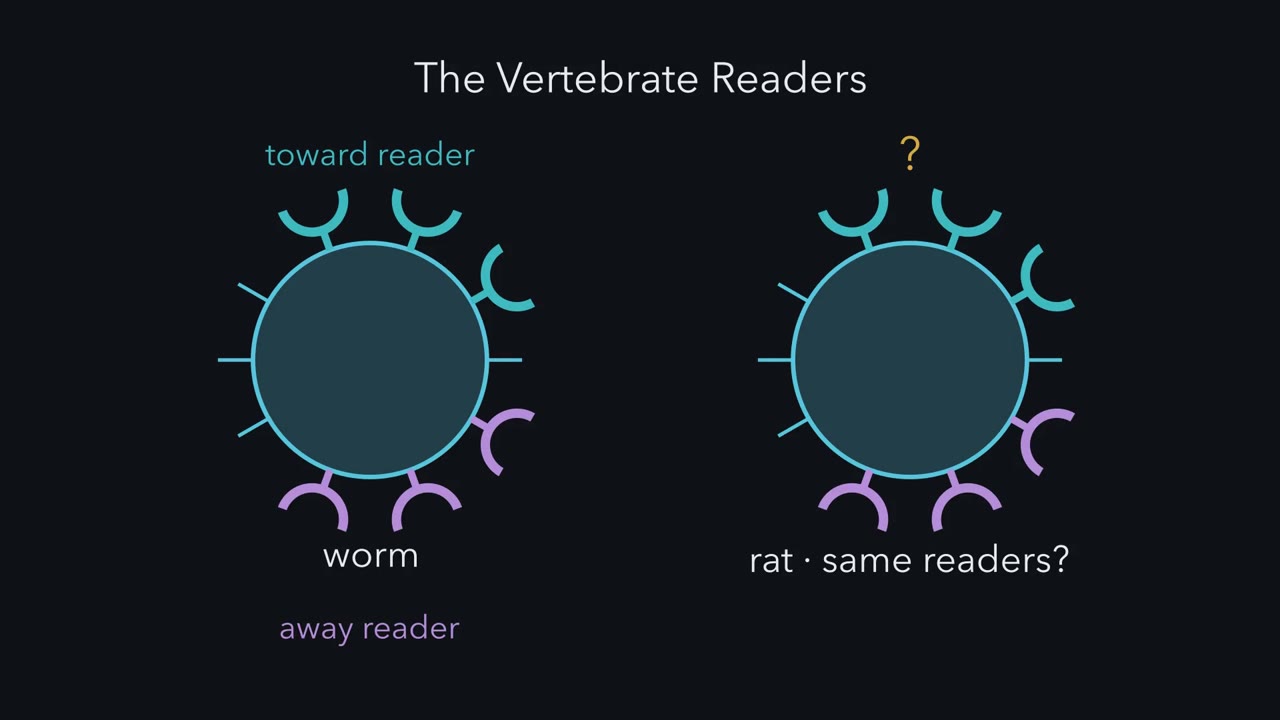
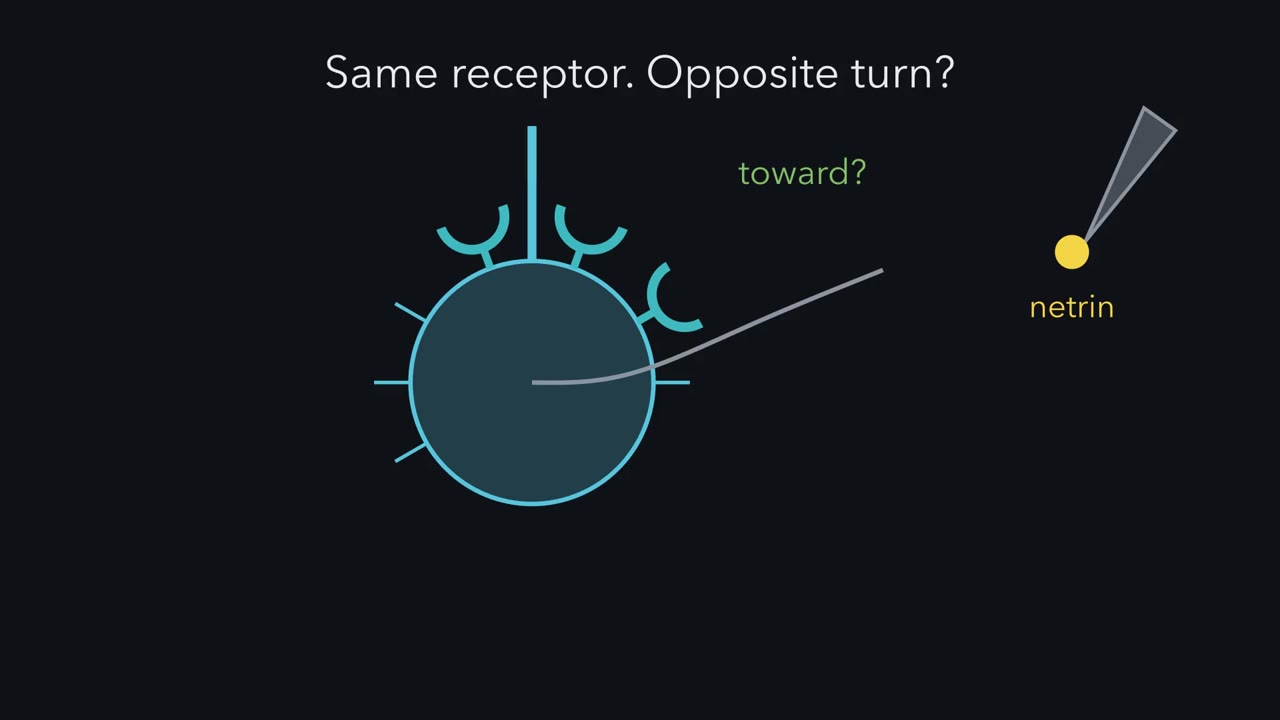
The same protein pulls one axon toward the midline of the embryonic spinal cord and pushes another away. What decides?
Continue in the lesson: Netrin and DCC: One Cue, Two Answers →
3:02 · Free, with captions and a transcript. The lesson has the full text, the questions and the sources.
More films from this lesson
How this film was made. Narration: an AI narrator voice (Kokoro, af_heart) reading narration written from this lesson's text. Animation: AI-generated in code (Manim) by Claude, a schematic with no drawn molecular structures. Captions come from the narration script. See something wrong? Report it.