Press play to start at .
Where the Profit Comes From
From the film
- On the standard ladder, a kinase can load ADP favorably only from a phosphate above ATP's.
- At step 6, an oxidation is saved in an activated bond, and inorganic phosphate, not ATP, then makes 1,3-bisphosphoglycerate, whose new phosphate sits above ATP.
- Steps 8 and 9 rearrange the molecule into PEP, lifting its old phosphate to the top of the ladder, because what remains after the phosphate leaves quickly settles into pyruvate.
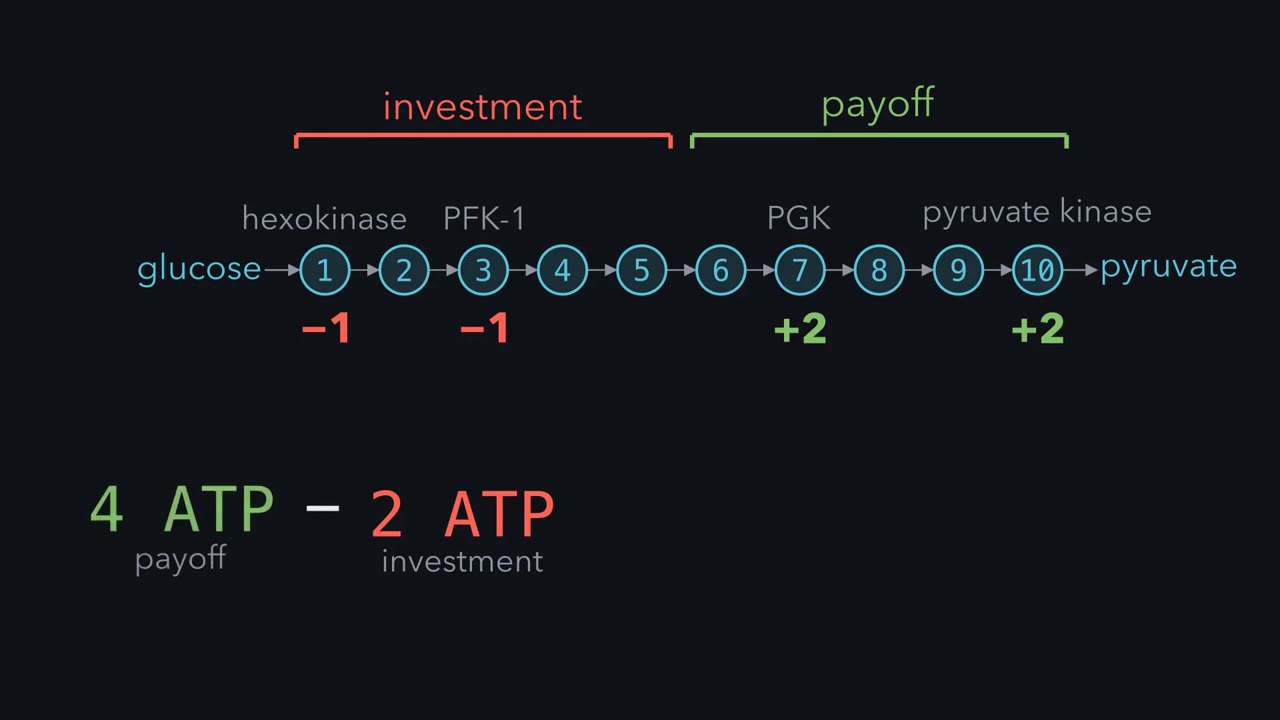
- Counting phosphate groups for one glucose, four go to ADP: two repay the ATP spent at steps 1 and 3, and two are new.
- From glucose, the net gain is exactly the new phosphate captured by the step 6 oxidation.
Read the transcript of “Where the Profit Comes From”
Film transcript: Where the Profit Comes From
Tap a sentence to play from there.
- 0:00 The first film did the arithmetic.
- 0:04 Spend two ATP, earn four, keep two.
- 0:07 But each half of the sugar carries one ordinary phosphate.
- 0:11 So how does each half hand two phosphates to ADP?
- 0:17 Phosphates sit on a ladder, ranked by how eager they are to leave.
- 0:23 ATP sits at −30.5 kJ/mol.
- 0:27 On this standard ladder, a kinase can load ADP favorably only from a higher rung.
- 0:34 The sugar half's phosphate is an ordinary one, far below.
- 0:38 So the cell builds a higher rung.
- 0:41 At step 6, an enzyme oxidizes the sugar half, and NAD+ plus takes the electrons.
- 0:49 Done in one go, that energy would be lost as heat.
- 0:53 Instead, the enzyme holds it in an activated bond.
- 0:57 Then inorganic phosphate, from the cell's pool, not from ATP, attacks that bond and carries the sugar half away.
- 1:06 Its new phosphate sits at −49.3 kJ/mol, well above ATP.
- 1:11 At step 7, a kinase hands it to ADP.
- 1:15 Here is the idea to hold.
- 1:18 From glucose, the net gain is exactly the new phosphate that this oxidation captures. Everything else the cell hands to ADP is only paid back.
- 1:29 But that old phosphate is still on the sugar half, below ATP.
- 1:35 There is no second oxidation.
- 1:38 So how can it make ATP?
- 1:45 Rearrange the molecule.
- 1:48 Step 8 slides the phosphate from carbon 3 to carbon 2.
- 1:53 Step 9 pulls off water, making PEP.
- 1:56 That barely changes the free energy.
- 1:59 Yet PEP's phosphate sits at the top of the ladder, −61.9 kJ/mol.
- 2:06 The secret is what stays behind.
- 2:09 Once the phosphate leaves, the rest is an unstable form that quickly settles into pyruvate. So this phosphate leaves very readily.
- 2:19 At step 10, a kinase hands it to ADP.
- 2:23 Now count phosphate groups for one glucose.
- 2:26 Four leave to ADP.
- 2:29 Two only repay the ATP spent at steps 1 and 3.
- 2:34 Two are new, taken from inorganic phosphate at step 6.
- 2:38 The oxidation paid for those two.
- 2:41 So the two phosphates lent by ATP only break even.
- 2:46 Every ATP glycolysis nets from glucose was paid for by the oxidation at step 6, which needs NAD+.
Glycolysis: the same idea, other levels
A level is a place to start, not a rank. If this loses you, the rung below teaches the same idea, told more simply.
College, upper level · the level you chose
Glycolysis: The Investment-and-Payoff Pathway · this lesson
Steps 7 and 10 make 4 ATP; steps 1 and 3 spent 2.
Biochemistry · about 25 min · film 2:37 · 17 practice questions
Next door
- Cellular respiration: Metabolism: Basic Concepts and Design Glycolysis is the first stage of releasing the energy in glucose.
- Fermentation: Stopping Partway · 3:11 · High school Without oxygen, pyruvate is turned to lactate or ethanol so glycolysis can keep running.
- Citric acid cycle: Follow the Electrons · 3:31 The pyruvate it makes is burned to carbon dioxide in the cycle.
More films from this lesson
Continue in the lesson: Glycolysis: The Investment-and-Payoff Pathway →
Free, with captions and a transcript. The lesson has the full text, the questions and the sources.
How this film was made. Narration: an AI narrator voice (Kokoro, af_heart) reading narration written from this lesson's text. Animation: AI-generated in code (Manim) by Claude, a schematic with no drawn molecular structures. Captions come from the narration script. See something wrong? Report it.