Press play to start at .
Two Fixes for the Lock
From the film
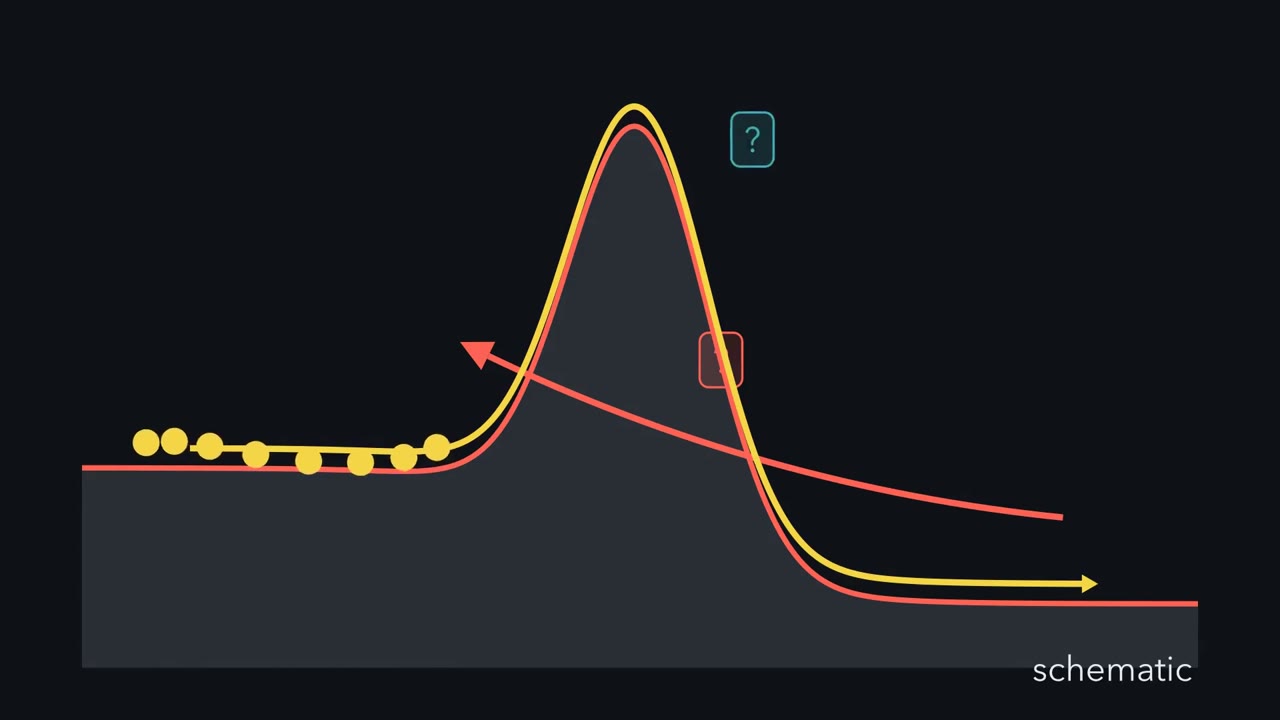
- Fischer's 1894 lock and key explained why an enzyme acts on one sugar and ignores its near-twin, but the picture needs two fixes.
- Fit: a rigid lock cut for the substrate would hold the substrate most tightly, but the active site fits the transition state best.
- Shape: in Koshland's induced fit, glucose binding closes hexokinase's site and lines up its catalytic groups, and water is too small to force that closing.
- Many enzymes also shift between open and closed shapes before substrate arrives, and the substrate picks the one that fits; real enzymes often mix both.
- Statins bind HMG-CoA reductase far more tightly than its substrate and keep the substrate out, as competitive inhibitors.
Read the transcript of “Two Fixes for the Lock”
Film transcript: Two Fixes for the Lock
Tap a sentence to play from there.
- 0:00 Last time, we ended inside an active site, gripping the transition state hardest.
- 0:06 But the famous picture of an enzyme is a lock cut for its key.
- 0:11 That picture needs two fixes.
- 0:14 What are they?
- 0:18 In 1894, Emil Fischer explained why an enzyme acts on one sugar and ignores its near-twin. His answer: enzyme and sugar fit like a lock and key.
- 0:31 Fix one is about fit.
- 0:34 A rigid lock cut for the substrate would hold the substrate most tightly.
- 0:39 Enzymes don't. Haldane and Pauling argued that the site fits the transition state best.
- 0:46 Fix two is about shape.
- 0:49 Locks don't change shape.
- 0:52 In 1958, Daniel Koshland proposed induced fit.
- 0:57 His case was hexokinase, which moves a phosphate onto glucose.
- 1:01 Water carries the same OH group as glucose, and water is everywhere.
- 1:07 An open site should let water take the phosphate instead.
- 1:12 It doesn't. Why not?
- 1:20 Because the open site is not ready.
- 1:24 Glucose binding closes it, bringing the catalytic groups into line.
- 1:29 Water is too small to force that closing.
- 1:32 Binding induces the fit.
- 1:35 Crystal structures later bore this out for many enzymes.
- 1:39 Later work added a second route.
- 1:43 Many enzymes already shift between open and closed shapes before substrate arrives.
- 1:49 The substrate picks the one that fits.
- 1:52 That is conformational selection.
- 1:55 Real enzymes often mix both.
- 1:58 Here is the one idea.
- 2:01 What an active site fits best, and whether it changes shape, are separate questions.
- 2:07 The answers: the transition state, and in many enzymes, yes.
- 2:12 The first answer reaches medicine.
- 2:15 Picture a molecule that binds the site more tightly than the substrate does.
- 2:20 If the enzyme cannot turn it over, it can shut the enzyme down.
- 2:26 Drugs shaped like a transition state exploit this.
- 2:29 Statins get there another way.
- 2:32 They block HMG-CoA reductase, the rate-limiting enzyme of cholesterol synthesis.
- 2:39 Part of each statin mimics the HMG part of the substrate and fills its pocket.
- 2:45 Extra contacts nearby let it bind far more tightly than the substrate.
- 2:51 Sitting in the active site and keeping the substrate out, it is a competitive inhibitor. Slowing the pathway makes the liver pull more LDL cholesterol from the blood.
- 3:03 So ask two things of any active site.
- 3:07 What is it built to fit?
- 3:09 The fleeting top of the climb.
- 3:12 Does it move? Locks never do.
- 3:16 Many enzymes do.
Free energy: the same idea, other levels
A level is a place to start, not a rank. If this loses you, the rung below teaches the same idea, told more simply.
College, upper level · the level you chose
Basic Concepts of Enzyme Action · this lesson
Glucose plus phosphate costs +13.8 kJ/mol: reading ΔG, ΔG°′ and Keq.
Biochemistry · about 25 min · film 3:18 · 5 practice questions
Next door
- Enzymes: Why doubling substrate stops doubling speed · 3:36 Enzymes speed a reaction toward equilibrium but cannot change where it ends.
- ATP: How cells pull reactions uphill · 3:18 ATP splitting releases free energy that cells use to drive reactions that would not run alone.
- Electrochemical gradient: Two Pushes, One Hill · 3:29 · College: the core An ion gradient stores free energy, and ions release it as they move down their gradient.
- Protein folding: Downhill, Not Random · 3:26 A chain folds into its shape because the folded form has lower free energy.
More films from this lesson
Continue in the lesson: Basic Concepts of Enzyme Action →
Free, with captions and a transcript. The lesson has the full text, the questions and the sources.
How this film was made. Narration: an AI narrator voice (Kokoro, af_heart) reading narration written from this lesson's text. Animation: AI-generated in code (Manim) by Claude, a schematic with no drawn molecular structures. Captions come from the narration script. See something wrong? Report it.