Films · Developmental Neuroscience
Winners Push Losers
Read the transcript of “Winners Push Losers”
Film transcript: Winners Push Losers
Feedback explains how a winner pulls ahead. Does it need help? What should a punishment signal look like? It should come from strongly supported neurons, and kill weak ones. It should spare strong ones. And it should start only after TrkA has risen. The candidates were already on the gene list. Strongly supported neurons make BDNF and NT-4. Sympathetic neurons carry little of the usual receptor for these, TrkB. But they do carry p75.
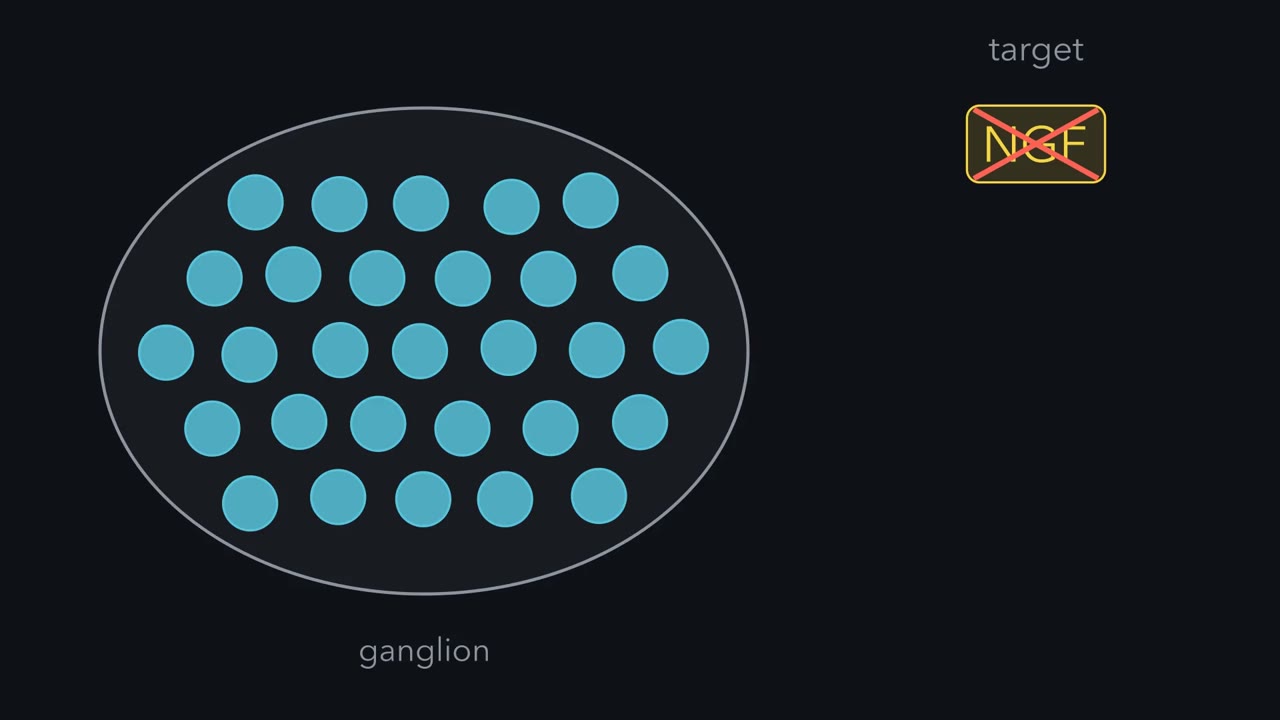
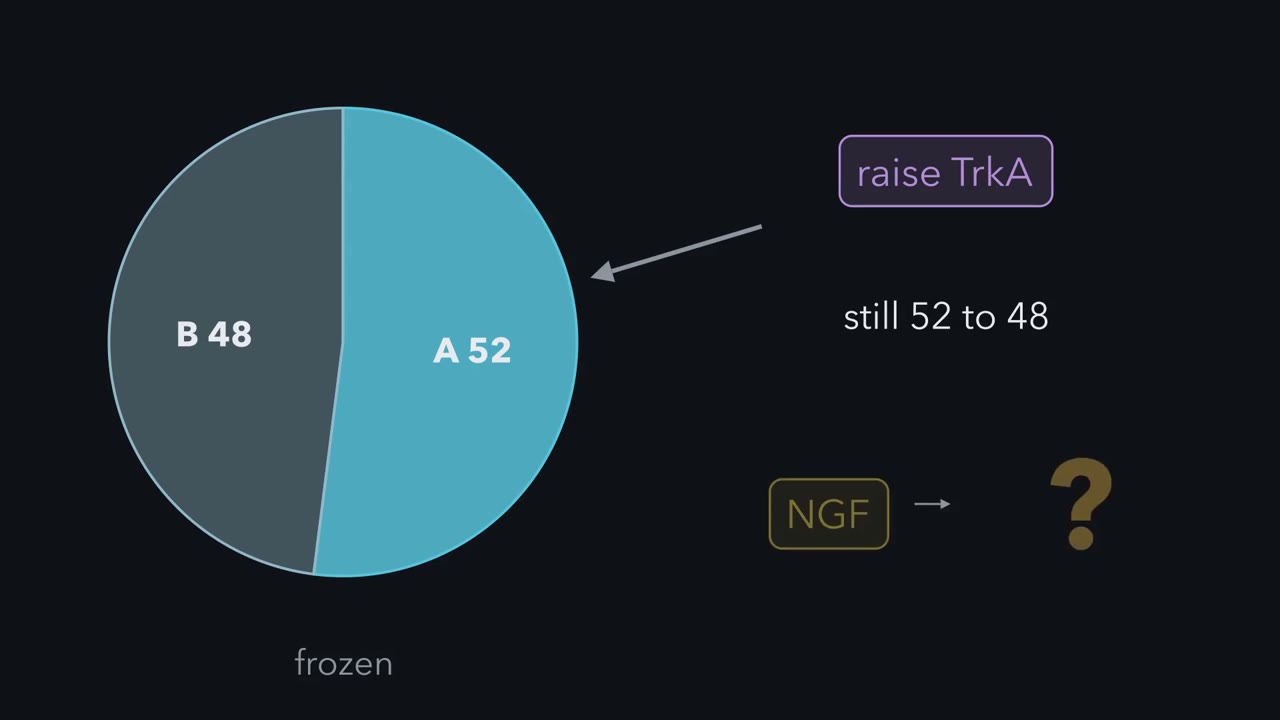
p75 belongs to the tumour necrosis factor receptor family. In this setting, it can promote death. These factors can act on neighbouring neurons, strong ones included. Why are the winners spared? A neuron with strong NGF and TrkA signaling is protected. One likely reason: strong TrkA signaling keeps survival pathways high, such as AKT. That outweighs a death signal from p75. A weakly supported neuron has no such cushion. The lab tested three predictions in the mouse superior cervical ganglion. First, competing neurons differ in TrkA level. This was tested in ganglia lacking Bax. Second, neurons with low TrkA show high p75 death signaling, read out by phosphorylated c-Jun.
c-Jun is a transcription factor. A stress kinase downstream of p75 helps activate it on the way to death. Third, removing punishment should delay the loss but not prevent it. Sketch neuron number against age, in normal mice and in mice lacking p75. What does the second curve do?
Both start at similar numbers. The normal curve falls steeply in the first days after birth. The curve without p75 falls more slowly. So for a while, it has more neurons. The losers still die of too little NGF, through Bax. Only the extra push is gone. All three predictions held, including the delay. In the simulations, punishment made the split faster. Without it, weak neurons lingered. The endpoint is less settled. In the 2008 study, the null ganglion reached the normal number by six months. An earlier study from Freda Miller's laboratory also found the loss delayed. But it counted an excess that lasted into adulthood. So both found the loss delayed.
They report different numbers at the latest ages counted. Takeaway. In the proposed model, winners speed the death of losers through p75. Without it, the loss is delayed; whether any neurons are permanently spared is less settled.
If the target makes too little NGF for every neuron, which neurons get to live?
Continue in the lesson: Competition: How Neurons Win a Target →
3:15 · Free, with captions and a transcript. The lesson has the full text, the questions and the sources.
More films from this lesson

How this film was made. Narration: an AI narrator voice (Kokoro, af_heart) reading narration written from this lesson's text. Animation: AI-generated in code (Manim) by Claude, a schematic with no drawn molecular structures. Captions come from the narration script. See something wrong? Report it.