Press play to start at .
Blockers and the Shape of a Shift
From the film
- A competitive antagonist binds reversibly at the agonist site, shifting the log dose-response curve right in parallel without lowering the maximum.
- Non-competitive and irreversible blockers are insurmountable and lower the maximum response, though a receptor reserve lets an irreversible blocker shift the curve right first.
- Across rising blocker doses, simple competition at equilibrium predicts a straight Schild plot of slope 1.
- A slope away from 1 or a curving line warns that an assumption failed, and slope 1 over a narrow range does not rule every alternative out.
- Naloxone competes with morphine for mu-opioid receptors without reacting with morphine, though clinical reversal is time-dependent rather than set by equilibrium alone.
Read the transcript of “Blockers and the Shape of a Shift”
Film transcript: Blockers and the Shape of a Shift
Tap a sentence to play from there.
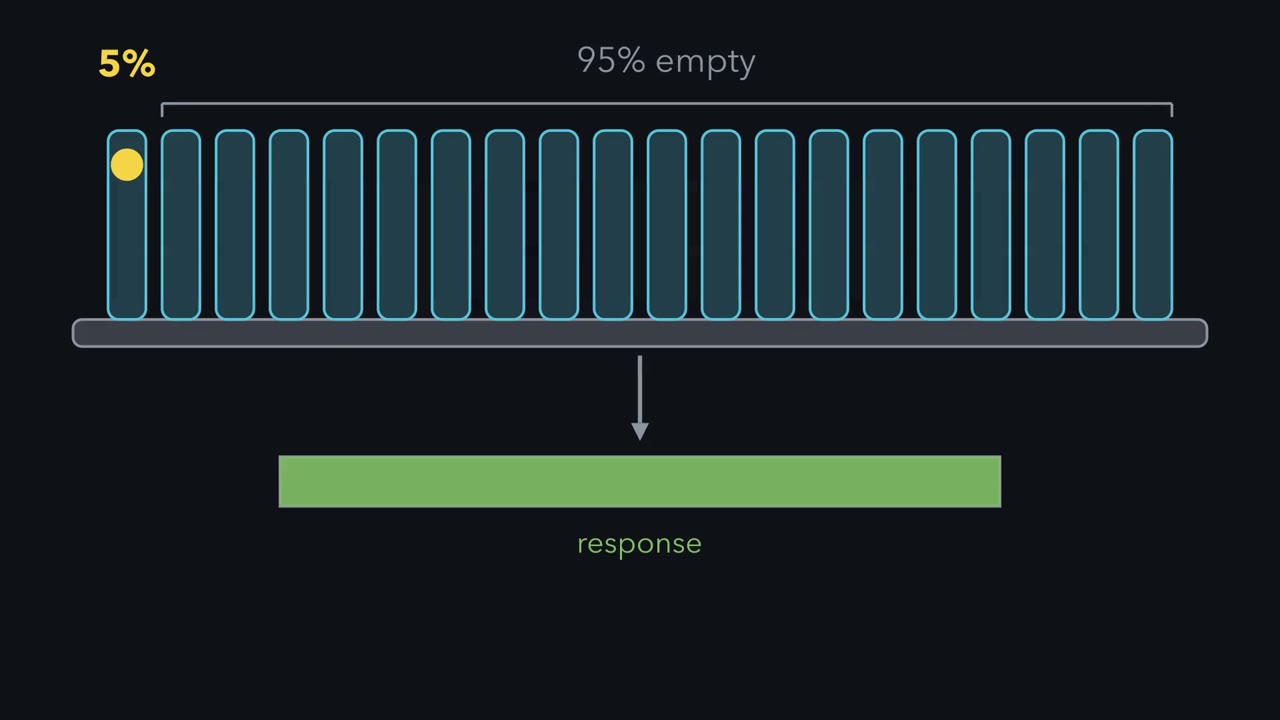
- 0:00 A receptor reserve lets a tissue respond fully with mostly empty receptors.
- 0:07 Naloxone can reverse a morphine overdose within minutes without reacting with morphine. How does a blocker's curve shift reveal its mechanism?
- 0:19 Start with a competitive antagonist, like naloxone.
- 0:24 It binds reversibly at the agonist's own site and switches nothing on.
- 0:29 One receptor holds agonist or blocker, never both.
- 0:34 Add enough agonist, and it wins the sites back.
- 0:38 On a log dose axis, each step multiplies the dose by ten.
- 0:43 The curve slides right in parallel: at every response level, the dose needed rises by the same factor.
- 0:51 That factor is the dose ratio.
- 0:54 Enough agonist still reaches the full ceiling, so this block is surmountable.
- 0:59 Other blockers are insurmountable: more agonist cannot overcome them.
- 1:05 A non-competitive blocker binds elsewhere on the receptor, or stops a downstream step. Even with every agonist site filled, the response hits a lower ceiling.
- 1:17 An irreversible blocker bonds covalently to the agonist site, so it cannot be washed off or outcompeted.
- 1:25 Now test an unknown blocker at one concentration.
- 1:29 The agonist curve slides right in parallel, with the same maximum.
- 1:35 Does that single curve prove the blocker is a reversible competitive antagonist?
- 1:45 No. With a receptor reserve, a small irreversible dose also slides the curve right before the ceiling drops.
- 1:55 Only higher doses separate them.
- 1:58 To name the mechanism, watch how rising doses reshape the agonist curve.
- 2:04 Heinz Schild made rising blocker doses a test for competition.
- 2:10 Raise the blocker tenfold, twice.
- 2:13 Simple competition at equilibrium might give dose ratios of 2, 11 and 101.
- 2:20 Subtract 1, since no blocker means a ratio of 1.
- 2:24 That leaves 1, 10 and 100.
- 2:28 As logs against log blocker dose, they form a straight line of slope 1.
- 2:33 A different slope, or a curve, warns that an assumption failed.
- 2:38 Equilibrium may not hold, or the tissue may remove agonist.
- 2:43 A blocker binding elsewhere, or a second receptor, can bend it too.
- 2:48 Even slope 1 over a narrow range does not rule those out.
- 2:53 Return to naloxone and morphine.
- 2:56 In a simple preparation at equilibrium, naloxone fills morphine's receptor without activating it, shifting morphine's curve right.
- 3:05 That reduces the signalling behind an overdose's slowed breathing, without touching morphine. Yet clinical reversal depends on time, and equilibrium ratios alone do not predict it.
- 3:19 Across rising doses, a curve's shift and ceiling separate surmountable competition from insurmountable block.
- 3:27 Next: can two curves in an unknown tissue measure a blocker's grip?
Dose-response: the same idea, other levels
A level is a place to start, not a rank. If this loses you, the rung below teaches the same idea, told more simply.
Graduate · the level you chose
Binding: Affinity, Occupancy and Dose–Response · this lesson
Full response at 5% occupancy: receptor reserve puts EC50 below Kd.
Cell Signaling · about 30 min · film 2:49 · 3 practice questions
College, upper level · the level you chose
Paroxetine at KD 0.08 nM: occupancy, and the 1 + L/K slowing factor.
Neuroscience · about 32 min · film 2:55 · 3 practice questions
Play the ladder · 2 films, about 6 min, from upper-level college to graduate level. Each film waits for you to press play.
Next door
- Binding strength: One Site, One Curve · 2:26 · College: going further Receptor occupancy follows the same Kd that describes how tightly any protein holds its partner.
- Antibiotic resistance: The Few That Survive · 3:12 · High school Dose matters for drugs against microbes too: too little drug lets resistant cells survive and spread.
- Neurotransmitters: Three Steps, One Drug · 3:01 · College: going further A drug that blocks or mimics a transmitter works by filling a share of its receptors.
More films from this lesson
Continue in the lesson: Binding: Affinity, Occupancy and Dose–Response →
Free, with captions and a transcript. The lesson has the full text, the questions and the sources.
How this film was made. Narration: an AI narrator voice (Kokoro, af_heart) reading narration written from this lesson's text. Animation: AI-generated in code (Manim) by Claude, a schematic with no drawn molecular structures. Captions come from the narration script. See something wrong? Report it.