Press play to start at .
Signal Two and Two Brakes
From the film
- Full activation needs a second signal, and checkpoints brake outside or inside.
- For a T cell meeting its antigen for the first time, CD28 binding B7 supplies signal two; signal one alone can leave cultured T cells anergic.
- CTLA-4 brakes from outside by outbidding CD28 for B7 and removing B7, while PD-1 brakes from inside by recruiting the phosphatase SHP-2.
- Checkpoint antibodies release these brakes on tumour-recognising T cells, while CARs wire an antibody fragment directly to zeta and co-stimulatory tails.
Read the transcript of “Signal Two and Two Brakes”
Film transcript: Signal Two and Two Brakes
Tap a sentence to play from there.
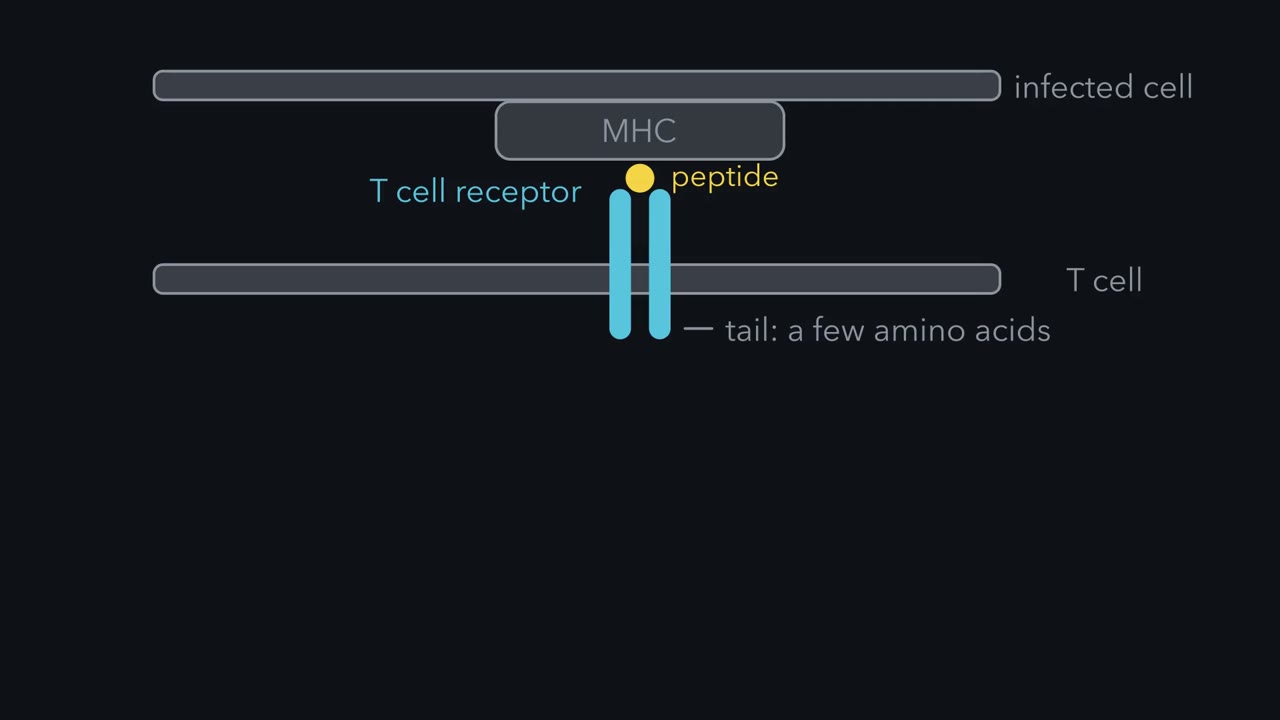
- 0:02 In the first film, two phosphates on partner tails switched the receptor on.
- 0:08 Those receptors vary almost at random, so some recognise our own peptides.
- 0:15 What stops an armed T cell from attacking healthy tissue?
- 0:19 A fresh T cell does not trust signal one alone.
- 0:23 Without a second cue, cultured T cells fall into anergy, a lasting unresponsive state. Full activation needs CD28 to grip B7.
- 0:35 Presenting cells raise B7 when they sense infection.
- 0:39 Once activated, the T cell puts up CTLA-4.
- 0:44 It resembles CD28 and binds the same B7.
- 0:49 But it is a brake.
- 0:51 Each CTLA-4 dimer grips two B7 at once, about ten times more tightly.
- 0:58 So CD28 is left empty, and it even drags B7 away to be destroyed.
- 1:04 A second brake, PD-1, works from inside.
- 1:08 Many healthy cells and many tumours display PD-L1.
- 1:13 When PD-L1 binds, two phosphates appear on PD-1's own tail.
- 1:19 They call in SHP-2, an enzyme that strips phosphates off proteins.
- 1:24 So does it strip the two phosphates that called it in?
- 1:33 No, because those two phosphates are its anchor.
- 1:37 SHP-2 grips both with two SH2 domains, so it stays docked.
- 1:43 Its working end then swings sideways and erases activating phosphates on CD28 and partner tails. So this brake dims the cell from inside.
- 1:54 Here is the second core rule.
- 1:57 Full activation needs a second signal, and checkpoints brake outside or inside.
- 2:03 A checkpoint is just a brake a T cell must get past.
- 2:08 Blocking antibodies cap CTLA-4 or PD-1 on the patient's T cells.
- 2:14 Tumour-recognising T cells keep firing, though healthy tissue can inflame.
- 2:19 Blocking a brake helps only if T cells already recognise the tumour.
- 2:25 Otherwise, engineers build a chimeric antigen receptor, or CAR.
- 2:31 An antibody tip outside is fused to the zeta tail inside.
- 2:36 It grips surface proteins directly, so no MHC is needed.
- 2:41 Yet a zeta tail alone gives signal one without signal two.
- 2:46 Those early cells often failed to persist in patients.
- 2:51 Engineers spliced CD28 or 4-1BB inside.
- 2:55 One binding event now supplies both signals.
- 2:59 That domain lets engineered T cells last.
- 3:03 From natural checkpoints to synthetic receptors, the same wiring rules the response.
Cancer immunotherapy: the same idea, other levels
A level is a place to start, not a rank. If this loses you, the rung below teaches the same idea, told more simply.
Graduate · the level you chose
Antigen Receptors and Checkpoints · this lesson
Blocking CTLA-4 made mice reject tumours; CAR T cells carry a built receptor.
Cell Signaling · about 19 min · 6 practice questions
Next door
- Cancer: How a Normal Switch Sticks On · 3:10 Tumours grow from one cell with changed DNA, and immunotherapy asks the body's own T cells to find and kill them.
- Cancer drug resistance: Selectivity and Escape at One Pocket · 3:18 Tumours can stop responding to immunotherapy, and the changes that let them escape are studied like other drug resistance.
- Targeted drugs: Selectivity and Escape at One Pocket · 3:18 Checkpoint drugs act on one named protein on a T cell, as other targeted drugs act on one pathway part.
More films from this lesson
Continue in the lesson: Antigen Receptors and Checkpoints →
Free, with captions and a transcript. The lesson has the full text, the questions and the sources.
How this film was made. Narration: an AI narrator voice (Kokoro, af_heart) reading narration written from this lesson's text. Animation: AI-generated in code (Manim) by Claude, a schematic with no drawn molecular structures. Captions come from the narration script. See something wrong? Report it.