Two Phosphates, Two Signals
Read the transcript of “Two Phosphates, Two Signals”
Film transcript: Two Phosphates, Two Signals
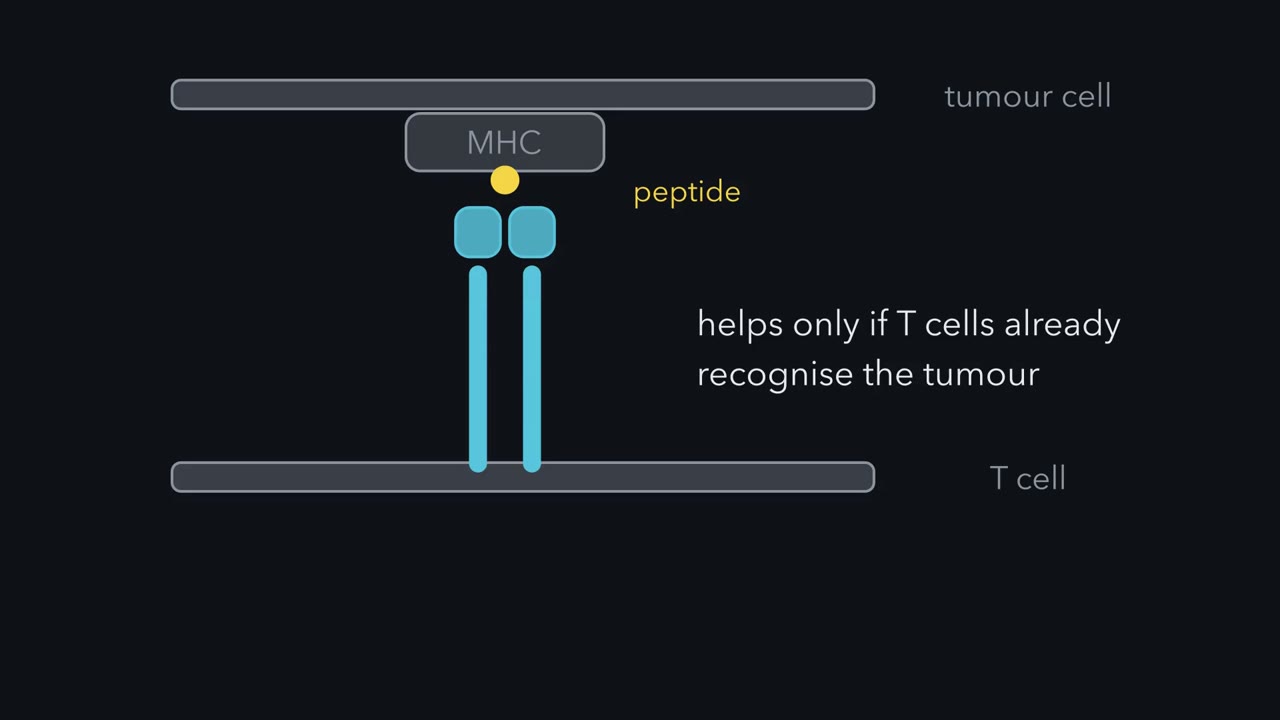
This is the T cell receptor. It tells a T cell that it has found an infected cell. But inside the cell, its tail is only a few amino acids long. It holds no enzyme anywhere, not even a kinase. So how does it send a message? The alpha and beta chains do the recognising. Beside them sit partner chains, called CD3 and zeta. Their tails reach into the cell. Each tail carries a short motif of two tyrosines, a fixed short distance apart. This motif is called an ITAM. So where is the kinase? It is already in the membrane. A co-receptor, CD4 or CD8, grips the display protein MHC that the receptor reads. A share of the tyrosine kinase Lck rides on its inner tail, beside the partner tails. Lck then adds a phosphate to both tyrosines.
Now the reader arrives: ZAP-70, a second kinase. It has two SH2 domains, side by side. Each domain grips one phosphotyrosine, and the pair is spaced to fit the two on one tail. With one phosphate, it binds weakly. It binds tightly only when both tyrosines carry a phosphate, so one stray phosphate does not start a T cell. Docking lets Lck switch on ZAP-70, which phosphorylates LAT, a scaffold set in the membrane. From LAT, one branch raises calcium, and NFAT enters the nucleus. A second runs through DAG and protein kinase C to NF-κB. A third loads Ras, and ERK helps build AP-1. The three meet on genes such as the one for interleukin-2. Even this is not enough, because receptors vary almost at random, and some fit the body's own peptides.
In classic experiments on cultured T cells, signal one alone did worse than nothing. The cells entered a lasting unresponsive state called anergy. For a fresh T cell, a second signal needs the receptor CD28 to bind a B7 protein on the presenting cell. Keep the rule for fresh T cells: two phosphates and two signals.
The T-cell receptor has no enzyme and almost no tail. How does it tell the cell to kill?
Continue in the lesson: Antigen Receptors and Checkpoints →
2:19 · Free, with captions and a transcript. The lesson has the full text, the questions and the sources.
More films from this lesson
How this film was made. Narration: an AI narrator voice (Kokoro, af_heart) reading narration written from this lesson's text. Animation: AI-generated in code (Manim) by Claude, a schematic with no drawn molecular structures. Captions come from the narration script. See something wrong? Report it.