Press play to start at .
Charge on the Gel, Grease in the Cell
From the film
- In sickle-cell hemoglobin, valine replaces glutamate at position 6 of each beta chain.
- Glutamate is negative at blood pH and valine has no switch, so each molecule loses two negative charges and lags toward the anode on an alkaline gel.
- A side chain also has a second property, polarity: charged glutamate is hydrophilic, greasy valine is hydrophobic.
- When hemoglobin gives up oxygen, a hydrophobic pocket opens; the valine patch of one molecule sticks into the next, building rigid fibers that deform the red cell.
- Charge explains how the defect was first seen; polarity explains why the cells sickle.
Read the transcript of “Charge on the Gel, Grease in the Cell”
Film transcript: Charge on the Gel, Grease in the Cell
Tap a sentence to play from there.
- 0:00 The first film ended on a gel, with sickle hemoglobin trailing normal hemoglobin.
- 0:06 But a slower drift in a gel cannot bend a red cell.
- 0:11 So what does that one valine actually do?
- 0:16 Start with what the gel saw.
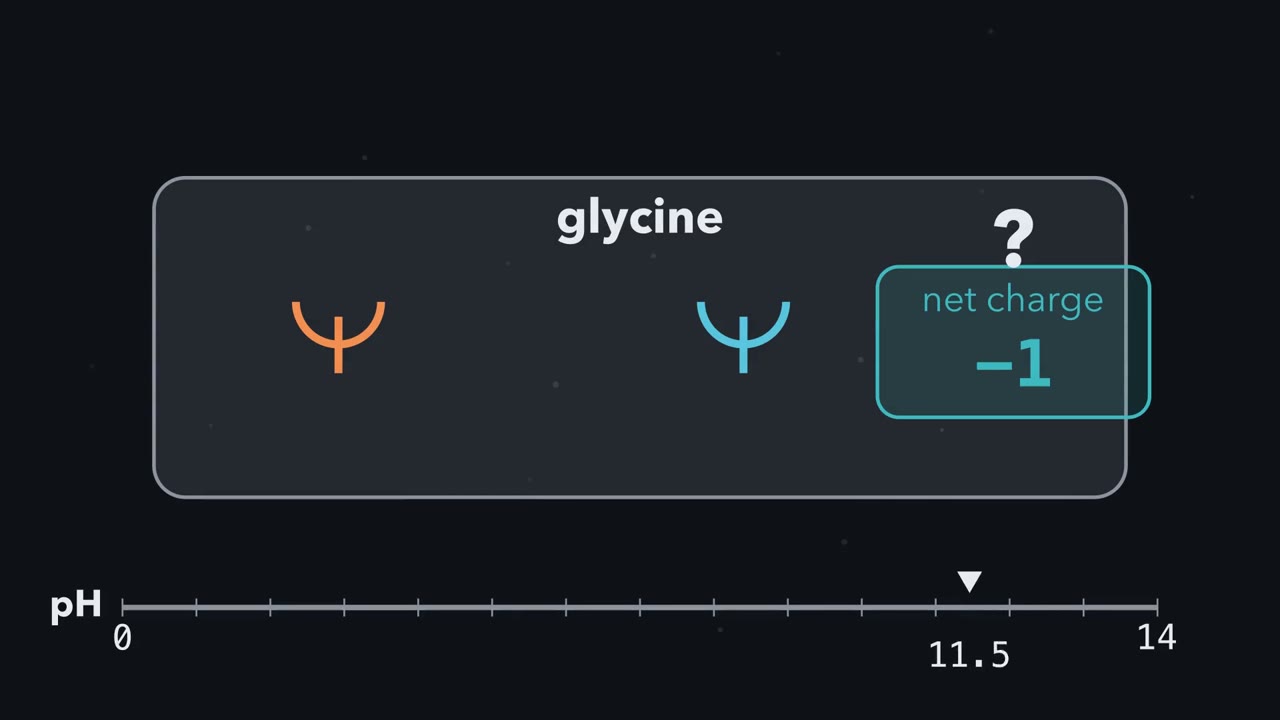
- 0:19 Glutamate's side chain is an acid switch, and at blood pH it has let go: −1.
- 0:26 Valine has no switch at all, so it carries nothing.
- 0:30 Hemoglobin has two beta chains, so the swap removes two negative charges per molecule. In an alkaline buffer, every hemoglobin is net negative and drifts toward the positive pole.
- 0:44 Sickle hemoglobin, two charges less negative, falls behind.
- 0:48 But a side chain has a second property: polarity, how comfortable it is in water.
- 0:55 Glutamate is charged and hydrophilic, at ease in water.
- 0:59 Valine is a greasy hydrocarbon chain.
- 1:03 It is hydrophobic.
- 1:05 In a protein that dissolves in water, greasy side chains tend to be buried in the core. There they stay away from water.
- 1:15 Charged and polar side chains tend to face the water outside.
- 1:19 Position six of each beta chain sits on the surface, facing water, where glutamate is at home. Swap in valine, and a greasy patch now sits out in the water.
- 1:31 So one swap changed two properties at once.
- 1:35 Here is the whole idea.
- 1:38 Charge explains how the defect was first seen.
- 1:41 Polarity explains why the cells sickle.
- 1:44 Now watch what happens when hemoglobin gives up its oxygen.
- 1:49 Its shape shifts. A matching hydrophobic pocket opens on its surface, greasy like the patch.
- 1:57 Picture two of these molecules side by side.
- 2:01 One carries a greasy patch.
- 2:03 The next has a greasy pocket.
- 2:07 Neither is comfortable in water.
- 2:09 What happens when they meet?
- 2:16 The valine patch of one molecule sticks into the pocket on the next.
- 2:22 That one's patch docks into the next pocket, and so on.
- 2:26 Hemoglobin chains into long, rigid fibers.
- 2:30 These rigid fibers deform the red cell into a sickle.
- 2:35 That is where the disease starts.
- 2:37 Hemolysis, inflammation and blocked vessels follow from it.
- 2:42 So read each side chain twice: once for its charge, once for its comfort in water.
- 2:48 The gel counted the lost negative charges.
- 2:52 The red cell felt the new grease.
Amino acids: the same idea, other levels
A level is a place to start, not a rank. If this loses you, the rung below teaches the same idea, told more simply.
College, upper level · the level you chose
Amino Acids: How One Side Chain Decides Everything · this lesson
Side chains sort four ways; one Glu to Val swap sickles hemoglobin.
Biochemistry · about 28 min · film 3:05 · 29 practice questions
Next door
- pH and buffers: Water, Weak Bonds, and the Generation of Order Side chains gain or lose charge as pH changes, which can change how a protein behaves.
- The hydrophobic effect: Count the Water · 3:19 Oily side chains are what water pushes inward, burying them in the middle of a folded protein.
- Protein phosphorylation: The Charge That Changes the Odds · 3:35 · Graduate school and beyond Cells add a phosphate to a few side chains, serine, threonine or tyrosine, to switch a protein on or off.
More films from this lesson
Continue in the lesson: Amino Acids: How One Side Chain Decides Everything →
Free, with captions and a transcript. The lesson has the full text, the questions and the sources.
How this film was made. Narration: an AI narrator voice (Kokoro, af_heart) reading narration written from this lesson's text. Animation: AI-generated in code (Manim) by Claude, a schematic with no drawn molecular structures. Captions come from the narration script. See something wrong? Report it.